I spent 11 years without my childhood friend. Finding our way back together was staggeringly simple
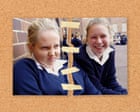
I spent 11 years without my childhood friend. Every time the Spice Girls’ 2 Become 1 music video came on, the sight of Victoria Beckham singing on an ice rink filled me with impending doom.
I thought about her a lot after our friendship imploded. When our birthdays rolled around, I wondered what we’d be doing if we were still in touch
I was 26 when I lost my childhood friend. By that point, I’d known her for almost two-thirds of my life.
Our first conversation was at an ice-skating party when we were nine years old. I’d been nervous in the weeks leading up to the party because I couldn’t ice-skate. Every time the Spice Girls’ 2 Become 1 music video came on, the sight of Victoria Beckham singing on an ice rink filled me with impending doom. I was sure I would disgrace myself at the party.
But the party – and I don’t often say this about parties – was a blast. As it turned out, my in-line skating experience gave me some advantage on the ice, and I met a girl who was easy to talk to. I was a shy child, so I was struck by that sense of ease – how I wasn’t panicking about what to say or lurking awkwardly on the edge of a conversation. I can’t remember what we talked about. She was kind enough not to mention the fact I’d chosen to wear a dolphin-print sarong. We held hands and at one point she asked: “What’s your name again?” Apparently, we’d had so much to say to each other, we’d skated right over all the usual greetings and pleasantries.
My friend and I went to the same high school, where we developed crushes on Orlando Bloom as Legolas in The Lord of the Rings and became obsessed with Baz Luhrmann’s Romeo + Juliet when we studied it in our year 9 English class. We loved reading and were into romantasy before it became a global phenomenon. She lent me her box set of Buffy and I made her read my own sexy vampire fan fiction.
As a teenager, I’d always believed I would become myself at university but, when I got there, it was harder and lonelier than I expected. I felt adrift in those first few years and saw less of my friend. We were at different universities, lived further away from each other and life got busy. When I graduated, I started working as a teacher at a large high school and threw myself into the joyous overwhelming chaos of it all.
But then the most exciting thing happened – the stars (and the end of lease agreements) aligned and we decided to get a place together. We moved into a terrace in Sydney’s hip inner west a few days after Christmas. On the first night we sat on the stairs and ate a box of chocolates for dinner. It was like the sleepovers we’d had as children, without supervision. We could do whatever we wanted. And, for a while, we did. We had our friends around. We read on the sunny veranda. We ate and drank our way up and down King Street.
Then one day, I started to feel sick. I thought it might be the iron tablets I was taking, or stress from work. It was diffuse large B cell lymphoma. It knocked me sideways. My prognosis was good from the beginning but the treatment was long, and emotionally I was all over the place.
At 26 I thought that asking for what you wanted was the most embarrassing thing in the world. For that reason, I never put down anything too flashy for my professional learning goals at work. When I went on dates, I aimed to be so casual that I came across as bored, even though I was desperate to be liked. I applied this same winning strategy to cancer. I wanted everyone to think I was fun and cool and not mention the fact that I was sick, and I also wanted their sympathy and for them to acknowledge my suffering. In other words, I wanted them to know instinctively, without being told, what I needed at any given time. It was an impossible demand and I was left disappointed and angry. So I pulled away, which only made me lonely too.
The friendship imploded. She moved out. I made sure I wasn’t around when she picked up her things. I stopped replying to messages and unfollowed her on Facebook. We didn’t speak for 11 years. For a while I was angry and then I was just sad.
I thought about her a lot. When our birthdays rolled around, I considered what we’d be doing if we were still friends. When I met my husband, I wondered what she would think of him. If I read a good novel, I imagined telling her about it. I was desperate to know her take on the Wuthering Heights film.
When you lose a childhood friend, you lose access to a certain part of your life. Without her I had no one to reminisce with about giving our Barbies disturbing makeovers or tearful late-night confessions at sleepovers and long afternoons spent lying on the trampoline, dreaming about our future selves. Back then, our lives were entwined and pulled taut with possibility. I missed her – and I missed that version of myself.
The Instagram algorithm brought us back together this year after more than a decade apart – possibly because we’d been secretly checking in on each other. She followed me and I followed her. She sent me a message, and we met for coffee and cake in the city. It was that staggeringly, heartbreakingly simple.
If I were 26 again (which, thank god, I never will be) I would tell myself that friendship, like all forms of intimacy, requires courage. I wanted my friends to think I was fun and cool and impressive and, when I wasn’t those things, I wanted to hide. It’s frightening to be vulnerable but when you find someone who knows who you are when you stop performing, it’s the greatest relief.
I see my friend regularly now – or as regularly as we can manage given the busyness of work and family. There’s a certain strangeness when one of us mentions a job or partner or trip the other has never heard of, and we are reminded how much of each other’s lives we have missed. But beneath the new strangeness, I sense that old familiar ease.
Dream Girls by Hannah Goldstein is available now through Allen & Unwin (AU$34.99)
- childhood
- friend
- ice
- party
- way
- lot
- friendship
- birthday