Want to know what all your co-workers earn? Be careful what you wish for
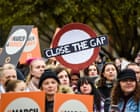
The gap between men’s and women’s pay had started to close when equal pay legislation was introduced in Britain in the 1970s, and then more women moved into previous male-dominated occupations in the 80s and 90s. André Spicer is professor of organisational behaviour at the Bayes Business School at City, University of London.
A new proposal for openness about pay could have unexpected downsides – if workers become demotivated, resentful and more likely to quit
Would you like to know what your colleagues are paid? If the Equality and Human Rights Commission gets its way, you will be able to find out. Under its proposals, workers will be able to request detailed information about the pay, bonuses and other perks received by their co-workers. The government agency argues that if we increase pay transparency, we can also reduce the pay gap between men and women. But countries that have tried this model have discovered that there are downsides to it too.
The gap between men’s and women’s pay had started to close when equal pay legislation was introduced in Britain in the 1970s, and then more women moved into previous male-dominated occupations in the 80s and 90s. Today, women in the UK earn on average about 6.8% less than what men earn.
This has left policymakers asking what else can they do. One intervention that dozens of countries have adopted is some form of pay transparency. The idea is that allowing people to understand what others are paid will help to shine a light on blatant inequalities, ultimately creating social pressure to remove them.
Many countries have introduced some version of these transparency laws. Since 2010, organisations in the UK that employ more than 250 people are required to publish their gender pay gap. In sectors such as higher education, employers must publish a report of the gender makeup of all those who are paid more than £100,000 a year.
These kinds of transparency laws have brought progress. One US study found that instituting gender pay reporting in the UK led to a 19% reduction in the gap between men’s and women’s pay. However, it also found that this reduction came largely from curtailing the growth of men’s pay, rather than stimulating the growth of women’s. In the UK university sector, meanwhile, a slightly different picture emerges. Following the 2007 requirement to report people paid above £100,000 a year, there has been a small increase in women’s earnings relative to men’s. However, this has mainly benefited highly paid women who have used pay transparency to help negotiate better packages. Outside the UK, increased pay transparency has also led to a notable improvement in women’s mental health. A Danish study found that following pay transparency laws, there was a decline in the number of women prescribed antidepression medication.
There are some things transparency laws have not changed. One is occupational sorting. This is the tendency for men to enter higher paid occupations, such as engineering and finance, and women lower-paid occupations, such as nursing and teaching. The introduction of transparency laws has allowed people to clearly see the average wages for different occupations. But this information does not seem to have changed people’s decisions about which occupations to enter. After Danish pay transparency laws were put in place, wages overall declined, because men’s wage growth slowed while women’s grew slightly. Another thing pay transparency laws did not change was overall levels of productivity in the economy: people produced a little less, but were also paid a little less to do it.
Given the success of gender pay laws in moving the needle on inequality, UK policymakers now want to push for even greater levels of transparency. Instead of just asking employers to publicly share their gender pay gap, the EHRC is now suggesting that employees be given the right to request details of other individuals’ pay, bonuses and performance reviews.
This kind of individual-level transparency has already been tried in a few sectors around the world. Canadian universities, the Californian public sector and Nordic countries have all made individual income levels publicly available. And it has helped to further increase pay equality: a study of the Canadian university sector found that individual-level pay transparency resulted in a 20% to 40% reduction in the gender pay gap; a study of 100,000 US scientists found that individual wage transparency led to reductions in gender inequality in pay; and the introduction of individual transparency in Norway also helped to narrow the pay gap, but it mainly benefited women changing jobs who were able to use pay information to search and negotiate for better-paid jobs.
But individual-level pay transparency can also have some less positive outcomes. The study of US scientists found that it broke the link between pay and performance: scientists who were significantly less productive than their peers were more likely to end up earning about the same as their more productive colleagues. A study of top managers in the Californian public sector found that pay transparency led to a drop in overall wages of about 7% – and a 75% increase in quit rates.
Another study of US universities found that when faculty members were made aware of the pay of their colleagues, those who earned less than the average became more dissatisfied with their jobs and more likely to look for another role. The same information had no impact on how better earners felt about their jobs. A recent modelling exercise has suggested that increasing pay transparency can lead to a rise in unhealthy social comparison, which can trigger feelings of anger and envy among co-workers.
More stringent transparency pay laws involve a real trade-off. These laws are likely to make the pay of women and men a little more equal. However, they are also likely to dent the link between performance and pay, stoke resentment among those on lower pay, drive up staff turnover rates and potentially drive down overall pay. Salary ranges in job ads along with published gender gap data gives employees what they need to spot unfairness. But there is a difference between being able to challenge an unfair system and being able to see what every colleague earns. Some sorts of openness actually reduce trust. Open pay books may be one of them.
André Spicer is professor of organisational behaviour at the Bayes Business School at City, University of London. He is the author of the book Business Bullshit
- pay
- worker
- woman
- man
- proposal
- downside
- gap
- business