Serbia has banished the monsters from Belgrade – it was, and still is, a truly wonderful revolution
The Student List has shown my generation, who protested against the Milošević regime in the 1990s, how we should have done it On Halloween, a few days after a student-led movement swept aside an illiberal, seemingly invincible regime in my native Serbia, I was sitting on the Vienna tram and watched various friendly and malicious monsters getting on and off around me. These men are the losers of the revolution that is taking place in Serbia.
The Student List has shown my generation, who protested against the Milošević regime in the 1990s, how we should have done it
On Halloween, a few days after a student-led movement swept aside an illiberal, seemingly invincible regime in my native Serbia, I was sitting on the Vienna tram and watched various friendly and malicious monsters getting on and off around me. Witches, devils and unicorns were politely making their way to their respective parties.
Not all monsters wear fancy dress. Later that evening, I walked past a Serbian restaurant; in front of it stood a group of grumpy-looking men. They were smoking, spitting and swearing. I recognised the hardened, couldn’t-care-less attitude, the smell of corruption, the penchant for violence. Yet they looked as though their lives were coming to an end. These men are the losers of the revolution that is taking place in Serbia. Their smuggling routes and deals are under threat. Their criminal networks no longer function.
There are other bogeymen that have lost the power to terrify. The slimy neoliberal aliens that grouped around their great leader, Aleksandar Vučić, our own version of Baron Vladimir Harkonnen in David Lynch’s Dune. The poor and desolate creatures known in Belgrade as sendvičari, or “sandwich people”, because they would allow the government to recruit them for political rallies in exchange for a sandwich.
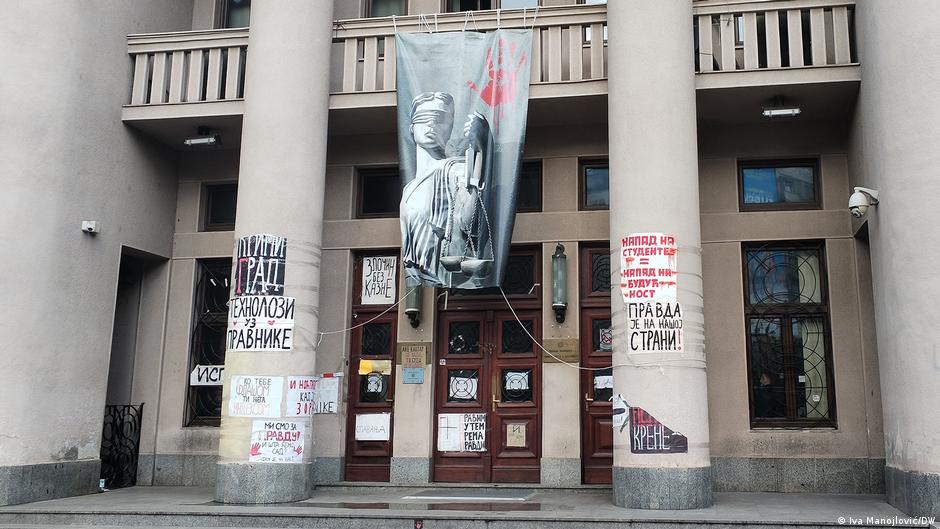
Even Ćaciland has fallen. During the two years of student protests, supposed supporters of Vučić’s Serbian Progressive party gathered in Pionirski Park in the centre of Belgrade. Vučić claimed that they were real students who wanted to study rather than protest. Someone in Novi Sad sprayed the words “Students, back to school!” on a wall but misspelled the word for students, đaci, as ćaci. The camp of astroturfed pro-government students thus came to be known as Ćaciland. It was a little Mordor in the middle of Belgrade, constantly threatening to unleash hordes of hooded orcs with stones in their pockets.
All these monsters have been banished into the night. Over the past two years, a student movement has managed to mobilise the Serbian population en masse. They have blockaded universities and established interesting flat structures.
When I was queueing in Vienna to cast my votes for the Student List in the election, a friendly student explained to me how the movement had grown from plenary to plenary until it reached the megaplenary, and how it hadn’t relied on any individual leaders. A single face was allowed to appear in the media no more than twice, and as soon as someone threatened to become too prominent, they were pushed back to the periphery.
The student protesters of my generation – those who protested during the fall of the Milošević regime in the 1990s – were different. Our medium was the radio, particularly B92. Our drugs were whatever we could get our hands on. We believed in divides – between cosmopolitan and nationalist, city and countryside, urban and rural.
We were monsters of a kind too: individualist zombies, who appeared in droves but each staggered along their own path. It was important to us to belong to a rare subculture. We refined our musical tastes until we were left alone with our favourite bands. Since wars were waged in our collective name and against our will, we developed a tendency to leave any group as soon as it no longer reflected our personal point of view. So now we wander a little aimlessly through the world with our individual successes and our individual fates.
“Your 1990s dichotomies aren’t important any more. Anyone who wants to join us in building a better society is welcome,” the student in the queue explained to me with satisfaction. “We are a collective.” At that moment, I realised that the student protesters are a bit like the Borg from Star Trek, an alien group of cyborgs linked in a hive mind. But in this case they are connected via mobile data – and they have been very good and peaceful monsters so far.
The Borgs are, in many respects, better, faster and better informed than we were. The Student List communicated with its supporters not via TV, but by “Insta-decree”. In a country where every media outlet was ridiculously dependent on the government, it allowed them to gain a large following and generate so much euphoria. This momentum came at the expense of certain issues that were particularly important to us in the past, such as taking responsibility for the wars of the 1990s. But perhaps we’ll get round to that, in a proper parliament, in a completely different atmosphere. A lot is still up in the air.
The Democracy Borgs demonstrate anew every day that change is indeed possible and that it is not too late for positive initiatives. I’m keeping my fingers crossed for them, getting involved where I can, and hoping that the nationalist and mob-like tendencies don’t overwhelm these delicate structures. It was, and still is, a truly wonderful revolution.
But back to me on Halloween. I had just popped out of the house, without a costume – just as the zombie writer that I am – to meet my ex-Yugo girlfriends, who also tend to belong to my generation. I walked into the cinema and realised that they’d all turned up dressed as student Borgs. You could tell by their aura and the topics of conversation. I was apparently the only zombie, and I was ashamed that I hadn’t realised this sooner. It’s time for a change. No props are needed for this transformation, no costume; you don’t have to do anything. Us zombies just have to be prepared to rethink things and tackle the world a little bit.
Barbi Marković is a Serbian writer based in Vienna. Her story collection Minihorror is published by Faber & Faber
- serbia
- revolution
- monster
- belgrade
- student
- regime
- man
- list