‘Every day, someone loses a hand or a leg’: the brutal reality of India’s textile recycling industry
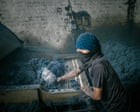
In Panipat, 1m tons of used clothing a year are turned into products for global brands, but dangerous machinery and few safeguards mean life-changing injuries are common For three months, Suraj Kumar’s job was to feed discarded clothes into shredding machines in Panipat, an industrial city in the north Indian state of Haryana. Suraj, 19, had travelled from West Bengal state to work in Panipat’s factories, following his cousins and friends who had already found jobs there.
In Panipat, 1m tons of used clothing a year are turned into products for global brands, but dangerous machinery and few safeguards mean life-changing injuries are common
For three months, Suraj Kumar’s job was to feed discarded clothes into shredding machines in Panipat, an industrial city in the north Indian state of Haryana. Clothes discarded in the US, Canada and Europe arrive in the city to be torn back into fibres and spun into yarn, feeding a textile recycling industry that supplies markets across the world.
Suraj, 19, had travelled from West Bengal state to work in Panipat’s factories, following his cousins and friends who had already found jobs there. He hoped to earn enough to send money home to his parents. But in late August, an electrical short circuit in the machine propelled him into the shredding mechanism. The accident crushed both arms.
“I wish I had died rather than lost both my arms,” Suraj says. An only child, he had hoped his job in Panipat would support his parents. Instead, he fears he has become a financial burden on them. The work he had taken up to help his family has left him dependent on others, with no certainty about what his future will look like.
By some estimates, Panipat processes more than 1m tons of used clothing from across the world every year, making it one of the world’s largest textile recycling hubs. In the city’s 20,000 factories, employing about 300,000 people, discarded clothes are shredded into yarn and made into finished products, including home furnishings for brands such as H&M Home, Ikea, Primark, Tesco and Walmart.
But the fast-fashion industry, built on buying more and more clothes and wearing them less, carries a devastating cost for workers tackling its waste. Ramesh Chaudhary, an environmental activist who has worked in Panipat’s labour department, has been tracking reports of injuries and amputations across the city for the past five years. He estimates that at least one worker a day loses a limb, rising to as many as five on some days.
“Every day, we come across cases of workers injured inside factories, sometimes losing a hand or a leg, and sometimes even dying,” Chaudhary says. He gathers his information through a network of labour contractors who supply workers to factories across Panipat. But not all news of injuries reaches him, he says, suggesting the scale of the problem could be greater.
Between 17 and 24 August this year, the Guardian monitored reports from 11 private hospitals and two government hospitals in Panipat. In that period, six cases of textile workers with severe limb injuries were reported: two had lost an arm, another man lost both, one lost a hand, one lost a leg and the sixth their fingers.
Such injuries are common in Panipat’s factories, says Chaudhary, because machinery often lacks the necessary safety mechanisms. If a worker gets caught in a spinning machine, he says, cutting the power may not stop it immediately. By the time the machine comes to a halt, a worker may already have catastrophic injuries.
During numerous visits to spinning units and factories, the Guardian did not see anyone wearing any kind of safety gear. None of the workers interviewed reported having safety training.
India’s 1948 Factories Act places a duty on factory owners to protect workers’ health and safety. It requires serious workplace accidents to be reported to the authorities. But the effectiveness of safety oversight remains a concern, says Sandeep Sachdeva, co-founder of the Safe in India Foundation, which works to reduce industrial injuries.
“Factories are often audited by buyers, especially where quality and critical components are involved, and inspected by government industrial safety and health departments. Buyer audits tend to focus more on commercial requirements and product quality than on workplace safety or working conditions,” he says.
“Government inspections are selected through a central software system, but inspectors are now required to inform factories before visiting. Their role is now that of a facilitator-cum-inspector – a shift that undermines the effectiveness of inspections, particularly in factories with unsafe working conditions.”
For workers, losing a limb means losing their livelihood. Ramashankar Singh, who is in his fifties, from Chapra in Bihar, spent 18 years in Panipat’s factories before an accident last year led to him having a leg amputated.
It happened when a hot ball bearing fell on his foot. Ramashankar’s injury was first just wrapped in discarded cloth, before the factory owner sent him to a pharmacy.
The wound worsened as the infection spread. When Ramashankar approached his employer again, the owner agreed to arrange treatment and admitted him to a private hospital. By then, the infection had progressed so far that doctors had to amputate his leg above the knee.
“The factory owner said he would give me another job, possibly as a cook or a security guard at the factory,” Ramashankar says. “But that never happened.” The owner also said he would help him secure a government disability pension, but he has received no pension since the accident and relies on a prosthetic leg provided by a charitable organisation.
After so much of his life spent in a factory, Ramashankar says: “I have almost forgotten how to live without work. Much of my day now passes lying on my bed, staring at the ceiling fan.”
He also struggles with guilt that he has become a burden on his family.
India’s textile industry is the country’s second-largest source of employment after agriculture, directly employing more than 45 million people. An estimated 92% of its workforce is informally employed. In Panipat, more than 90% of workers are employed informally, says Ina Bahuguna, programme manager at the Estonia-based Reverse Resources, which monitors the city’s textile waste.
“Formal employment contracts and the social security benefits that accompany them, including pensions, are largely limited to workers in management, clerical roles and some specialised jobs, such as tailoring,” says Bahuguna.
Most workers on the factory floor lack these protections, leaving those who suffer serious injuries particularly vulnerable. Without formal employment or adequate social security coverage, they are left without employer-backed compensation, rehabilitation support or a source of income.
The Guardian asked several factory owners why they hired workers on a contractual or piece-rate basis rather than in permanent positions, and most cited the workers’ seasonal migration, saying some did not return to Panipat after travelling home.
For workers who sustain life-changing injuries, getting employers to pay for medical treatment can be a struggle. Indrapal Singh, who lost his arm in 2017, had worked in Panipat for 15 years, two and a half of those at the factory where he was injured. His hand was caught in a Chinese-made carding machine, which tore away the skin. He was given a painkilling injection but, as the infection worsened, his arm had to be amputated. The factory owner refused to pay his hospital bills.
Indrapal spent six years fighting his case through the courts, but says he received no compensation. The police told him that he had signed documents withdrawing his complaint, something Indrapal, who says he cannot read or write, disputes.
“I lost my arm, fought for six years, and in the end, all I got was a government pension of 5,700 rupees [£45]. The factory owner has faced no consequences, and the factory continues to operate as before,” he says.
Chaudhary says: “Workers have very little bargaining power when they are up against factory owners who are not only financially powerful but sometimes politically influential too. For many workers, taking them on in a legal fight is simply not an option.”
Arvind Kumar, the officer in charge at one of Panipat’s 12 police stations, says three workplace injury cases have been registered at his station so far this year. One involved the death of a worker. “Fewer than 1% of workplace injury cases reach the police and are formally registered,” he says.
Most cases, the officer says, are settled outside the formal legal system. Workers may receive a one-time payment towards medical bills, but then are generally left to manage the long-term consequences of their injuries on their own. The police rarely get involved.
For now, Suraj Kumar’’s family are grateful that the factory owner covered his hospital bills. They are not sure whether to register a police complaint.
“He [the owner] is like God to us. He is paying for our boy’s treatment,” says his mother, Sita.
Suraj struggles to imagine what comes next. “I thought that if I worked hard for two years, I could buy myself a motorcycle. I had so many things I wanted to do with my life. I never thought I would have to start by figuring out how to live without my arms.”
- textile
- recycling
- industry
- panipat
- hand
- leg
- reality
- india