True North by Paul Theroux review – an American’s view of Canada
The veteran travel writer turns his eye for detail on his northern neighbour and its people Paul Theroux’s arrival in Canada doesn’t go well. Will Theroux find it stuffed with Sweeney-ites?
The veteran travel writer turns his eye for detail on his northern neighbour and its people
Paul Theroux’s arrival in Canada doesn’t go well. An immigration officer called Sweeney finds a small pocketknife in his car and fines him $500 for failing to declare a weapon. “I’m going to make you famous,” he angrily tells her, stumping up. Maybe he will, with this book. Canadians are reputed to be polite and easygoing, “slaves to their courtesy”, but the country has changed enormously in recent years. Will Theroux find it stuffed with Sweeney-ites? Luckily the answer is no.
He issues a warning that, after 11 previous travel books, this may be his last; global overtourism appals him and so does much travel writing. But he shares Jack Kerouac’s delight in being on the road, and from his home in Massachusetts it’s just a four-hour drive to the border. His purpose is less to check out “the strangers next door” than to visit the village of Yamaska, in Quebec. It was there that a Frenchman called Antoine Theroux settled in the 17th century; a dozen or more Theroux families still live there; one local street is called Rue Theroux. The author isn’t only made welcome but presented with a certificate of honour by the local mayor. He repays the honour with a long chapter of family history.
A joshing relative calls him ratoureux, a mischief-maker, and the next time he visits he heads on to see the mischief in Ottawa, where truck drivers are staging a protest against the Trudeau government. It’s a scene of mayhem in freezing weather, “a mob of truckers and their huge vehicles occupying and violating a handsome city”. He’s intrigued by the unleashed anger. By the time the protest ends, with the ringleaders arrested, he’s heading west on the Trans-Canada Highway.
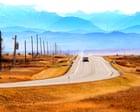
He describes his process as “idly motoring, looking and listening”. Budget motels are preferable to swanky hotels because it’s easier to strike up conversations; ditto in cheap eateries. It’s a hit-and-miss method (not everyone is forthcoming or insightful) but he gathers stories wherever he goes – from foresters, pig farmers, lobster fishers, plumbers, moose hunters, historians and social justice campaigners. As an American whose president has threatened to take over Canada as the 51st state, he’s tainted. But people are friendly, not hostile. And Trump’s insults bring defiance, with a flurry of Maple Leaf flags and “Canada – Not for Sale” T-shirts. Come the 2025 election, the fancied populist loses and Mark Carney triumphs.
Despite the surge in patriotism, Theroux is struck by how few people consider Canada to be their home. Many are “unmelted migrants” living in “ethno-bubbles” or “ethno-burbs”, he writes; they have come from elsewhere and – whether Filipinos, Sikhs or Somalis – often see themselves as short-term expats. Some white Canadians Theroux talks to say they feel displaced, too. In 2022, the population expanded by over one million and even among the mild-mannered, younger citizens, there are those who struggle to accept the change.
The groups with the greatest grievance are First Nations, not least the Cree. British and French colonialism robbed them of their heritage, then demeaned them as idle, drunk and dishonest. Reparation and apology have been slow. Though far more visible than Indigenous people in the US, they’re “aliens in their own land”. With his colonialist ancestor guiltily in mind, Theroux describes how much they have endured, from old-world scalping to more recent “starlight tours” where Indigenous men in trouble with the police were taken to remote spots in freezing weather at night and left there, often to die.
This is the dark side of Canada, with so-called Indian residential schools a particular horror. Indigenous children were forced into them to be “educated”, that is made Christian. Theroux is told that many died in unmarked graves, including 250 at a school in British Columbia. Paedophilia was widespread, too. One school had an electric chair wired up to punish children with shocks; at another, when any pupil wet the bed, the soiled sheet would be draped over their head. The last such school shut down as recently as 1997.
Theroux accumulates stories by listening to CBC on his car radio and even when he’s back home, at his desk. Many novelists are quoted, for their perspectives on Canadian cities or regions, some of them past stalwarts of Canlit (Mordecai Richler, Margaret Laurence, Sinclair Ross), others at work today (Margaret Atwood, Miriam Toews). In Edmonton he meets Jan Morris’s son, the victim of “the fantasies and the deceptions of a chilly woman who’d been his fond father”. Whereas Morris stuck with cities in her book O Canada! (“never resorted to the road, never camped, never roughed it”), Rue Theroux is rural, meandering through the wilds, the Prairies, the great outdoors.
At 85, and despite the thousands of miles he drives from east to west, the author’s energy seems undimmed. Downbeat at the start, he’s rejuvenated by the end, ready for another road trip, eager to see the Yukon, Hudson Bay, Labrador. If nothing else, he’ll get back to Yamaska, the village of his ancestors.
- theroux
- paul
- canada
- travel
- north
- review
- american
- view