The best recent poetry – review roundup
The Universe is an Animal by Jessica Mookherjee; Sleep Gate by Sylvia Legris; The Other Love by Henri Cole; Stay Winter by Nidhi Zak/Aria Eipe Sleep Gate by Sylvia Legris (Fitzcarraldo, £12.99)
The Universe is an Animal by Jessica Mookherjee; Sleep Gate by Sylvia Legris; The Other Love by Henri Cole; Stay Winter by Nidhi Zak/Aria Eipe
The Universe Is an Animal by Jessica Mookherjee (Nine Arches, £11.99) In this confident and capacious collection, scientific language commingles with familial histories of displacement and war. Echoes of violence, from the partition of East Pakistan and India, now modern-day Bangladesh, to an arrival in Wales, haunt many of the poems. In Waterlily, Mookherjee inverts Monet’s signature image into something far more sinister. An aunt “hides under Bhatiyari Lake, sari billows / until the men leave” to escape communal riots. Longer poems, such as this one, encode repetition and refrain into a genetic pattern of sound and meaning: “the dress she sews me is washed / with river mud from Bangladesh. / And I become Welsh. Uncle becomes ash.” Another long poem, The Reproductions, emerges from the poet’s study of evolutionary biology. Mookherjee asks how the stresses of famine, migration, war and racism impact uniquely on mother and child. She considers how suffering is not unique to the human animal only, as “ten percent / of mammalian foetuses don’t make it / out”. Death may be sometimes out of our hands, and the conditions of love and safety, too, may not be up to us. “I learned / a foetus can be reabsorbed / by the womb in sub-optimal / environments. When is it a good time?”
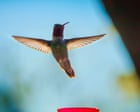
Sleep Gate by Sylvia Legris (Fitzcarraldo, £12.99) In these sharply observed poetic ecologies, Legris tests the limits of human and nonhuman consciousness through a dizzying taxonomy of dream life. The dreams of earthworms, honeybees and hummingbirds are recounted unsentimentally with an apparently scientific precision. Likewise, circadian rhythms and pineal glands, producers of melatonin in the human brain, impossibly dictate the sleep patterns of an inanimate world of clouds, plants and minerals. In this great shared sleep between all things, we come to gradually recognise our common mortal destiny: “Sleep descends / as blood displaces air in the chest. // Sleep is a cooling off. / A rehearsal for death.” Mostly Legris avoids the simple anthropomorphism of nature poetry, in which a speaker projects inner feeling on to a landscape to cue up a Wordsworthian bliss or solitude. In fact, Legris sidelines the poetic “I” altogether, a deliberate response to the horror of mass extinction and the Anthropocene. Her poetry reads, at times, like a catalogue or list of specimens. Drawing from predecessors who also reckon with Armageddon, such as Danish experimental poet Inger Christensen and modernist poet Hilda Doolittle, Legris asks: what will outlast us in the evolution of life? Who or what will measure time after the great extinction, when “the clock strikes / quarter past dianthus, / alyssum on the half hour, / hyssop at high noon”?
The Other Love by Henri Cole (Penguin, £12.99) The title poem of Cole’s eleventh collection begins “It doesn’t smell here. / I can be whoever I want to be.” Bang in the middle of a series of short, at times pithy lyrics is this watershed poem of solitude, selfhood and containment. “Astringent” is a word sometimes attached to Cole’s poetry for its sharply crafted tension. In solipsistic vignettes of a distinctly American life – presidential elections, the ubiquity of guns, eating mushroom soup in Covid isolation – we hear the “herd of one” singing. In No One Over Fifty, Please, to give oneself over to love is the antidote to mortality. “Another year passes, never to be lived again. / I remember being touched, but I cannot be and have been.” Cole is also quite funny, in a light, patrician way. Elsewhere, in TS Eliot’s boyhood bedroom, a Prufrockian man nearing old age confesses with some humour that he always preferred Eliot’s contemporary, the more restrained poet Marianne Moore. Another, later American poet of elegant reserve, James Merrill, quite literally haunts the book. In Autumn Fern, a sonnet dedicated to Merrill, Cole stands over his grave: “If the lane to the dead is generative, as you said, / let this hole be a point of light.” It is impossible not to be moved by the energy and ferocity of Cole’s lust for an uncertain future, a recurring concern summarised by the book’s final line, “For all I know, the rest of my life is taking flight.”
Stay Winter by Nidhi Zak/Aria Eipe (Faber, £12.99) As in her debut Auguries of a Minor God, Zak/Eipe distils folklore and mythology from a wide range of sources. Here, classical Greek myth and ancient Hindu and Celtic figures are woven into an incantatory web of urgent, complex relations. Modern literature gets similar treatment. And Our Eyes Are on Europe collages language from the episode in Ulysses in which Joyce’s nationalist “citizen” and Bloom enter into an argument about nationhood and empire. The poem begins “Our fingers trace the map – and here, you say, / is where the Armada went astray”, but points to a reconciliation, a meeting of lovers drawn “with ancient words, into this hidden copse of jade”. It is intriguing how love, whether erotic, romantic, or divine, emerges from Zak/Eipe’s collages of found text. Something of the essence of a masterwork is extracted under the poet’s hand and reshaped into its maker’s likeness. In Eros the Blacksmith, her revisioning of a love lyric by Anacreon, it is no wonder that for Zak/Eipe love works tirelessly at the forge because “this world / is held together by something / that you made”.
- poetry
- sleep
- legris
- mookherjee
- animal
- poem
- poet
- time