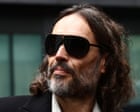
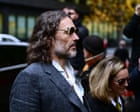
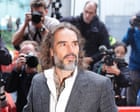
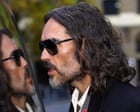
‘He’s manipulating its power’: why did Russell Brand convert to Christianity?
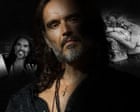
Sincere or self-serving, the disgraced comedian’s case shows how the church became a culture war frontier The women whom Russell Brand raped and sexually assaulted have for weeks endured the ordeal of a heavily publicised trial. Throughout, Brand held online prayer meetings with followers.
Sincere or self-serving, the disgraced comedian’s case shows how the church became a culture war frontier
The women whom Russell Brand raped and sexually assaulted have for weeks endured the ordeal of a heavily publicised trial. Throughout, Brand held online prayer meetings with followers. Does he feel Christian sympathy for those women?
Only Brand, in the deepest recesses of his conscience, can know.
The answer would be the best indicator of whether the disgraced comic, actor and born-again Christian has worn his newfound faith as a cloak in an effort to deflect and distract from the seriousness of the allegations against him. Or whether his conversion is a profound and sincere one – a spiritual crutch he may need in the coming years.
Whatever the truth, Brand’s case demonstrates how Christianity has become a frontier in the culture wars along which battle lines are now drawn on all kinds of ethical, political and even legal issues.
It is not hard to see why Brand’s embrace of Christ has raised suspicion. His reputation for most of his career has been one of a hell-raiser, and even when spirituality did call, it was the eastern traditions of Buddhism and the Hare Krishna movement that first caught his eye.
Now, latterly dedicated to the teachings of Christ, his very visible displays of devotion have at times seemed farcical.
When Brand was interviewed by Piers Morgan in April, one moment went viral: Brand was asked to quote from a Bible that he was carrying with him – the same he took to the dock in Southwark crown court. When Morgan asked Brand to find relevant passages he had been reading, Brand struggled, helplessly turning pages for more than a minute.
Achieving familiarity with scripture is a lifelong Christian journey. But for sceptics, the moment was compelling proof of a calculated rebrand rather than a spiritual rebirth.
Having spent years as a standup comic, Ravi Holy, the vicar of Trinity Benefice, Folkestone, had long heard rumours of Brand’s predatory behaviour and learned of him mixing in evangelical circles years before the celebrity went public.
Holy said: “There’s that famous verse where Paul says there are people who preach Christ out of true motives, and some out of vain ambition, but it doesn’t matter as long as Christ is preached. I could imagine some saying that about Brand, but I don’t see it like that. I’m interested in the motives of the person.”
Dr Maria Power, an expert in Christian nationalism at the University of Oxford, said: “I can’t really judge whether [Brand] has had a personal conversion, certainly the way he’s gone about it has been very performative: his [2024] baptism in the Thames was very much in the style you would expect from this sort of appropriation of Christianity.
“I’m not saying Russell Brand is part of a Christian nationalist movement, but he’s certainly manipulating its power to try and gain support for himself.”
That Christian nationalism is important context. In the US, a wave of Trump-era populist plutocrats, conspiracy theorists, manosphere influencers and rightwing populists have used Christianity to shore up personal their brands and launder often racist and misogynistic narratives.
Meanwhile, well-intentioned podcasters have given Christian faith a new relevance to people seeking meaning in an uncertain world; a time when Pope Leo XIV and the archbishop of Canterbury, Sarah Mullally, articulate a theology of social justice.
In the UK, the country’s wealthiest Anglican church, Holy Trinity Brompton, known widely as HTB, and its Alpha courses have introduced millions of people to basic Christian tenets.
HTB’s evangelism shaped the spiritual life of Justin Welby before his tenure as archbishop of Canterbury blended liberal and evangelical theological positions.
The Old Etonian adventurer Bear Grylls, who assisted with Brand’s Thames baptism, has praised HTB as “full of love and acceptance”. Paul Marshall, the billionaire owner of the Spectator and co-owner of GB News, has given HTB and the Church Revitalisation Trust (CRT) £13m via his Sequoia Trust.
The image of Christian nationalism in the UK – Tommy Robinson supporters cosplaying as crusaders – is a world away from HTB’s Knightsbridge pews.
Power sees the UK iteration of Christian nationalism as the result of well-funded attempts by wealthy evangelicals and “post-liberal” ideologues to merge Christian social thought with politics – for the sake of “power” rather than a grassroots, working-class movement.
She says Christian nationalism has an 800-year European history, encompassing leaders from King Henry VIII to the Portuguese dictator António de Oliveira Salazar, 19th-century antisemitism and anti-Catholicism, and Ireland’s “near-theocratic” history.
In its current form, she adds, it appeals to a “search for meaning” in an age of insecurity.
Against this backdrop, Brand presents as a dissident martyr to his audience – who see themselves as truth-seekers – while gaining acceptance among some prominent Christians as a celebrity convert.
Among them are those who hope his understanding of Christianity will evolve, just as they hope the adjacent movement of Christian nationalism will give way to an authentic understanding of the gospel that will change society for the better.
Arun Arora, the bishop of Kirkstall, has been outspoken about the threat of Christian nationalists appropriating Christian symbolism to further nativist authoritarianism.
But he warns against “making a window into men’s souls”, adding that he rejoices when people come to faith, “whoever they are”.
“It’s not unusual for people to discover faith during times of personal crisis,” he said. “In that way, celebrities are no different from the rest of us. None of us are beyond redemption.
“I appreciate people will view the outward religiosity of those such as Russell Brand or Stephen Yaxley-Lennon [the real name of Tommy Robinson] with a degree of cynicism, but there is always a possibility for faith to be discovered at times of testing.”
For Nick Spencer, a senior fellow at the Christian thinktank Theos, controversial converts highlight the tension between justice and mercy.
He said: “On the one hand, if Brand says: ‘I was deeply immoral in my attitude to women and sex and I repent as a Christian,’ that’s great. But the court case is not about him being immoral. It’s about him raping people, it’s about him doing something illegal.
“There is this ongoing tension, because you want to affirm a sense of grace, a sense of forgiveness, of repentance and a new life, without ignoring the claims of justice.”
The Rev Holy hopes that if Brand’s conversion is genuine, it makes him “face up to what he put those women through”, publicly apologise and confess.
He added: “I believe in redemption – assuming there’s genuine repentance – but I don’t particularly see that here.
“People, might go: ‘Well, I thought you believed in forgiveness.’ I do, but that doesn’t mean if someone’s committed serious crimes, and then they become a Christian, that you go: ‘Oh well, fair enough.’”
- brand
- russell
- power
- christianity
- woman
- self
- comedian
- case