Tesla to 'wind down' production of flop Cybertruck
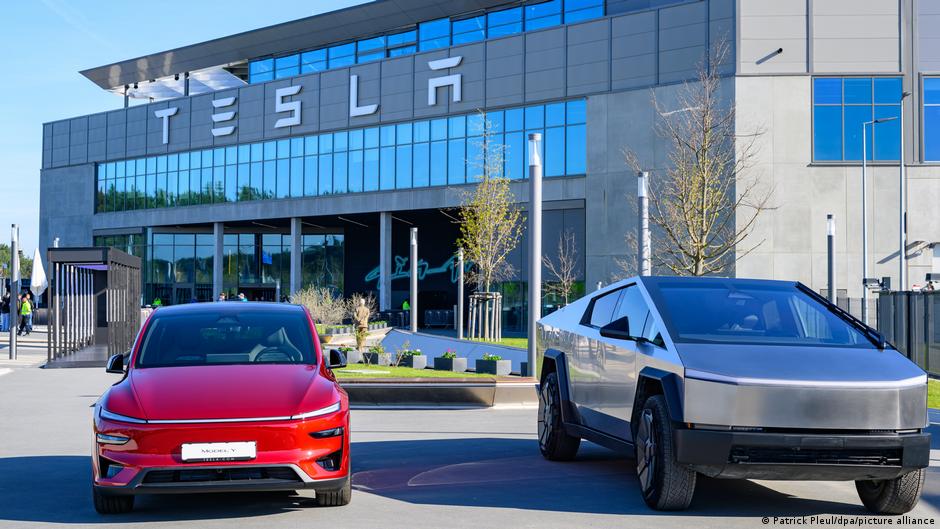
Elon Musk's electric pickup for the future will start to be consigned to the past next year. The Cybertruck's bulk and crude shape meant it could only pass regulatory standards in more permissive markets.
Tesla owner Elon Musk said on Friday that the company would scale down production of the Cybertruck at its Austin factory in the coming year.
The South African entrepreneur said Tesla would be scaling back production of his futuristic but often-mocked pickup truck and amping up production of what he hopes will soon become a fleet of fully automated taxis.
"Tesla will be winding down production of the cybertruck at Gigafactory Texas around the middle of next year to make room for increased Cybercab production," Musk said on his X social media site.
The announcement follows a bruising week for Musk amid the US midterm elections, where Republicans struggled despite his major donations, with his companies losing billions in value by market capitalization as investors sought to ditch stock.
Musk later responded to a complimentary user online who hailed the Cybertruck as the "best vehicle Tesla has ever made," and calling it an "end of an era" by saying: "True."
For years he had poured much of his enthusiastic marketing zeal into promoting the Cybertruck, saying during the 2023 launch "finally, the future will look like the future."
However the oversized body, straight lines and stainless steel and the post-apocalpytic vibe these created also met with widespread criticism and even mockery.
The electric powertrain was probably a barrier to sales in the US, by far the biggest pickup truck market, where Musk had hoped to take on some of the country's top-selling gas-guzzling vehicles like the Ford F150 or the Chevrolet Silverado and the Dodge Ram.
Meanwhile, the car's striking shape, weight and size made it impossible for Tesla to try to crack Europe, where electric vehicles are gaining a much larger market share.
Unlike in the US, EU safety regulations place considerable emphasis not just on people in cars in accidents, but also on the dangers posed to pedestrians who might be hit by a vehicle. That meant it was not possible for Tesla to register and sell the Cybertruck for road use in Europe.
Beyond this, the vehicle's size would likely have rendered it impractical and unpopular on many European roads, where space tends to be at more of a premium.
Depending how quick the wind-down proves to be, the Cybertruck's production run could prove shorter than its five-year R&D phase.
Given its longstanding issues meeting Musk's very public sales and production predictions, Tesla does not publish sales figures broken down by model.
But according to the automotive data platform Kelley Blue Book, the company sold 20,237 Cybertrucks in the US last year, down from 38,965 in 2024.
At launch in 2023, Musk had predicted unit sales nearer a quarter of a million.
For orientation, Ford sold more than 800,000 F-Series pickups in the US last year, a slight boost on 2024's numbers. These vehicles start at less than half the list price of a Cybertruck in the US.
The IPO for SpaceX this year revealed that Musk's second-largest company was comfortably the biggest buyer of Cybertrucks in 2025. It bought vehicles worth $131 million and did not even enjoy a bulk-buy or friends-rate discount, paying list prices for the fleet.
The Cybercab is a vehicular element in Musk's bid to transform Tesla towards a company focused more on AI and robotics than automobilies.
Rather than just featuring the self-drive or driving assistance programs that Musk has been championing for years, the Cybercab has no steering wheels, pedals or mirrors at all and is designed never to have a human in control.
Musk say the model will be the company's main autonomous model and will supply a global network of Robotaxis.
Starting in the past few months, around 300 such vehicles have been registered and have started operating, on approved roads in the Austin area near Tesla's Gigafactory Texas. They're being added to the existing fleet of autonomous Model Y Teslas being used for the purpose, serving in an area known as a geofence of around 680 square kilometers (264 square miles).
- cybertruck
- tesla
- production
- flop
- elon
- musk
- pickup
- future