Democrats' crushing midterms win could spark battle for party's soul
The Democratic Party is no longer just a broad church, but a huge multi-faith centre. Now their prayers for an electoral resurrection have been answered, the perennial battle for the soul of the party begins.
The "bluenami" that swept across the United States this week carried with it into Congress a progressive Muslim, a moderate Jew, a young seminarian and a former Republican Methodist pastor.
The Democratic Party is no longer just a broad church, but a huge multifaith centre. And now that their prayers for an electoral resurrection have been answered, the perennial battle for the soul of the party begins.
It is clear voters were rejecting the Trump administration this week; what's less clear is what they wanted from the Democrats. That has left competing wings of the party to make their own interpretations.
Representative Alexandria Ocasio-Cortez (AOC), the spiritual leader of the party's left, released an election day memo highlighting her influence in the midterms.
It read like a job application, perhaps for a position set to open up in late 2028.
"Over the past two years, Rep. Ocasio-Cortez has built a record of success that extends beyond her own electoral victories," it read.
"The Congresswoman has emerged as one of the most powerful endorsements in the United States and New York State specifically."
One of the achievements listed in AOC's memo is her support for Abdul El-Sayed in the Michigan Senate race.
Written before the polls closed, the memo claimed El-Sayed had "a chance to up-end conventional wisdom about the kind of agenda that can win in Michigan".
El-Sayed's campaign was long seen as a test for the Democrats of whether a progressive candidate could win in a purple state.
His victory is being seen by some as an endorsement of the progressive policies he took to voters, most notably universal healthcare, taxes on billionaires and corporations, and ending US military aid for Israel.
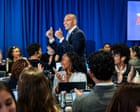
The 42-year-old doctor was joined on the campaign trail by an icon of the Democratic establishment, former president Barack Obama.
Like many on the party's left, El-Sayed had been highly critical of the former president in the past, but Obama brushed off their ideological differences to stump for the young doctor in late October.
Obama had previously cautioned Democrats against veering too far to the left, saying the average American did not want to "completely tear down the system".
On stage in Detroit, he dismissed suggestions El-Sayed was "radical". But bridging the gap between the establishment and the insurgents is not always so easy.
That was made clear when Democratic representative Haley Stevens, who El-Sayed beat in August's primary, endorsed his Republican rival, Mike Rogers, two days before the election after a public dispute over Israel.
The saga exposed internal fighting over policies on Israel that could threaten to fracture both the Democratic and Republican parties.
Elaine Kamarck, a senior fellow at the Brookings Institution and former official in the Clinton White House, said where that fight went would depend on events in Israel.
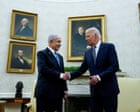
"It depends on whether Netanyahu remains as prime minister or if he's ousted," she said.
"What does the opposition coalition do? Do things settle down in Gaza? Do they reduce the violence in the West Bank? I mean, there's a lot of things that depend on Israel."
While some are trying to paint the midterm result as a victory for the far left, Kamarck said it was really just a consolidation of their power in certain districts.
"The far-left Democratic Socialist types have shown no ability to win in red districts," she said.
"The balance of power is still with the moderates in the Democratic Party."
The Democrats will now have a broad range of people in Congress who will have to navigate their own differences, as they attempt to thwart the Trump administration's agenda and launch investigations into the scandals and alleged corruption that have plagued it.
The day after the midterm elections, CNN questioned Texas's new senator-elect James Talarico about whether he would be willing to fight or split from fellow Democratic senator-elect El-Sayed.
Talarico emphasised that he intended to be an independent-minded voice, stating that power belonged to the people rather than party elites, and that he planned to represent his constituents while working across the board.
Jon Ossoff, re-elected in Georgia and another possible 2028 presidential candidate, ran on the idea of a broad coalition.
But progressive groups and some new members of Congress have been calling for leadership change, demanding the party replace Chuck Schumer as Senate leader.
Before the election, several Democratic candidates who have since won Senate seats, in Michigan, Kansas, Illinois and Maine, said they would not back Schumer as leader.
At a time of party renewal, the 75-year-old from New York has been criticised for his low approval ratings, support for overly centrist candidates and taking PAC money.
His counterpart in the House, Hakeem Jeffries, also faces pressure from a new crop of progressive members who view him as too moderate or out of touch.
Kamarck doubts either man is in any serious trouble.
"I think Jeffries will almost certainly become the next speaker. And Schumer, I bet, would still become the next majority leader," she said.
She also believes the party will manage to remain united, not by any of their own leaders but by their opposition to Donald Trump.
"The real fissures, if there are within the party, won't occur until we have a Democratic president," she said.
"Until then, we've still got Trump to deal with. And there will be a fair amount of unity."
- battle
- soul
- party
- win
- democrats
- midterm
- democratic
- church