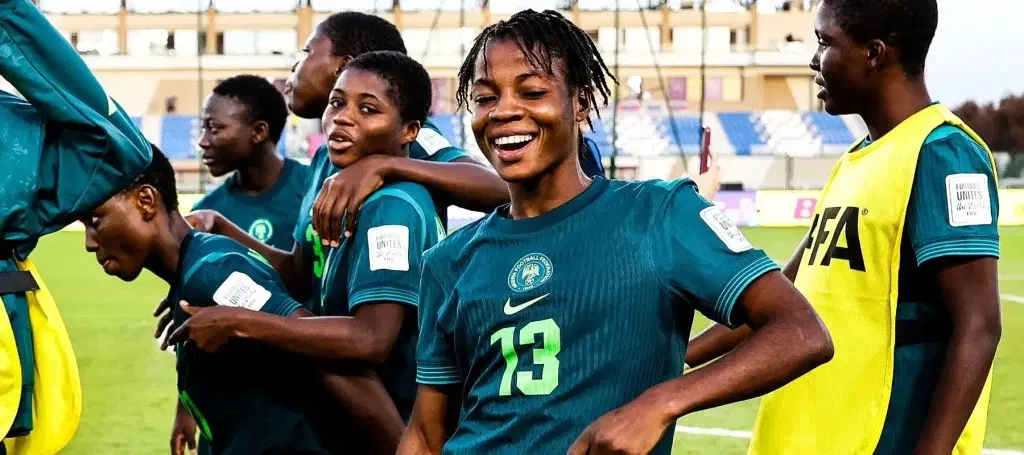
Japan vs Nigeria Preview: Flamingos chase historic U-17 Women’s World Cup glory in Morocco

It is a fascinating contest between a nation chasing its maiden crown and a former champion seeking to add another trophy to its collection. But for Nigeria and the wider African football community, the stakes could hardly be higher.
Forward Oluebube Umejiaku will be keen to shoot Japan down
One victory stands between Nigeria’s Flamingos and an unprecedented place in African football history as Akeem Busari’s side prepare to face former champions Japan in the final of the 2026 FIFA U-17 Women’s World Cup.
After recovering from an opening defeat to Poland to win five consecutive matches, the Nigerians are now 90 minutes away from becoming the first African nation to conquer the world at the football match. It is a chance to turn an extraordinary opportunity into a celebration, end Africa’s long wait for a title at the FIFA U-17 Women’s World Cup, and announce another generation of Nigerian female footballers on the global stage.
The Flamingos have earned their place in Saturday’s final through resilience, attacking ambition and an impressive ability to respond to difficult situations. Their journey has included a statement victory over defending champions DPR Korea, a hard-fought knockout victory against Venezuela and an emphatic semi-final triumph over Brazil.
Standing in their way, however, is a Japanese team with a considerably richer history at this level. The Asian powerhouse has appeared in three previous finals, winning the competition in 2014 and finishing runners-up in 2010 and 2016. They return to the championship match after a decade away, determined to reclaim the title.
It is a fascinating contest between a nation chasing its maiden crown and a former champion seeking to add another trophy to its collection. But for Nigeria and the wider African football community, the stakes could hardly be higher.
Nigeria’s journey to the final did not begin with the authority expected of a team carrying Africa’s hopes.
The Flamingos suffered a 2-1 defeat to Poland in their opening Group B fixture, immediately placing pressure on their campaign and leaving little room for further mistakes.
Rather than let that setback derail their ambitions, Busari’s players responded with five consecutive victories, gradually building confidence and delivering increasingly convincing performances.
Their first response came against Puerto Rico, where goals from Oluwakemi Adegbuyi and Precious Oscar secured a 2-0 victory. The result restored belief within the squad and kept their qualification ambitions firmly on track.
However, their subsequent meeting with defending champions DPR Korea truly announced Nigeria’s arrival as serious contenders.
Goals from Adegbuyi, Oluebube Umejiaku and Kanyinsola Yusuf inspired the Flamingos to an impressive 3-1 victory over the four-time champions. Beyond the result, the manner of the performance caught attention, as Nigeria showed they could match technically accomplished opposition.
The knockout stages brought another level of examination as Nigeria faced Mexico in the Round of 16 and emerged with a 2-1 victory, courtesy of goals from Umejiaku and Mary Dunstan. It was another important demonstration of their attacking depth and ability to find solutions against difficult opponents.
Their quarter-final encounter with Venezuela proved considerably more demanding. With the contest heading towards extra time, the Flamingos found their breakthrough in the 89th minute after Umejiaku was brought down inside the penalty area.
Captain Azeezat Oduntan stepped forward and converted the resulting penalty to send Nigeria into the semi-finals.
Brazil provided the next challenge, and the Flamingos responded with arguably their most complete performance of the competition.
After a goalless first half, Queen Joseph broke the deadlock in the 56th minute before substitute Awawu Bashiru took centre stage with two goals in the 71st and 80th minutes. Greise Kelly scored a late consolation for Brazil, but Nigeria had already established an unassailable advantage in a 3-1 victory.
The performance was particularly impressive statistically. Nigeria registered 35 attempts on goal compared to Brazil’s seven, while the South Americans managed just one effort on target.
It was a commanding display that reflected the progress Busari’s team had made since their opening-day disappointment.
Having scored 11 goals and conceded just three during their five-match winning sequence, the Flamingos now head into the final with confidence and momentum.
While Nigeria’s campaign has been defined by recovery and momentum, Japan have built their journey to the final around technical quality, organisation and attacking efficiency.
Under experienced coach Sadayoshi Shirai, the Japanese began their Morocco 2026 campaign with a convincing 5-0 victory over Zambia before recording successive 2-0 wins against France and Venezuela.
They finished the group stage with maximum points and an impressive defensive record, conceding no goals across their three matches.
Their progress continued in the knockout rounds with a 3-1 win over Kenya, followed by a narrow 1-0 victory over Ghana.
However, their semi-final meeting with DPR Korea proved their toughest test yet.
Japan had endured painful defeats against their Asian rivals in recent years, including a 5-1 loss in the quarter-finals of the 2025 U-17 Women’s World Cup and another 5-1 defeat in the 2026 AFC U-17 Women’s Asian Cup final.
The semi-final therefore gave Shirai’s team a chance to overcome a difficult recent history against one of Asia’s strongest youth sides.
DPR Korea appeared to be heading towards another victory after Ri Ui-gyong scored in the 52nd minute. Japan struggled to create clear-cut opportunities and managed just four attempts, with only one on target. However, they continued searching for an equaliser rather than accepting defeat.
Their persistence eventually paid off deep into stoppage time when a 90+5-minute own goal by Won Sol-gyong sent the contest into a penalty shootout.
Japan converted all four of their attempts, while goalkeeper Kou Kadowaki produced an important save and another DPR Korea effort struck the post.
Asuka Tanaka subsequently converted the decisive penalty to secure Japan’s return to the final.
It was not their most convincing performance of the tournament, but it showed their ability to survive difficult circumstances and deliver under pressure. That resilience is another quality Nigeria must be prepared to confront.
Saturday’s encounter will mark the first meeting between Nigeria and Japan at the FIFA U-17 Women’s World Cup.
There is therefore no previous head-to-head record at the competition to provide a direct reference point ahead of the final.
Both countries bring different footballing traditions and tournament histories, but the circumstances surrounding this generation are unique.
Japan’s experience at this level is undeniable. At the same time, Nigeria’s progress throughout Morocco 2026 has shown that the gap between established powers and emerging challengers can be bridged through preparation, talent, and collective belief.
The final will ultimately be decided by the players on the pitch, their tactical execution and their ability to handle the pressure of competing for a world title.
The midfield contest could prove decisive in determining which nation lifts the trophy.
Nigeria have shown attacking variety, directness, and the ability to create chances through different channels. Their semi-final performance against Brazil, particularly their 35 attempts, highlighted their ability to put opponents under sustained pressure.
Japan, however, present a different tactical challenge. Their game is built around technical combinations, intelligent movement, possession and coordinated attacking transitions. They are comfortable building from the back, using short passing sequences to draw opponents forward before exploiting spaces through their wide players and supporting full-backs.
Busari has already provided an insight into his assessment of Japan.
Speaking after Nigeria’s semi-final victory over Brazil, the Flamingos coach identified similarities between Japan and DPR Korea, particularly their preference for building attacks from the back, using passing combinations and encouraging their full-backs to move forward.
The Nigerian tactician believes his team can draw confidence from their 3-1 group-stage victory over DPR Korea. However, Japan possess their own individual qualities and should not simply be regarded as a replica of their Asian neighbours.
For Nigeria, the challenge will be disrupting Japan’s passing rhythm without compromising their defensive structure.
The Flamingos must identify the right moments to press, close down passing lanes and force Japan into uncomfortable situations. Poorly coordinated pressure, however, could leave spaces for the Japanese to exploit, particularly through their movement in wide areas.
Nigeria must also be prepared to defend for periods without the ball. Japan’s ability to dominate possession means the African side will need concentration, discipline and patience to avoid being dragged out of position.
At the other end, the Flamingos must use their attacking strengths. Their ability to transition quickly, exploit spaces and bring multiple players into scoring positions could cause Japan significant problems.
For Shirai’s team, controlling the tempo and preventing Nigeria from turning the contest into an open, end-to-end encounter will be equally important.
The battle in midfield, the management of transitions and the effectiveness of both teams in the final third could ultimately determine the destination of the trophy.
Although this is Nigeria’s first appearance in the final, the country has maintained a strong presence in the competition since its establishment in 2008.
Japan, meanwhile, have been one of the tournament’s most consistent nations, appearing at every edition and regularly progressing into the latter stages.
The Japanese have reached the final three times before Morocco 2026, winning their only title in 2014 after defeating Spain 2-0 in San Jose, Costa Rica.
They finished runners-up in 2010 and 2016, establishing themselves as one of the competition’s traditional heavyweights.
Nigeria’s best previous performance came in 2022, when the Flamingos secured a third-place finish in India. They reached the quarter-finals in 2024 before exiting in the Round of 16 in 2025.
Their progress to the 2026 final therefore represents the best achievement in the country’s tournament history.
The contrast is clear. Japan are looking to reclaim a title they last won 12 years ago, while Nigeria are chasing an achievement that has eluded every African nation.
For the Flamingos, victory would represent a breakthrough not only for the country but for the entire continent.
Both finalists have shown strong attacking form throughout Morocco 2026, but their defensive records reveal a clear difference.
After six matches, Japan have scored 14 goals and conceded just two, while Nigeria have found the net 12 times and allowed five goals. Japan have also recorded four clean sheets compared to Nigeria’s two, highlighting the defensive organisation that has helped Shirai’s side reach the final.
One of Nigeria’s biggest strengths has been the distribution of goals across the squad. Eight different players have contributed to their 12-goal tally, giving Busari several attacking options heading into the final.
Seven of their goals have also come in the second half, suggesting that the Flamingos have developed an ability to maintain their attacking threat as matches progress.
Japan’s numbers, on the other hand, point towards a team that combines attacking efficiency with defensive discipline.
The Japanese have scored two more goals than Nigeria while conceding three fewer. Their ability to protect their goal has been particularly impressive, with only DPR Korea in 2024 and Japan themselves in 2014 recording fewer goals conceded at the corresponding stage of the tournament.
However, statistics alone will not decide Saturday’s final as Nigeria have already demonstrated that they can break down some of the strongest teams in the competition, while Japan’s semi-final against DPR Korea showed that even the most organised sides can be vulnerable when placed under sustained pressure.
For Busari, the final represents the biggest examination of his time with the Flamingos.
His team have already demonstrated their ability to respond to adversity, make tactical adjustments and compete against different styles of opposition.
However, the challenge now is to prepare his players for a Japanese side whose technical quality and experience demand maximum concentration.
The Nigerian coach will also have important selection decisions to make, particularly following Bashiru’s outstanding semi-final performance.
The youngster’s two-goal contribution against Brazil has strengthened her case for a starting role, although Busari must consider the overall balance of his team and the tactical demands of the final.
For Shirai, the objective is equally straightforward: guide Japan to a second world title and end their decade-long wait for another appearance in the final with a trophy.
His experience of the competition could prove valuable, but Japan must improve their attacking output after struggling to create clear opportunities against DPR Korea.
Both coaches have demonstrated their ability to make important decisions during the tournament. Their tactical approaches and in-game adjustments could prove decisive when the pressure reaches its highest point.
For Japan, victory would deliver a second FIFA U-17 Women’s World Cup title, 12 years after their triumph in Costa Rica.
For Nigeria, the opportunity is considerably bigger. No African nation has ever won the FIFA U-17 Women’s World Cup. The Flamingos have already become the first African team to reach the final, and a victory would take Nigerian and African women’s football into entirely new territory.
It would also represent another significant milestone in Nigeria’s long-standing contribution to women’s football, particularly at youth level.
The country has consistently produced talented female footballers who have represented Nigeria across different age categories, and a world title would provide another powerful endorsement of that talent pipeline.
Beyond the trophy, it would inspire another generation of young African girls to believe that the highest levels of international football are within their reach.
Flamingos captain Queen Joseph captured the significance of the occasion after the semi-final, emphasising that Nigeria were not simply representing their country but the entire African continent.
That responsibility will be shared by every member of the squad, but the players must also recognise that they have earned their place in this final.
They have recovered from an opening defeat, beaten defending champions DPR Korea, negotiated difficult knockout encounters against Mexico and Venezuela, and produced a commanding performance to eliminate Brazil.
They have earned the right to compete for the trophy.
Now comes the final hurdle; Japan have the pedigree, the technical quality and the experience of previous finals. Nigeria have momentum, attacking depth and the belief that has carried them through one of the most memorable campaigns in the country’s youth football history.
For Busari and his Flamingos, the mission is clear; one match, one trophy, one opportunity to make history for Nigeria and Africa.
Would they make it? One can only hope for the best.
- nigeria
- japan
- preview
- flamingos
- chase
- women
- world
- cup