In defense of feral children
Then when they do, the world tells them to quiet down On the Maine island where I live, childhood ends when you’re old enough to catch the 7.15am ferry to school. We live year-round on Peaks Island, a small island accessible only by boat about 3 miles off the coast of Portland.
Adults complain and say kids should occupy more space in the world. Then when they do, the world tells them to quiet down
On the Maine island where I live, childhood ends when you’re old enough to catch the 7.15am ferry to school.
We live year-round on Peaks Island, a small island accessible only by boat about 3 miles off the coast of Portland. There is an elementary school here, but no middle or high school. So, once island children reach sixth grade, they begin commuting to the mainland by ferry. In many ways, it is a rite of passage.
When my son Theo started middle school, I was thrilled for him – and a little heartbroken. Suddenly, he was across the bay all day, reachable only by boat or cellphone (which he didn’t have). Theo has always belonged to our island as much as he has belonged to me. After years of rinsing sand from his socks and pulling twigs from his hair, sending him away each morning felt a little like prying him loose from his natural habitat.
Now his school days stretch from the 7.15am ferry until the boat deposits him back on the island at 7.35pm, after sports practice. That means less time roaming the woods and shoreline, and more time indoors being shaped into someone civilized. I have always subscribed to Henry David Thoreau’s idea that “all good things are wild and free”, and lately I find myself wanting my children to stay that way a lot of bit longer.
Fortunately, my son’s daily commute across Casco Bay suggests he has not yet been entirely domesticated.
The ferry is essentially our island’s school bus, except that tourists, commuters, construction workers, dogs, bicycles and people hauling groceries share the ride. Each morning, my son and his gaggle of friends pile into a corner of the cabin with their backpacks and cereal-bar wrappers, trading jokes and half-awake grievances at a volume best described as gull-adjacent. One of the boys is deaf in one ear, so the others naturally speak louder to make sure he doesn’t miss the plot.
It is a bright, goofy and very noisy pocket of preteen life. At least, that is how I see it.
But for a while, another regular passenger saw things differently. The boys didn’t know her name, so inevitably they nicknamed her “Ferry Karen”. My son began coming home with reports of their latest encounters with her. She sat rigidly in her seat, neck craned forward like a heron preparing to strike, and shushed them with clockwork regularity. Too loud! Too boisterous! Too much!
The ferry engine groaned. Gulls shrieked overhead. Waves slapped the hull. And somehow it was the children who were making too much noise.
The boys, good-hearted as they are, tried to lower their voices. Before long, they boarded each morning already bracing themselves, their joy bridled by the expectation that someone would tell them to quiet down before they had even warmed their hands.
When I heard about this, something defiant sparked in me. Maybe it was the mother in me. Or maybe it was the recognition that the world these children are inheriting is already asking an awful lot of them. School shootings, artificial intelligence, political turmoil, economic anxiety, academic pressure … we have handed children a frightening world, and then somehow still have the nerve to ask them to be quieter in it.
These kids already spend most of their weekdays indoors, where bells regulate their movements and adults regulate their voices. The ferry ride is one of the few unsupervised stretches left in their day: 20 minutes on the ocean suspended between island and mainland when they can be loud, loose, ridiculous and wholly themselves. Meanwhile, the adults complaining about kids these days are frequently staring into their phones as though doom-scrolling were a civic duty.
If anyone commuting is modeling questionable behavior, perhaps it isn’t the children being exuberantly alive. Perhaps it’s the grownups hunched over their screens like Dickensian clerks auditing the apocalypse.
To be clear, I am not arguing for children swinging from the ferry rafters or terrorizing commuters before coffee. Kids should learn that public spaces belong to other people, too. But that lesson works both ways. Lately I’ve been wondering whether the problem isn’t simply that parents have forgotten how to let children go. Maybe the rest of us have forgotten how to let children arrive.
Parents worry about their kids’ safety, anxiety, loneliness, resilience, their dependence on phones, their inability to tolerate boredom. We lament that children don’t roam neighborhoods or knock on doors or disappear on bicycles until dinner, the way children supposedly once did. So we tell them: get off your phones! Go outside! Be independent! Figure things out! Take risks!
And then, when they actually appear in the world without us, the rest of the world tells them to quiet down.
Children used to occupy much more of public life: sidewalks and buses, corner stores and vacant lots, parks and stoops and malls. Increasingly, childhood happens in places specifically designated for children – schools, camps, organized sports, scheduled playdates, bedrooms – or on screens. Their lives are supervised, programmed and transported from one adult-approved location to another.
That isn’t entirely the fault of anxious parents. Parents are responding to the world around them. Giving a child independence requires a surrounding culture willing to receive that child. But we seem to want independent children who somehow don’t inconvenience anybody with their independence. We want children in the world, provided they don’t take up too much of it. That may be the contradiction we need to examine.
Years ago, my neighbor May told me something I have carried with me ever since. “When a child is born on Peaks Island,” she said, “it is all our child.” (She was only about 15 herself at the time when she said this.) What she meant was that children here are raised not only by their parents but, in small ways, by everybody. Like the neighbors who let them cut through their yards. The deckhands who hold the ferry as they kids are racing to catch the morning boat. The checkout clerk at our little grocery store who know which candy they’ll choose before they even reach the counter (and remind them to brush their teeth). There is very little anonymity on an island of 1 sq mile.
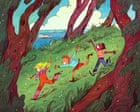
Paradoxically, this watchful web of familiarity gives children tremendous freedom. Because everyone knows them, everyone is quietly looking out for them. Kids can roam freely, and roam freely they do. Island kids climb rocks and trees, they jump from docks and poke around tide pools without helicopter supervision. “Good thing we live on an island,” we parents say to one another when they wander home with wet sneakers and pockets full of mussel shells, they tear around on bicycles and disappear into the woods only to return when they’re hungry or when the sun has set.
They are gloriously feral. But they are also startlingly capable. By middle school, many of them know how to talk to adults without shrinking, how to read a ferry schedule, how to navigate a city bus, how to get themselves from point A to point B without an adult narrating every step like a GPS with anxiety.
When May told me that every island child was “all our child”, she was giving the adults around her a job, even if these kids weren’t biologically or legally “theirs”. Perhaps that job isn’t always to correct them; sometimes the job is simply to make enough room and to protect the spark that makes children tear down the road on bicycles at speeds that terrify their neighbors. To let them get muddy. To let them argue and reconcile without immediately refereeing. To allow them to grow in every direction, not just the polite ones.
And maybe this isn’t only an island proposition. Maybe wherever children live – in apartment buildings or suburbs, on city blocks or dirt roads – the adults around them can choose to create a little more territory in which childhood is allowed to remain untamed.
So the next time you encounter a cluster of children laughing too loudly on a bus, a sidewalk or a subway platform, consider it less a nuisance than a small daily miracle, the sound of children alive and unedited, the future refusing to sit still, lips sealed.
Look up from our phones, look out the window, and remember what it felt like to be on the verge of everything.
- island
- school
- defense
- child
- world
- ferry
- adult
- kid