Wanted review – generic crime musical lacks outlaw grit
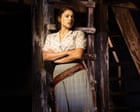
James Earl Jones theatre, New York City A ‘mostly true’ tale of 19th-century sisters running from the law is underserved in a production stuffed with superfluous showboating The new retooled musical Wanted, from writer Angelica Chéri and composer Ross Baum, opens with a blare of excitement: a Greek chorus of sorts, clad in billowing white garments like spirits from the great beyond, lay their scene in 1890s Texas. Mary and Martha are light-skinned and thus figure they can pass in the white world, at least long enough to earn some money that might allow their mother, Tallulah, to buy the…
James Earl Jones theatre, New York CityA ‘mostly true’ tale of 19th-century sisters running from the law is underserved in a production stuffed with superfluous showboating
The new retooled musical Wanted, from writer Angelica Chéri and composer Ross Baum, opens with a blare of excitement: a Greek chorus of sorts, clad in billowing white garments like spirits from the great beyond, lay their scene in 1890s Texas. There, we meet two Black sisters, Mary and Martha Clarke, who will become wanted criminals. The tone of Baum’s music is portentous, its volume high, suggesting that an epic journey is about to unfold. What ensues from there is, sadly, not quite as suspenseful, moving or grand as advertised.
Chéri based this “mostly true” story on two of her great-great aunts, daughters of an emancipated sharecropper whose absent father was white. Mary and Martha are light-skinned and thus figure they can pass in the white world, at least long enough to earn some money that might allow their mother, Tallulah, to buy the cotton-field land she’s been working for decades. It’s a dangerous gambit, and soon devolves into a gun-wielding crime spree in which the sisters rob various deserving targets. But that potentially invigorating spree is reduced to a mere montage, a quick flurry of activity that saps these daring acts of their inherent tension, of any true sense of risk. Despite its dynamic subject matter – marginalized people violently asserting themselves in a repressive time and place – this is a dismayingly tame production, albeit a more muscular one than was staged at New Jersey’s Paper Mill Playhouse in 2024.
That version was far flatter, well-intentioned but clumsy. The tweaks made for the Broadway transfer were mostly smart ones. The pacing is tighter (though, maybe too tight in places), the orchestrations are lusher and the design is more robust. Lauded scenic designer Beowulf Boritt houses most of the action under the weathered-wood framing of a barn, affording director Stevie Walker-Webb the chance to create some levels in his stage pictures. Stefania Bulbarella’s video projections are tasteful more often than not, effectively employing patterned color washes to establish changes of location. We at least see the intended grit and passion of the piece, even if we don’t always feel it.
Disappointingly lacking in levels are Chéri and Baum’s songs, almost all of which are pitched as belting showstoppers. Wanted is a musical near entirely built out of pop- and gospel-inflected 11 o’clock numbers; even the romantic ballads and duets whip themselves up into a frenzy after a verse or two. Everyone in the cast has the pipes to pull off all this maximalism, but one craves a softer song here and there. More specifically story-driven numbers might have helped flesh out characters that are otherwise underdeveloped.
As Mary – who is drawn into a new life as the presumed-white wife of a shady landowner – the actor Solea Pfeiffer has at least some nuance to play. But we don’t fully understand why she in particular becomes so committed to this con, or why it (rather quickly) transforms into something much more meaningful than that. One would think that playing Martha, who is the fiercer and more rebellious outlaw, would give Liisi LaFontaine (reprising the role from the Paper Mill production) lots of dynamic stuff to do. And yet, only a costume change that makes Martha look a little like Joan Crawford in Johnny Guitar really communicates her evolution into a true renegade.
Both actors have gorgeous, powerful voices, but they seem somewhat stranded, searching for characters that have not been sufficiently provided for them. As Martha’s love interest, Elijah, Luke James deftly deploys his silky tenor and forlorn sex appeal, but his storyline is truncated. Wanted is not without its arresting performances, though. I was most taken by Awa Sal Secka as Flo, one half of the show’s gossipy-housemaid double act. Whether singing or speaking her lines, Sal Secka brings sorely needed vim and detail to all her scenes; if only she was a more central figure in the story.
Perhaps in the next iteration of Wanted, wherever and whenever that might be, that story will be more sharply realized. As is, this is a western that’s not wild enough, a melodrama lacking heat, a song showcase that grows repetitive in all its smooth and unsurprising melody. In a scene toward the end of the show, Martha stands defiant on a high perch with an enormous projection of an American flag behind her. We are meant in that moment to feel the rumble of something enormous – of history, and of individual lives and adventures that went mostly unrecorded, but have endured nonetheless in the passing-down of family lore. That’s a lovely, potent sentiment, particularly about Black experience in this country. But it’s one smothered by a too-heavy lacquer of generic Broadway pomp.
Wanted is at James Earl Jones theatre, New York City, until 31 March 2027
- crime
- sister
- review
- grit
- production
- wanted
- chéri
- baum