Turkey pushes for transition at COP31 as coal burns
The host of this year's UN climate summit remains heavily dependent on fossil fuels as it tries to inspire a global switch to clean energy.
As Turkey welcomes delegates to the 2026 UN climate talks in Antalya and pushes for cuts in global greenhouse gas emissions, it can point to surging renewable energy capacity at home.
The COP31 host has approved more than 33 gigawatts (GW) of battery storage projects since 2022 that can power over 27 million homes.
Among the largest battery project pipelines in Europe, this storage will complement fast-expanding wind and solar energy that today provides 22% of electricity in Turkey, up from 4.5% a decade ago.
Yet this clean energy upswing is a long way from compensating for an over-reliance on fossil fuels.
Turkey's coal-fired electricity generation increased by roughly one-third in the last decade, and in 2024 overtook Germany and Poland, which previously had the highest coal power capacity in Europe before it began to decline.
Turkey is among the few industrialized countries that is yet to commit to a phase-out date for coal — the fossil fuel with the highest planet-heating emissions.
Yet at the same time, "coal's position in the electricity market in Turkey is increasingly precarious," Efe Baysal, Turkey team lead at global environment network, 350.org, told DW.
He points to high local community opposition to coal projects on environmental grounds or due to lack of financial viability. According to German nonprofit climate campaigners, Beyond Fossil Fuels, some 97% of new coal projects have been cancelled in the last decade in Turkey, in what it calls "a global record."
"Turkey's coal project failure rate is the final nail in Europe's coal coffin," said Kasia Szeniawska of Beyond Fossil Fuels in a statement earlier this year. "Coal power is finished: it's financially risky, increases costs for billpayers, harms people's health, and sabotages climate goals."
But in June, Turkey announced plans to expand one of its largest coal plants and near double its capacity.
The move underlines Turkey's "conservative energy policy" and "highly insufficient" climate goals, said Umit Sahin, head of the climate change program at the Istanbul Policy Center, a global research institute.
Turkey's current climate target allows emissions to keep rising until 2038, meaning it will struggle to meet its plans to reach net zero by 2053, notes Climate Action Tracker, a climate research think tank.
Aside from climate concerns, Turkey's high dependence on imported fossil energy makes it extremely vulnerable to volatile global oil and gas markets. The nation currently imports 95% of its natural gas, 83% of crude oil and 60% of its coal – which together make up a "lion's share” of Turkey's energy capacity, said Baysal.
It is partly this dependence that has inspired Turkey's push for greater electrification at the COP31 climate conference.
In September, the country launched the "35x35" global electrification pledge, which aims to increase electrification of world economies from just over 20% today to 35% by 2035.
The goal is for electrification to replace fossil fuels, including in transport, buildings and industry, and preferably using clean energy, though this is not mandatory – heat pumps, for example, emit fewer greenhouse gases than gas boilers, even when the electricity is generated using fossil fuels.
The pledge complements existing UN climate goals of doubling energy efficiency and tripling renewables to keep temperature rise in line with the Paris climate agreement.
Turkey COP31 president Murat Kurum will promote the 35x35 pledge in Antalya on both climate and energy security grounds.
"[The war in the Gulf] has shown us, once again, that fossil fuels do not guarantee energy supply security," he said earlier this year at a UN climate meeting in Bonn, Germany. "Investment in alternative energy sources, in particular to support energy diversity, means stability, resilience and clean development."
But despite the rhetoric, Climate Action Tracker says that under Turkey's National Energy Plan, the COP31 host is only on track to electricify around 25% of total energy consumption by 2035.
Turkey is one of numerous Mediterranean countries facing extreme climate impacts like wildfires and record heat, in addition to recent severe and deadly flooding.
As it hosts this year's climate summit, the country has a great opportunity to hasten the energy transition, says Baysal, especially since it receives nearly double the annual sunlight of Germany.
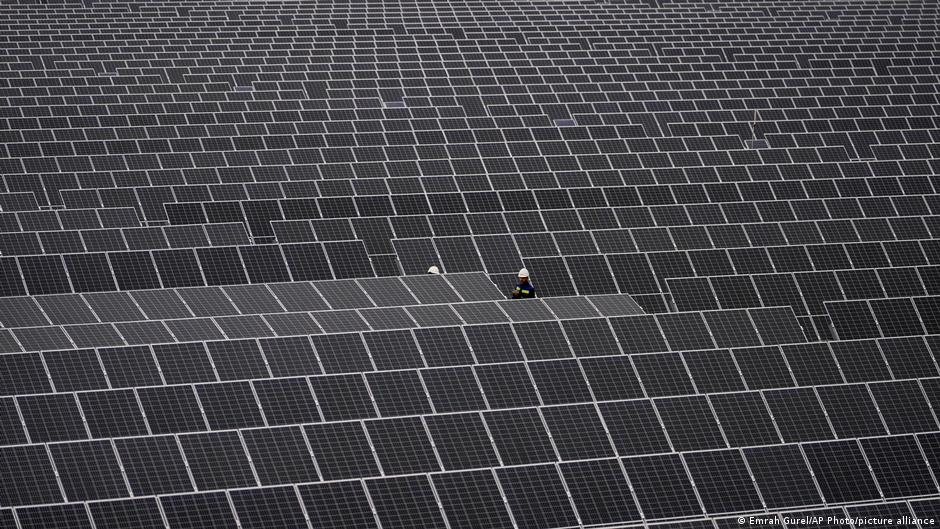
Turkey is already starting to realize some of this potential, with one analysis showing the country produces more solar module manufacturing capacity than several major European countries combined.
Solar increased from around 0.1% of total installed electricity capacity in 2014 to almost 21% at the beginning of 2026, according to Turkey's resources and energy ministry.
The COP31 host can reduce its emissions 35% by 2035 if 10 GW of solar and wind is added each interim year — as opposed to the government's target of 8 GW — notes Umit Sahin. This goal will be helped by fast-expanding battery capacity, he said.
"But if you don't phase out coal, your emissions cannot go down," he added.
Meanwhile, the COP presidency could be a "turning point" and "a very important step for Turkey," Sahin told DW.
If the country wants to show climate leadership, and reduce energy dependency, it will need to embrace a "progressive climate policy" that promotes a full energy transition, he added.
Serdar Vardar and Jonathan Rampley-Sturgeon contributed reporting to this article.
- turkey
- transition
- coal
- burn
- host
- climate
- summit
- fuel