The pest I’ll never forget: the wattle bird who dive-bombed me
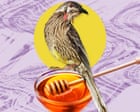
It worked a treat until one chased the rest off – and then turned on me The error took place last autumn when I offered honey to the nectar feeding birds in my neighbourhood in a bay-side suburb of Melbourne. Our grevilleas, which would normally attract them, hadn’t flowered, and my stopgap would hopefully see Australia’s native birds through the winter.
To help native birds through the winter, I put out honey. It worked a treat until one chased the rest off – and then turned on me
The error took place last autumn when I offered honey to the nectar feeding birds in my neighbourhood in a bay-side suburb of Melbourne. Our grevilleas, which would normally attract them, hadn’t flowered, and my stopgap would hopefully see Australia’s native birds through the winter. With luck, magpies, pardalotes and ravens would discourage intrusion by an increasing population of common mynas – notorious for their aggressive displacement of native species.
It worked, at first. Wattle birds visited in greater numbers. One, whom we named Wally, aggressively saw off the mynas. He arrived wan and thin, and I watched him grow plump and hale.
But then Wally began acting the alpha male, guarding the honey dish and attacking any of his own species wanting a sip. I saw him tackle a currawong (think a black-and-white raven) twice his size, and wrestle to the ground a grey butcherbird that had tried to sway him in song. Currawongs and butcherbirds are the most exquisitely melodious creatures in my neighbourhood, and now they were gone. I had eliminated one pest, but created another.
I had corrupted Wally’s natural imperative to conserve energy by providing him with an artificial, concentrated food source. Nectar naturally dispersed across hundreds of flowers could not be monopolised, and required enormous effort to gather. Wally was exploiting my contrived, late-stage-capitalist ecosystem to compound his advantage, widening the wealth gap to others of his kind. Now, alone with his hoard, Wally was outnumbered by the mynas, which had returned to the back yard.
On impulse, I hid the dish, hoping Wally would return to his wild ways. But nothing provokes umbrage, in nature or politics, like a boon removed. Stepping out of the back door became an exercise in terror. To Wally, I was a turncoat benefactor; out of nowhere, he began dive-bombing to percussively snap at my ears. Dependency had bred contempt.
I still needed Wally and his fellow native birds to discourage the mynas, so I decided to wave my invisible hand again, put the eco back in economy and imitate nature by trying something unfashionable: democratic socialism.
I have begun widely distributing offerings of honey where they could not be monopolised and were needed most – a devolution of resources to my back yard’s provinces. It’s too early to tell if this quest to restore nature’s default setting will work. But I am hopeful. For in nature, and politics, a new season always comes.
- bird
- pest
- wattle
- winter
- honey
- myna
- treat
- rest