Judging this year’s Booker prize taught me our humanity cannot be captured by algorithms and data
As the demand for information and transparency about our lives increases, these brilliant books dealt with shadows, mystery, privacy and intimacy The first box of submissions for the 2026 Booker prize arrived by courier a few days before Christmas. There was the excitement of – as was the chair of this year’s judging panel Mary Beard’s method of choice – reaching your hand into the box, playing lucky dip to choose your next adventure.
As the demand for information and transparency about our lives increases, these brilliant books dealt with shadows, mystery, privacy and intimacy
The first box of submissions for the 2026 Booker prize arrived by courier a few days before Christmas. As I made my way through 19 books over the next six weeks (they start you off at a leisurely pace) I spotted a theme: God is back. In novels set from antiquity to our contemporary world, from romances to comedies to thrillers, characters reached for transcendence and absolution and found themselves mired in all manner of sin, or at least spiritual confusion. Priests were popping up everywhere; people sought comfort in the ancient texts; near-biblical bouts of extreme weather would prove either cleansing or calamitous.
The boxes continued to arrive month after month, making me feel as though I was part of a very generous but exacting book club. There was the excitement of – as was the chair of this year’s judging panel Mary Beard’s method of choice – reaching your hand into the box, playing lucky dip to choose your next adventure. There was the joy of spotting recurring themes. Publishers decide which of their books to submit for consideration, and I’ve heard that it can lead to agonising second-guessing about what the judges may like (the preponderance of priests may have been due to the poet Patricia Lockwood, who wrote the wonderful memoir Priestdaddy, being on the panel). I heard reports of one publisher declaring: “Mary Beard hates sex scenes.” “I don’t hate them,” she said when I told her this, “but they can’t be bad.” She was true to her word. In our first meeting, I made the case for a novel I enjoyed. She later emailed us a description of a penis in it that was admittedly clumsy.
“Water is the chief of all metaphors,” a character says in Missouri Williams’s longlisted novel The Vivisectors, referencing John Donne. There were many drownings, and coasts proved to be fraught, charged spaces between the material and spirit worlds. Spring saw the arrival of novels about death, ghosts and karmic retribution. Time moved strangely in many books, appearing fuzzy and elastic. Surrealism was back. Bodies were failing and minds were unravelling. Three of the novels on our longlist featured characters with dementia, and their sense of being out of time and out of place in the universe seemed to reflect the emergent human condition. Glass houses were sparkling, foolish symbols of human ambition.
Why all these signs, and what could they possibly be pointing to? One answer could be found in how the future in these books often seemed like an implausible prospect. Gwendoline Riley’s longlisted The Palm House opens to a London awash in dust from fires in Europe and refers to “our Mad Max future”. The young protagonists in Djamel White’s All Them Dogs and Williams’s The Vivisectors only hope to survive a hostile present. The old world was falling away but, as Emma Cline observed in Switzy, “the new world not slurring over empty space”.
We had emerged out of the pandemic and into a time of war, an ongoing climate emergency and creeping transhumanism; novelists, too, were moving towards new forms and new ways of representing the world. Magic had arrived to fill the gap that reality left. Kenan Orhan’s The Renovation transports a Turkish prison to a bathroom in Italy to illuminate the agony of exile; a spell in Makenna Goodman’s Helen of Nowhere rounds out a parable about culture wars and male power. The characters in Chloe Aridjis’s The Shadow of the Object find themselves transfixed by the analogue magic lantern, a kind of projector with a light source, and the fantastical figures it casts.
Judging the Booker prize is a surreal combination of the public and private. For most of the time, you are at home alone with your books, then one day you’ll find yourself at a photoshoot next to Jarvis Cocker and Raymond Antrobus posing beautifully. This year, my own hermetic life of reading was mixed in with the recognition that out there, in the literary world, things were fractious. The debate about whether we have reached a post-literacy age rolls on. Accusations of AI misuse have started to swirl around literary prizes (only a handful of our novels discussed AI; I suspect we saw the dawn). Given how little money there is in it, there has long been a degree of masochism involved in being a writer. Now, the advent of large language models has made publishing any work feel like oiling the engine of our own obsolescence, providing fodder for the AI-generated summary, tithing the kingdom of gold belonging to three guys in the US.
The meeting to decide the winner took place last weekend. When I think of all six shortlisted novels, I think of how they undermine the idea that humanity is transparent and knowable, a thing to be data-mined and sucked into the machine. Here, instead, are stories about shadows and mystery, privacy and intimacy.
The gay men of Marlon James’s The Disappearers live by necessity in the hidden corners of Kingston, finding moments of release in the club; the king of Rebecca Perry’s May We Feed the King is a slippery figure, subject to many conflicting rumours within the court. Father and son remain unknown to each other in Douglas Stuart’s John of John; Luke Kennard’s Black Bag is, among many things, an ode to the perverse pleasures of literally denying the world your image (its premise: man encases himself in a black bag). “How blind we humans are,” the narrator observes in Elizabeth Strout’s The Things We Never Say. “We travel through life unsighted, grasping only the smallest details of one another’s selves, including our own. Thinking all the while that we can see.”
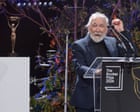
The winner this year, M John Harrison’s The End of Everything, is filled with mystery and ambiguity. Aliens have arrived in Britain, ushering in a confusing and protracted apocalypse. The sea is full of strange objects; ghosts flit around the skies, and here it is the English who queue up at the coast to board ships in search of better futures. “I hoped for a future but it just isn’t here,” one character says to another. The book drops the reader into a Britain of thwarted hopes and dangerous nostalgia, of unintelligible technological progress and a decayed social contract, and in doing so, captures something about how it feels to be alive now. My favourite lines in it concern the old world. “In those days, many moments had been like that,” Harrison writes of the decadent “before times”, which sounds suspiciously like the New Labour 1990s: “Tainted by leisure chemicals, aspiration, the downwash of celebrity culture […] life had been like a huge silent beautiful blossom opening to the economic light.”
These are not soothing lines – it is not a soothing book – but it has bottled up something in the air and pinned it down in text. The before times have come and gone, and we seem to be moving towards something new, but do not yet know what. In the meantime, people will continue to write novels that will console and enchant, challenge and provoke. My year of reading has shown what a gift that can be.
Rebecca Liu is a Guardian commissioning editor
- booker
- prize
- book
- box
- humanity
- theme
- novel
- priest