‘We said no, no, no, but they kept insisting’: the Paraguayan people battling a eucalyptus empire
It is Paraguay’s largest private investment but local people accuse a forestry giant of ignoring their contamination concerns over its vast plantation When Paracel arrived in Tacuarita, an Indigenous community of homes made from planks and plastic sheeting in Paraguay’s poorest region, six years ago, it was a welcome sight. “They fulfilled all their promises,” says Florencio Garcete, 55, chief of the Mbya Guaraní community of 211 people.
It is Paraguay’s largest private investment but local people accuse a forestry giant of ignoring their contamination concerns over its vast plantation
When Paracel arrived in Tacuarita, an Indigenous community of homes made from planks and plastic sheeting in Paraguay’s poorest region, six years ago, it was a welcome sight. The company improved the dirt roads and dug an electric-powered well, saving villagers a two-mile journey to fetch water from a cattle pond that often made them sick. It also gave dozens of local people forestry jobs.
“They fulfilled all their promises,” says Florencio Garcete, 55, chief of the Mbya Guaraní community of 211 people.
But today, the minimum-wage work often dwindles and the well stops working during power cuts. More worrying are its eucalyptus plantations, which begin less than 200 metres from the community’s crops and homes.
Paracel is made up of the Paraguayan Zapag group, the Austrian pulp producer Heinzel and Swedish forestry company Girindus Investments. The project is expected to be the largest private investment in Paraguay’s history.
The company will reportedly invest about $5bn (£3.7bn) and create 7,000 jobs, mainly in the northern region of Concepción. Financed by the Inter-American Development Bank (IDB) and Paraguay’s government, the company says it is protecting existing ecosystems while “reforesting” former ranchland with 162m eucalyptus trees to fight global heating.
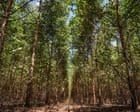
It is also building an industrial plant to process these non-native trees – which already cover an area larger than New York City – into pulp for the global paper and packaging industry.
Paracel was championed by the then-president Santiago Peña, who headlined the construction launch of the company’s pulp mill in May.
Peña was removed from office and arrested this month over the collapse of Ueno Bank. He denies any wrongdoing. Though unrelated to Paracel, the case has cast uncertainty over the signature projects of his administration.
But an investigation by the Guardian with the local media outlets Consenso and the Paraguay Post, has documented accusations of water contamination, harmful pesticide use, worsening drought, land disputes and forced evictions in 12 communities.
Paracel is a “hidden monster that has quietly taken root”, says Benjamín Valiente, a human rights defender who works for the local Catholic diocese. “They’re murdering nature for profit.”
Official documents indicate that the plantations are being treated with sulfluramid, an insecticide that degrades into a “forever chemical” linked to cancer in humans. Sulfluramid is banned in the EU, one of Paracel’s two main export markets, along with China.
Paracel says it had “no record” of staff saying water near Tacuarita would be contaminated by its chemicals, as one of the company’s representatives had allegedly told the community. In a 39-page response to a request for comment, the company highlighted its “significant contributions to economic, social and environmental development in the area”.
Meanwhile, farmers in the town of Puentesiño, near Paracel’s plantations, accuse the company of occupying land earmarked for people living in poverty 50 years ago by presidential decree.
In March 2024, a local organisation occupied part of a disputed property and planted maize and cassava. At night, they say, the company used drones to spray the area with an unknown substance, leaving residents with headaches, vomiting and diarrhoea. After talks with Paracel, police evicted them in September 2025.
“We left crying like children,” says Bernardino Galeano, 67, the group’s leader, who now faces criminal charges.
Paracel says a government demarcation confirms its property title, and it conducted only ground-based spraying during the occupation.
The farmers also claim the plantations have dried up streams and wells. “It’s not just us humans that are suffering, but the animals too,” Galeano says. “What will they do without water?”
In the neighbouring region of Amambay, Paracel held consultations with the Indigenous Paĩ Tavyterã community of Cerro Akangué. “We said no, no and no,” says Ana Valiente, a local resident and an organiser with the Kuña Guaraní Aty (Association of Guaraní Women of Paraguay). “But they kept insisting.”
According to participants, Paracel indicated the project would go ahead regardless; the meetings were only to determine if they wanted solar panels, wells and jobs.
A report by the Bank Information Center and five other civil society organisations in 2022 said Paracel had not translated key documents into Spanish or Guaraní, had misled communities into consenting and failed to record those who objected.
Paracel “categorically” denies the claims, saying it had held 52 meetings in Guaraní accompanied by INDI, the government institute for Indigenous peoples. The year after the people of Cerro Akangué declined to participate, the company received an environmental licence to plant eucalyptus downstream of local watercourses.
Silvino Mendoza, another Paĩ Tavyterã local leader, asks of the process: “What sense does it make to consult us once the government has already given them permission?”
In interviews, residents say construction workers at Paracel’s plant – which the company says is being built to “the highest global sustainability standards” – suffered mass food poisoning from the meals they were provided, were made to work overtime, and were fired if they protested. “It’s gig work,” says Pedro Calonga, a 54-year-old local man, “not long-term employment.”
Paracel says it has not dismissed anyone over complaints, that forced overtime is prohibited by its internal code of ethics, and that it replaced the company blamed for the food poisoning. It employs 1,013 registered workers.
Documents obtained by this investigation show an official inquiry found that 252 hectares (623 acres) of forest cover – equivalent to about 350 football pitches – were lost at Rancho Z between 2004 and 2021, which Paracel bought in 2020. Paracel denies illegal deforestation, saying the loss predates its purchase. Satellite images show eucalyptus plantations on the former ranch a year before Paracel acquired it and the company says those plantations did not belong to it.
Margarita Amaral, 64, a retired teacher who once urged neighbours to support Paracel, now coordinates protests against it. “Those eucalyptus plantations will last five, six years. And what will be left? Sand, sun and earth.”
According to public statements, Paracel will harvest and replant its plantations every seven years. The company says it plans to operate in northern Paraguay “for the long term”.
The factory is in Paso Horqueta, one of Paraguay’s smallest and newest districts. “We started with nothing,” says the mayor, Cynthia Cabañas.
The district has no environmental officer and the taps are not working in the town hall; residents drink orange, silty water from a river downstream of the plantations.
Paracel pays no local taxes because the plant sits in a free trade zone.
Guillermo Achucarro, of the Paraguayan thinktank Base-Is, says Paracel has come to “replace the state in the poorest areas”, providing vaccination clinics, Red Cross medics and ID cards, and creating “a kind of enclave economy”.
“It’s like everything revolves around Paracel’s needs,” Achucarro says.
Paracel says it contributed $3.6m to the national treasury in 2025, having invested $1.4bn as of December 2025.
Drone images show a roughly 300-hectare area cleared of vegetation for the future pulp mill, whose treated wastewater will be discharged via an underwater pipe more than a mile away in the Paraguay River.
Yet experts say even state-of-the-art pulp mills can release contaminants when monitoring is weak or safeguards fail. In 2023, a plant owned by the Finnish company UPM in Uruguay leaked about 1m litres of caustic soda, killing fish and receiving a $188,000 fine. In March 2025, a tonne of sulphuric acid was released at an older UPM mill, resulting in a $40,000 penalty.
“The forestry industry has generated serious environmental, economic and social problems over the past 40 years,” says Daniel Peña Vergara, of the University of the Republic in Montevideo. “The promised jobs never materialised.”
The regional capital, also called Concepción, is 12 miles (20km) downriver of the factory and most of Paracel’s plantations; water is pumped from the river, treated and distributed to 30,000 households. “We drink that water,” says Crispín Díaz, 57, president of a fishers’ association. “With the poisons they’re using for the eucalyptus plantations, even young people and kids will get cancer,” he says. “Even the fish will suffer.”
According to a recent annual report, between 2023 and 2025, Paracel used 703 tonnes and 118,000 litres of herbicides, insecticides, fungicides, surfactants and spray oils, plus nearly 43,000 tonnes of fertiliser. Glyphosate, a weedkiller that Paracel uses in its plantations, was classified as “probably carcinogenic to humans” by the World Health Organization in 2015.
Perfluorooctane sulfonate (PFOS), which sulfluramid becomes when it degrades, was recently classified by the US Environmental Protection Agency as likely to be carcinogenic, with no safe level in drinking water. Chemicals used by agribusiness have been linked to paralysis and genetic damage among Paraguayan children. The UN has criticised Paraguay for failing to protect its citizens over several related deaths.
Paracel acknowledges the chemicals’ “known dangers” but says workers are trained to use them “responsibly”.
Meanwhile, Concepción’s governor, Liz Meza, describes how authorities have worked “hand in hand” with Paracel to pave roads and build a new hospital and a cancer clinic. “Every project has its pros and cons. Our job is to get ahead of the downsides,” she says.
Paracel, she argues, is a “once-in-a-lifetime opportunity” for a region trying to move beyond decades of deprivation and conflict between armed groups and the state.
Paracel says it monitors water quality and has not detected its agrochemicals in ground or surface water, sprays no closer than 100 metres from streams, communities and native forests, and complies with Forest Stewardship Council standards. It says drought in the area was mainly due to low rainfall, with its modelling showing plantations only reducing water levels by up to 2.3%.
“After six years working on the ground,” it says, “we have witnessed concrete transformations in the lives of hundreds of people.”
Multiple European pulp producers are looking at Paraguay, where labour is cheaper, trees grow faster and environmental laws are weaker. One UN expert has criticised the “flagrant double standards” of the US and Europe for exporting “highly dangerous” agrochemicals prohibited in their own countries to emerging economies such as Paraguay.
“The idea is to turn Paraguay into this whole pulping landscape,” says Jamie Gagliano, a Rutgers University doctoral candidate who is studying the sector. “But that’s only if this industry doesn’t collapse.”
In 2023, Verra, the world’s biggest carbon-credit certifier, rejected Paracel’s certification amid doubts about “additionality” – meaning the emission reductions would not have occurred without the carbon-credit revenue. The company had claimed it needed carbon revenue despite securing a $200m IDB loan.
Paracel’s own 2020 environmental review projected the project would be a net greenhouse gas emitter, with gross annual emissions of more than 400,000 tonnes of CO2-equivalent, similar to 93,000 petrol vehicles. The company says those figures are outdated.
In September, the company announced that Verra had approved its first batch of carbon credits, covering nearly 24,000 hectares of its plantations.
In the Paĩ Tavyterã village of Ita Guasu, amid one of Paraguay’s last fragments of Atlantic forest, a community leader, Luis Arce, 70, says individuals claiming to work for INDI put pressure on them to allow Paracel to plant their trees nearby. The community stood firm.
The forest, he says, is now disappearing. “Without it, the planet itself is growing weak.” Shown photos of Paracel’s “planted forests”, Arce and his family laugh at the empty space between the thin, identical trunks. “This is a forest,” the Indigenous elder says, gesturing to the surrounding hills.
This investigation was supported by Journalismfund Europe. Additional reporting by Laila Bareiro and Sebastián Olazar
- people
- eucalyptus
- empire
- paraguay
- forestry
- community
- investment
- giant