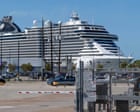
This small Alaska town is swamped by cruise ship visitors every summer. But what happens when they all go home?
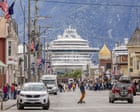
This small Alaska town is swamped by cruise ship visitors every summer. Skagway’s 1,100 permanent residents are caught between a boom time – when the ships bring more than a million tourists – and a lull in winter October comes to the small Alaska coastal town of Skagway like a sigh.
Skagway’s 1,100 permanent residents are caught between a boom time – when the ships bring more than a million tourists – and a lull in winter
October comes to the small Alaska coastal town of Skagway like a sigh. The shops that were bustling throughout the crazed tourist season are reducing their opening hours or beginning to close. The hordes of employees sleeping in overcrowded bunkhouses are leaving or have left.
The crowds of cruise passengers who have filled the streets since April, wearing lanyards emblazoned with the names of their ships, have dwindled to a trickle. Soon, they will all be gone. Snow is visible on the nearby mountains.
What is left after the season has ended and the last ship has disappeared from sight is a year-round community of about 1,100 people – on paper, at least – and the concern that, as the demands of the cruise ship industry grow, life in this small town is becoming more and more difficult.
“The year-round economy, the year-round population is one of my bigger concerns as someone who lives here,” says Skagway’s mayor, Orion Hanson. “What does Skagway do without a coffee shop to congregate in or without a restaurant open all the time? We don’t have a diner any more.”
Two local restaurants stay open, albeit with limited hours outside the cruise ship season. But the Sweet Tooth cafe, once a longstanding year-round diner, is gone. It is now a storefront for Diamonds International, a tax-free jewellery store that partners with cruise lines for onboard retail and shops in ports that open seasonally.
At the height of the Klondike gold rush, Skagway was the largest town in Alaska, with a population of about 10,000 people. In 1900, it became Alaska’s first official city. But by 1910, as the gold rush subsided, the population had dwindled to about 600 people.
It took a decade for that dramatic swing. Now, as one of the most popular cruise ship destinations in the world, it can happen in a single day, when thousands can flood on to Skagway’s streets from cruise ships, only to leave again when the sun sets. The most recent figures available show that more than 1.35 million tourists arrived in Skagway by cruise ship in 2025, alongside more than half a million crew – and the numbers are growing each year.
That means housing, services and infrastructure designed for a town of about 1,000 people having to accommodate an influx of thousands of workers who arrive in late winter and stay until early autumn.
“Part of the complication of Skagway is that you have such a boom in the summer and such a lull in the winter,” says Hanson. “In terms of revenue that’s not directly related to cruise ships there is not a lot.
“As we saw during the pandemic, we’re at risk,” he says. “If all your eggs are in one basket, it leaves you very vulnerable.”
Like many tourist towns, Skagway has a housing shortage. Unlike other towns, however, it is squeezed into a narrow valley set at the northern end of Alaska’s Inside Passage, a 500-mile maritime route that hugs the coast along Alaska and British Columbia. It is known for its rugged mountains, forests, glaciers and abundant wildlife; there are no realistic commuting options and no room to expand – the only road leads to Canada.
The Skagway Development Corporation commissioned a report in 2023 that found there were 644 housing units in town. In the years since, more have been added, but not enough for the town to accommodate the cruise ship industry and the businesses that support it, its permanent residents, seasonal employees and the workers and families who keep Skagway’s essential services running.
As a result, everything from warehouses to single-family homes, from tents to recreational vehicles or motorhomes, are accommodating the increasing numbers of seasonal workers each year.
“There’s a lot of congregate living and couch surfing,” says Al Wall, director of the town’s Dahl Memorial Clinic. “There are quite a few people that sleep in hammocks in the woods. And frankly, some would prefer to sleep in a hammock in a tree than stay in a crowded place with a bunch of people.”
In years past, many seasonal workers slept in camp sites. But a change in the town’s law forbidding season-long camping pushed them into traditional homes that previously housed the town’s established population.
Janilyn Heger, a longtime Skagwegian, owns the town’s distillery, Skagway Spirits. She and her husband Gary, who owns a construction company, once managed the town-owned camp sites.
“The city made the decision for whatever reason to abandon that type of housing, and that created a domino effect that has been a disaster for the community,” she says.
“Employers started buying buildings and displacing year-round housing and so now we’re at an absolute standstill. There’s none to be had.”
Skagway’s housing shortage has become so severe that many of the town’s limited hotels have been converted into accommodation for seasonal employees.
Longtime resident Mike Healy bought Sergeant Preston’s hotel from friends when he was unable to find land to build enough employee housing to meet his businesses’ needs.
“I didn’t want to purchase Sergeant Preston’s … I approached the city and said, hey, Municipality of Skagway, I am going to purchase the only year-round hotel in this community if you don’t free up some land for housing.”
Healy, not receiving an answer, duly converted the hotel into seasonal housing, part of a portfolio that provides off-season accommodation to visiting workers and contractors.
Jonathan Hillis, a town assembly member who owns the local Mountain Shop outdoor gear store, says that pattern is playing out across town.
“We have very few places now for independent travellers to stay, which is fostering this kind of cycle of more and more cruise ship tourists and fewer independent travellers.”
The scale of cruise tourism is a frequent topic of debate in towns throughout the Inside Passage. As the 2026 season winds down, these towns are consulting the docking schedules for 2027 and 2028, making note of the projected increase in tourism, and asking how much they can realistically handle.
One hundred miles south of Skagway in Alaska’s capital, Juneau, there have been repeated attempts to limit cruise ship tourism. After a ballot measure for “ship-free Saturdays” failed in 2024, the city introduced a voluntary limit on the number of ships that could dock daily.
Farther south in the Inside Passage, Ketchikan has reported more ships as a result of cruises adhering to Juneau’s limitations, while Sitka, also on the cruise ship destination trail, is reviewing its agreements with the industry after an anticipated increase in visitor numbers in 2027.
A survey conducted by Oregon State University reveals a nuanced position when it comes to the cruise sector in Skagway. Just over 40% of people who responded thought that the benefits of tourism outweighed the costs, compared with 25% who put it the other way round. Another 33% viewed the relationship as roughly balanced.
Whatever the sentiment, for a small town that is economically dependent on one industry for its livelihood, options are limited.
“There’s only so much we can do, even if we wanted to,” Hanson says. “We need to be incredibly careful about not rocking the boat.”
- ship
- alaska
- town
- cruise
- summer
- skagway
- tourist
- visitor