Victims of Nazi war in Poland call on Germany for support
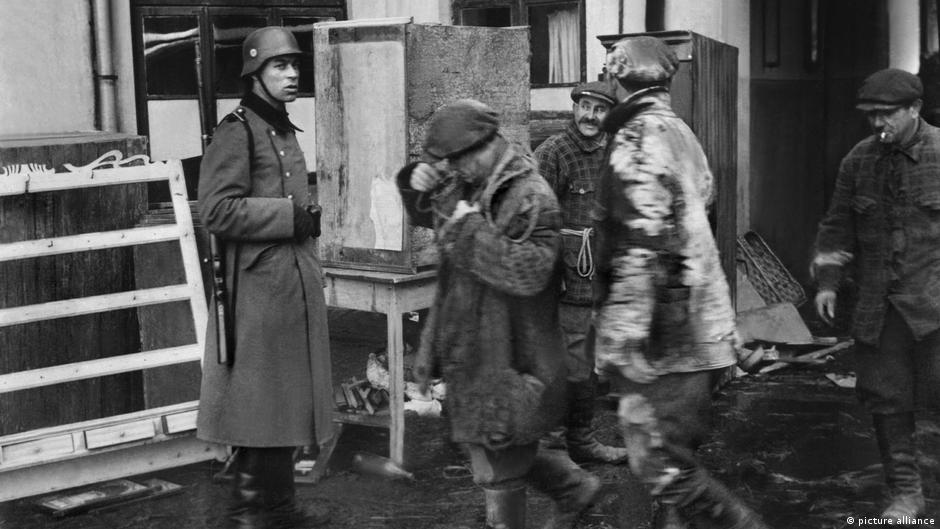
More than 80 years after the end of World War II, Polish victims of the Nazi regime are still waiting for a "humanitarian gesture" from Germany. The 2027 draft budget hasn't left them much hope for possible reparations.
"We can no longer wait," declared Polish victims' organizations in a dramatic appeal to German civil society, published on November 5 on the website of the Foundation for Polish–German Reconciliation.
"Around 50,000 survivors of Nazi persecution during the German occupation still live in Poland today. They include former concentration camp and prison inmates, people deported to Germany for forced labor and those subjected to other forms of Nazi repression," wrote the signatories of the appeal.
The open letter pointed out that many of the survivors are over 90 years old, struggling with illness and rising costs, and in need of help in their daily lives. "For many, any further delay in deciding to provide assistance means that help will come too late," said the appeal, which was distributed in German, Polish and English.
While Germany has recognized its moral responsibility toward the remaining survivors of Nazi persecution, the signatories pointed out that a corresponding decision on possible reparations by the German federal government has yet to be made.
"Today, we appeal primarily to German civil society to provide humanitarian support to survivors of Nazi persecution living in Poland," they wrote, addressing businesses, foundations, associations and private citizens. "Every donation matters."
The unresolved issue of war reparations has clouded German-Polish relations for decades.
Following the 1989 democratic transition in Central and Eastern Europe and the reunification of Germany, the federal government provided 500 million deutschmarks to Holocaust victims in Poland. More than 1 million people received support through these funds. Former forced laborers also received payments from the EVZ Foundation, which works to preserve the memory of the victims of National Socialist persecution.
However, given the scale of German crimes during World War II, the reparations provided to date have been considered as insufficient by large parts of Polish society. German occupation policy in Poland was characterized by systematic crimes against the Polish population. An estimated 6 million Polish citizens were killed during the war, including about 3 million Polish Jews.
As part of the "General Plan East," a large portion of the population was to be displaced, enslaved or murdered. As early as 1939, the "Intelligenzaktion" specifically targeted the Polish elites, including teachers, clergy, civil servants and intellectuals. In addition, approximately 2.5 million Poles were deported to the German Reich for forced labor and made to work there under inhumane conditions.
When it came to power in 2015, Poland's right-wing conservative Law and Justice Party (PiS) made the issue of war reparations a central focus of Warsaw's policy toward Berlin. The PiS government estimated Poland's war losses at 6.2 trillion zloty (approx. €1.3 trillion/$1.58 trillion) and officially demanded this sum from Berlin in October 2022.
The center-left government led by Donald Tusk has distanced itself from these demands since Tusk's election victory in December 2023. However, the government has also made no secret of the fact that Poland is expecting a "creative solution" from its German partner, according to Foreign Minister Radek Sikorski.
Former German Chancellor Olaf Scholz had offered €200 million ($224 million) prior to his visit to Poland in the summer of 2024, an offer rejected by Tusk as insufficient. The talks held since then between Berlin and Warsaw have failed to produce a solution.
In a final declaration following the German-Polish government consultations in December 2025, the German government promised to "analyze possibilities for additional support for Polish victims of Nazi aggression and the German occupation of Poland."
"Currently, there is no decision regarding a humanitarian gesture and the draft budget reflects this status," Josef Hinterseher, deputy spokesperson for Germany's Federal Foreign Office, told reporters on September 23.
Germany's opposition Greens party has not given up hope of a turnaround in its efforts to secure a "humanitarian gesture."
"Our parliamentary group submitted a request to the budget committee to secure funding for this 'humanitarian gesture.' Unfortunately, the request was rejected," Franziska Brantner, co-chair of the Greens, told DW on Thursday in Warsaw.
"Hope dies last, so we will do everything in our power to ensure that the coalition makes this change after all," she emphasized. Brantner sees the budget committee's "final review session," which will take place this week, as a last chance.
The issue of reparations still plays an important role in Polish society, even more than 80 years after the end of the war. There is hardly a family that did not suffer during the war. In the latest German-Polish Barometer — a representative survey that has been conducted for 25 years — 53% of respondents stated that the suffering of the Polish people is not sufficiently acknowledged in Germany. Only 18% believed that the Germans have done enough.
Jakub Deka, chairman of the Foundation for Polish–German Reconciliation, believes the appeal by the victims' associations could now mobilize Germany's civil society. Following an initial appeal in May directed at the German federal government, several hundred Germans responded with donations ranging from €50 to several hundred euros.
To date, a total of more than €35,000 ($39,000) has been deposited into the foundation's account. Several people in need have already received one-time assistance from this fund. "It's a drop in the bucket, but every little bit helps," Deka told DW.
The foundation's chairman quotes Jerzy Tarasiewicz — who led the victims' association in the Polish city of Gdansk for many years — as a cautionary reminder. In January, Tarasiewicz was quoted in an interview with the daily newspaper Gazeta Wyborcza as saying: "They [the Germans] are waiting for us to die."
Tarasiewicz, who was born in 1942 on a German farm where his parents were performing forced labor, died in late September at the age of 84 without being able to witness this "humanitarian gesture."
"It is a painful reminder that the victims cannot wait any longer," said Deka.
- nazi
- war
- germany
- victim
- poland
- support
- end
- world