Bots, deepfakes and surveillance: Israel’s election goes to war online

Netanyahu and his rivals are tied days from the vote, and both camps are fighting with bots, deepfakes and data.
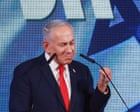
Polls show the blocs linked to Israeli Prime Minister Benjamin Netanyahu and the opposition, led by former Chief of Staff Gadi Eisenkot, are locked in a virtual tie before Tuesday’s general election.
Efforts to mobilise supporters, win voters and attack opponents are being played out online through a series of social media advertisements and doctored AI videos. Many of these paint a bleak vision, the outcome depending on whether the party is on the right or centre, of Israel if their rivals win.
On Thursday, the Israeli liberal daily Haaretz reported that dozens of online bots created to undermine the Iranian government were being repurposed to spread campaign propaganda supporting Netanyahu and his Likud party, and warn voters of the dangers posed by Eisenkot and former Prime Minister Naftali Bennett, who make up part of the opposition bloc.
Both camps are pushing AI-generated and deepfake videos on X. Several of them show Netanyahu confronting his alleged failings before the Hamas-led attack of October 7, 2023; others show the opposition being sympathetic to Arab parties (those representing the Palestinian citizens of Israel) which have been perceived by many as kingmakers in the coming election.
“We’re competing against parties with far greater budgets and technological resources, particularly the Likud,” Mauricio Lapchik, director of the Arab-dominated Joint List Hebrew-language campaign, said. “The use of technology is clearly deepening an already unequal playing field … We may not have the same resources, but we are convinced that our message matters more than the artificial technology behind it.”
Significant resources have been used by the Israeli right against the left-wing Joint List – an alliance of Hadash, Balad and Ta’al – and Ra’am, also known as the United Arab List. Palestinian citizens of Israel generally support one of these two blocs, and all the parties have faced legal challenges before the parliamentary election.
Likud were looking to use Elector, an app that tracks voter turnout on election day, but were restricted by the Central Elections Committee due to privacy concerns. They will instead use a new app named Victory 26. Unlike Elector, this does not reveal the identities of voters but would allow Likud activists and officials to determine which areas have the lowest turnout, manually take the names of people who have cast their votes, and then target those who have not yet.
This app could play a crucial role in the election, which will likely be determined by voter turnout.
“Elector and similar programmes are very basic compared to what the Israeli military is capable of now,” Sebastian Ben Daniel, a doctoral researcher into algorithms, computability, and AI, said. “Israel has the perfect laboratory with which to develop this kind of technology.”
Privacy issues are a particular concern for the Palestinian citizens of Israel, who make up about 20 percent of the population and whose political activity is already heavily monitored.
In recent weeks, Finance Minister Belazel Smotrich caused uproar when he released an AI video showing the Supreme Court’s president, a justice and the attorney general – all frequent targets of the far-right government who have sought to shake off judicial oversight – being violently dragged from an antigovernment protest.
In another AI video shared by Netanyahu earlier this year, his key political rival Eisenkot is seen running towards an AI figure who many believe resembled his son, Gal, who was killed while taking part in the genocide on Gaza, before passing him entirely and embracing the head of the Arab Ra’am party, Mansour Abbas.
Netanyahu’s camp later said they did not intend the figure to mirror Eisenkot’s son, who wears a T-shirt saying “Israel’s Unity” in Hebrew, and replaced the male character with a female one.
There has also been heavy use of AI to demonise Palestinian citizens of Israel, with a video shared by far-right National Security Minister Itamar Ben-Gvir portraying the people of Gaza as donkeys, and “herding” them to Paris. Ben-Gvir has called for the ethnic cleansing of Gaza via “voluntary emigration” and frequently targets Palestinians in his political stunts, such as humiliating detainees and prisoners in Israeli jails.
There has also been a heavy use of bots by Netanyahu and Ben-Gvir’s campaign to amplify their political messaging, according to numerous accounts.
“The online campaign has been especially violent. AI, algorithms and data management are all utilised to cement what we call ‘affective polarisation’,” Roi Zur a lecturer at Essex University and specialist in voting behaviour and election strategies, told Al Jazeera. This term is used by political scientists to refer to the entrenchment of political blocs and an increased animosity towards the opposing side.
“Affective polarisation targets people at the fringe, who might be thinking of voting for a party in an opposing bloc, and bring them back into the fold.” As this election will likely be determined by the success of the smaller parties and voter turnout in general, this is a pertinent point.
“Turnout and management of the parties will be essential. If you look at large secular cities, such as Tel Aviv or Haifa, turnout is typically only 60 percent,” he said. “If you compare that to cities and towns with a large Haredi (ultra -Orthodox) population, such as Jerusalem and Bnei Brak, the turnout is around 80 to 85 percent, so a large part of the campaigning is also to get people out to vote by threatening them with the ‘other’.”
- bot
- deepfake
- surveillance
- israel
- election
- war
- online
- netanyahu