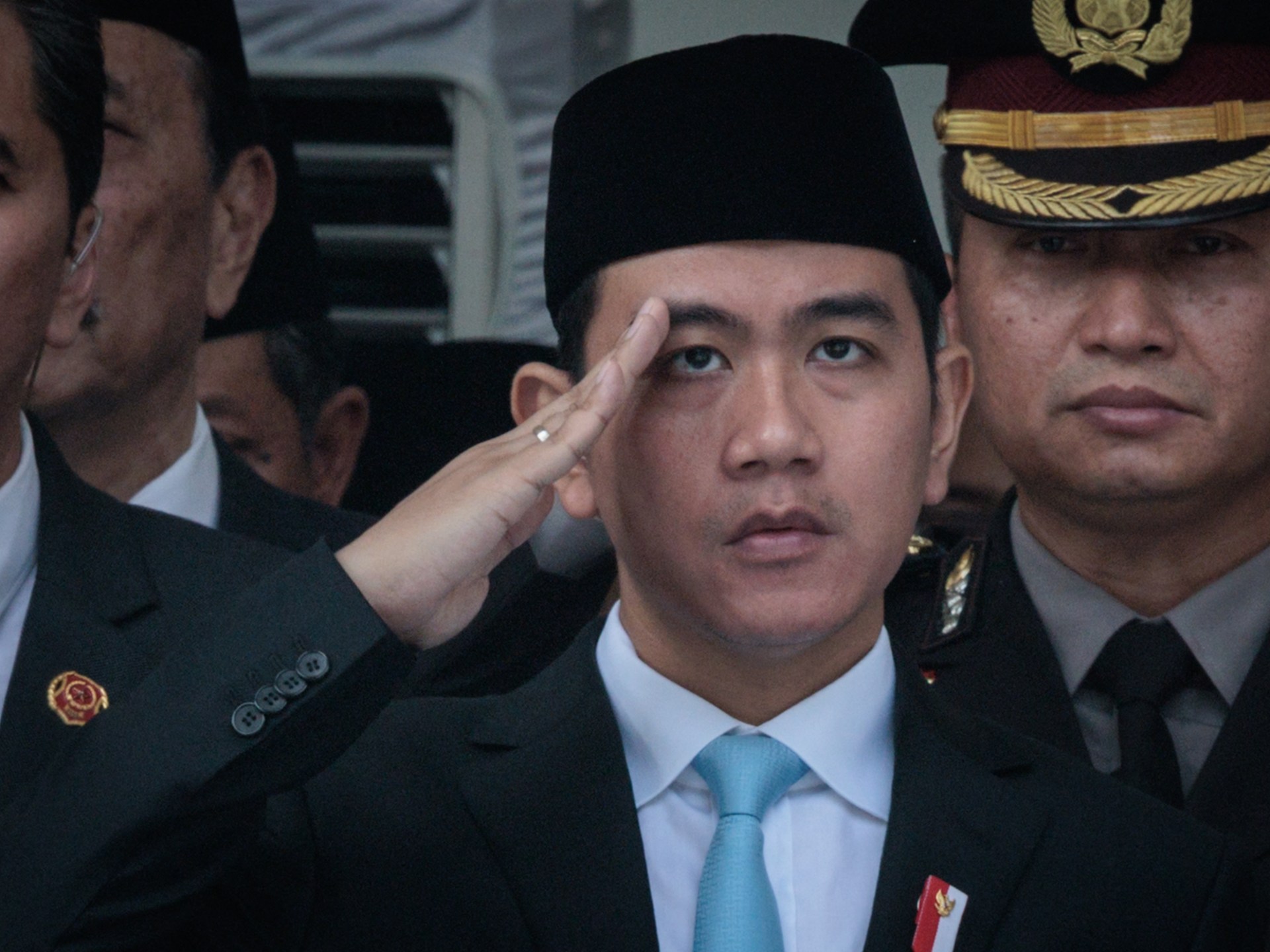
What went wrong for Indonesia's VP Gibran Rakabuming Raka?
Indonesia's vice-president has resigned amid mounting calls for his impeachment. Here's what we know about why he resigned and who could be in the running for the position.
Indonesia's Vice-President Gibran Rakabuming Raka has resigned, ending a political saga that has played out across multiple court cases and amid mounting calls for his impeachment.
Here's what we know about why the country's youngest ever vice-president resigned before the end of his term and how his successor will be chosen.
Gibran Rakabuming Raka is the eldest son of Indonesia's seventh president, Joko Widodo, widely known as Jokowi.
Mr Gibran was a businessman before entering politics.
He founded a wedding organising business and launched a range of food and beverage ventures with his younger brother, Kaesang Pangarep, several of which remain in operation.
Mr Gibran formally entered politics when he joined his father's party, the Indonesian Democratic Party of Struggle (PDIP), in September 2019.
Soon after, he successfully ran for mayor of Solo in Central Java — a position once held by Mr Jokowi before he became president — with the support of his party.
During the 2024 presidential election, Mr Gibran was the running mate of Prabowo Subianto, the co-founder and chairman of the Gerindra Party.
This put him at odds with the PDIP, which backed rival candidates. Mr Gibran was later expelled from the party.
In Indonesia, presidential and vice-presidential candidates aren't required to be from the same party.
Mr Prabowo and Mr Gibran were sworn in as Indonesia's president and vice-president in October 2024.
The controversy centred on a single document.
Under Indonesian election law, the presidential and vice-presidential candidates must have completed senior high school or the equivalent.
Several politicians challenged Mr Gibran's eligibility, arguing he had failed to provide proof of his qualifications.
They alleged he relied on a substitute certificate that should not have been accepted by the General Elections Commission, and argued he should be disqualified from office.
The Constitutional Court rejected the challenge, ruling the matter could no longer be addressed through the presidential election dispute process because Mr Gibran had already been sworn in as vice-president.
However, Judge Adies Kadir said: "The court found no convincing evidence that Gibran has a foreign diploma equivalent to having completed senior high school, or another equivalent qualification as stipulated in the Election Law."
The Constitutional Court's finding was later reinforced by a Supreme Court ruling that invalidated the substitute high school equivalency certificate issued by the Ministry of Primary and Secondary Education that he had used when registering for the election.
The rulings fuelled calls in parliament to remove Mr Gibran from office, with politicians arguing he no longer met the requirements to serve as vice-president.
Before the impeachment process could run its course, however, he chose to resign.
The resignation does not affect Mr Prabowo's position.
Under Indonesia's constitution, the president continues to govern if the vice-presidency becomes vacant.
The People's Consultative Assembly, or MPR, must then convene a session within 60 days to elect a new vice-president.
The replacement will be chosen from two candidates nominated by the president.
The process begins with the president submitting the names and supporting documents of two nominees, which are then verified by the MPR.
The assembly will determine whether the candidates meet the requirements before holding a vote in a plenary session.
The candidate who wins the most votes will become vice-president.
If both candidates receive the same number of votes, a second round will be held.
And if the result remains tied, the president will choose one of the two candidates.
It is still too early to know who will replace Mr Gibran.
Several potential candidates are already being discussed, both from Mr Prabowo's political circle and from outside the governing coalition.
One name frequently mentioned is Puan Maharani, a senior PDIP politician, Speaker of the House of Representatives, and the daughter of former president Megawati Soekarnoputri.
Mr Prabowo ran as Ms Megawati's running mate in the 2009 election, but was unsuccessful.
While the PDIP is not part of the governing coalition, it has never formally declared itself an opposition party either.
Other names being floated include Sugiono, the former foreign minister and secretary-general of the Gerindra Party, and Sufmi Dasco Ahmad, a deputy speaker of parliament and Gerindra's executive chairman.
Both men are among Mr Prabowo's closest political allies and come from the president's own party.
Constitutional law expert Zainal Arifin Mochtar said one thing is clear:
- indonesia
- gibran
- rakabuming
- raka
- vice
- president
- call
- impeachment