From Pong to GTA VI: Play your way through 50 years of video games
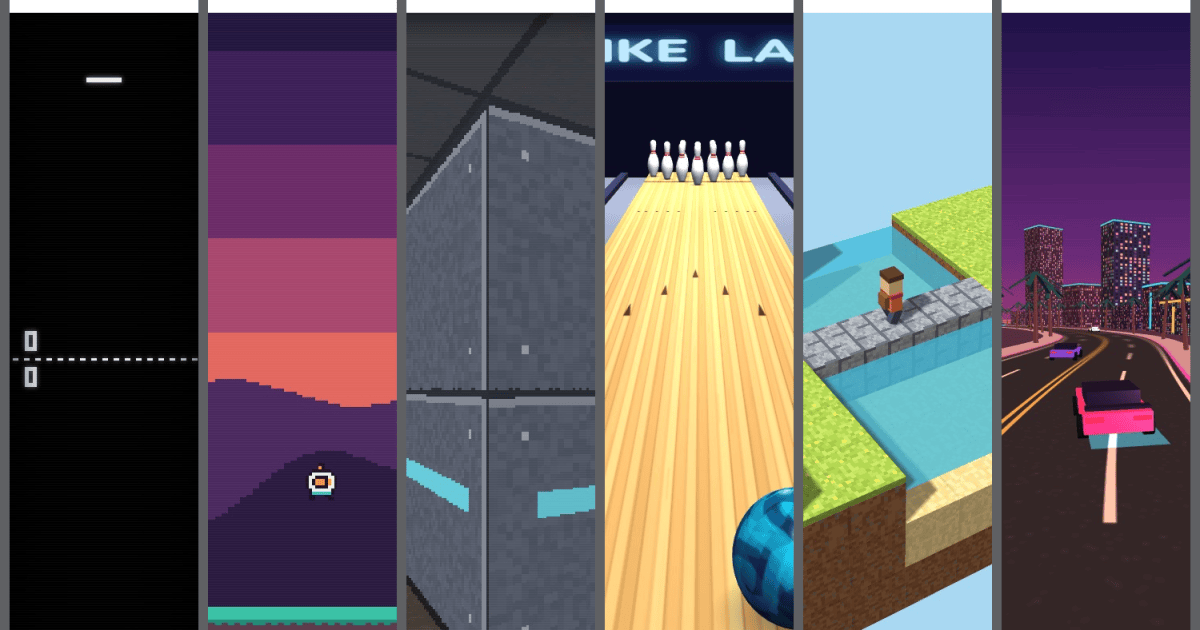
Video games are now a $200bn business. Play through the six games that tell the story of how they got there.
On November 19, Rockstar Games releases Grand Theft Auto VI, ending a 13-year wait for the sequel to one of the best-selling games ever made. Few games have arrived with more riding on them. Its first trailer drew more than 90 million YouTube views in 24 hours in December 2023, a record for a game reveal.
It arrives in an industry that generated $201.6bn in revenue in 2025, according to market research firm Newzoo. That business started with two paddles and a square of light.
Using AI tools, Al Jazeera built six short levels inspired by the games that defined each decade, from Pong to GTA VI. Play through 50 years of gaming and try to beat our times.
Choose a decade to jump ahead, or scroll down to play the whole journey.
Video games were not invented in 1972, but that was the year they began reaching a much wider public.
In 1958, physicist William Higinbotham wired a tennis game to an oscilloscope for visitors at Brookhaven National Laboratory in New York. People queued to play Tennis for Two, but it was never sold.
In 1972, two machines brought video games to the public. The Magnavox Odyssey became the first home console, plugging into the family television. Months later, a young California company called Atari put a test version of Pong in Andy Capp's Tavern, a bar in Sunnyvale.
Within days, it stopped working. The coin box was too full of quarters.
Pong, with its two paddles, square ball and scoreboard, became an early commercial sensation, helping establish the arcade video game business.
By the end of the decade, arcades were packed with cabinets. Atari's 2600 console, launched in 1977, helped popularise interchangeable game cartridges, allowing players to buy new games without buying a new machine.
The boom did not last. Flooded with rushed games and too many consoles, the US video game market collapsed in 1983. Atari buried thousands of unsold cartridges in a landfill in Alamogordo, New Mexico, in 1983. Among them was E.T., a rushed film tie-in that became notorious as one of the worst games ever made.
Japan revived the industry. Nintendo launched its Famicom in Japan in 1983 and brought it to the US in 1985 as the Nintendo Entertainment System. To persuade wary retailers to stock it, Nintendo marketed the console as an entertainment system and included a toy robot, R.O.B., in one of its launch bundles.
Its star was Super Mario Bros. Instead of a single screen, the world scrolled sideways, past the edge of the television, with secret pipes, hidden blocks and a hero with a personality.
In 1989, Nintendo launched the handheld Game Boy in Japan and North America, packaged with Tetris, a puzzle game created by Soviet programmer Alexey Pajitnov. It reached Europe in 1990.
The 1990s brought a console war and a third dimension. Sega's Mega Drive, sold as the Genesis in North America, took on Nintendo with faster games and edgier advertisements. Then Sony entered the market with the PlayStation, launched in Japan in 1994 and elsewhere in 1995. Its use of CDs, which held far more data than conventional cartridges and were cheaper to manufacture, helped transform console gaming.
On PCs, a small Texas studio called id Software released Doom in December 1993. Its first episode was given away as shareware, copied onto floppy disks and passed around offices and campuses before most people were online. Doom transformed flat maps into immersive, fast-moving 3D-like corridors. Players could also connect computers over networks to fight one another.
Violence came with the realism. In 1993, US senators, including Joe Lieberman, held hearings on games such as Mortal Kombat and Night Trap. The industry responded by setting up its own age-rating body, the Entertainment Software Rating Board, in 1994.
In 1997, a Scottish studio called DMA Design released a top-down crime game. It was called Grand Theft Auto.
In the 2000s, games went mainstream. Sony's PlayStation 2, launched in 2000, doubled as a DVD player and became the best-selling console ever, at about 160 million units. It still holds that record.
In 2001, Grand Theft Auto III moved the series into 3D, giving players a sprawling city to explore and helping establish the modern open-world game. It also kept the series at the heart of arguments about violent games for the rest of the decade.
Nintendo took a different route. Instead of chasing more powerful graphics, the Wii, launched in 2006, used a motion-sensing remote that players swung like a tennis racket or a bowling ball. Wii Sports became one of the best-selling games ever, with more than 82 million copies sold, including those bundled with the console.
The game became popular with people who had never considered themselves gamers, including older adults and families.
Consoles went online, too, with Microsoft's Xbox Live linking players from 2002. Then in 2008, Apple opened its App Store. Few noticed at the time, but mobile phones were about to become the biggest platform in the video game business.
The 2010s belonged to players who made things. Minecraft, officially released in 2011 by Swedish studio Mojang, gave players a world of blocks to dig up and rebuild, with enormous freedom to set their own goals. Microsoft bought Mojang in 2014 for $2.5bn. By 2025, Minecraft had sold about 350 million copies, more than any other game.
Phones changed who played and how they paid. Many of the biggest games were free to download and made money from in-game purchases. Watching became a major part of gaming culture, as streaming platforms such as Twitch turned gamers into broadcasters and e-sports tournaments attracted large audiences.
Grand Theft Auto V, released in 2013, became one of the most commercially successful entertainment products ever made. By June 2026, it had sold more than 230 million units worldwide, according to its publisher, Take-Two Interactive.
The pandemic sent people indoors and onto games in 2020. The boom was followed by a slump, and thousands of industry jobs were cut in 2023 and 2024.
Now comes GTA VI, set in Leonida, a fictional version of Florida, and its neon-lit Vice City. Its first trailer became the most-watched game reveal on YouTube, with more than 90 million views in a day. First promised for 2025, the game was delayed twice before Rockstar settled on November 19, 2026. It will run on PlayStation 5 and Xbox Series X/S, consoles that support 4K graphics.
From two paddles in a California bar to an entire fictional state, games have become a business worth more than $200bn a year. GTA VI will test how much bigger they can get.
- video
- game
- pong
- gta
- way
- business
- story