Don’t just blame the culture for keeping powerful men’s dirty secrets. Blame the law too
A challenge to that can’t come soon enough There will be empty shelves in many bedrooms this weekend, where the David Walliams books once stood. At his peak, Walliams was the bestselling children’s author in Britain for 100 weeks straight, to say nothing of the spin-off theatre productions, Christmas specials, countless World Book Day costumes, and that family-friendly stint as a judge on Britain’s Got Talent during which we now learn he was reportedly inviting teenagers to his dressing room.
It is important to understand just how effectively perpetrators of abuse have used lawyers as their shields. A challenge to that can’t come soon enough
There will be empty shelves in many bedrooms this weekend, where the David Walliams books once stood. For parents of a certain era, there was no escaping that particular publishing-industrial complex, and I certainly did my share of wearily reading Gangsta Granny or Mr Stink on repeat. At his peak, Walliams was the bestselling children’s author in Britain for 100 weeks straight, to say nothing of the spin-off theatre productions, Christmas specials, countless World Book Day costumes, and that family-friendly stint as a judge on Britain’s Got Talent during which we now learn he was reportedly inviting teenagers to his dressing room.
“What I try and do most of all in my books is encourage reluctant readers,” he told breakfast TV’s Lorraine Kelly in 2024, the year before publisher HarperCollins finally dropped him after allegations over his behaviour towards junior female staff. But it’s parents who would have been reluctant to bring his books anywhere near bedtime had we known earlier about the young girls claiming that Walliams exploited his fame to prey on them, and then threatened legal action if they tried to speak out.
One 19-year-old was left “shaking” in fear by a missive from Walliams’s lawyers, Schillings, warning that she risked committing a serious civil offence if she talked publicly about her experiences with him, and requesting a signed legal undertaking not to do so. (Schillings maintains it was acting on its client’s instructions that she might sell “untruthful” stories to the press.) If it takes an agonisingly long time to bring some stories to light – the Guardian has been investigating Walliams since 2022, while the Sunday Times started piecing together its separate case against Russell Brand in 2019 – then don’t underestimate the herculean effort required now to build the evidence and to win the trust of frightened young women. They are not just afraid of having to relive a trauma in court, or being outed and harassed on social media, but of being personally sued for everything they have.
This isn’t just about Walliams, who denies the allegations and was eventually named after failing to secure an injunction against publication sought on the grounds that he might attempt suicide, however. Shortly afterwards, Private Eye reported that another male celebrity accused by multiple women has secured an injunction preventing the magazine from publishing. And even now, some women are still reportedly gagged by so-called non-disclosure agreements (NDAs) from sharing what they know about the convicted rapist Russell Brand. Publicly and privately, in our increasingly angry conversations about how exactly toxic men get away with it, women are starting to ask some very pointed questions about the law’s role in protecting them.
Twenty years ago, celebrities facing embarrassing stories about their sex lives might have asked their PRs to lean on a friendly tabloid editor and get it spiked. But that doesn’t work in an era of girls whistleblowing independently on TikTok, which means reputation management is increasingly now the preserve of lawyers, and in particular privacy specialists.
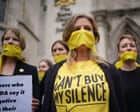
Why risk suing for libel in open court, if you can stop things long before that? Five times as many women as men have signed NDAs, according to the campaign group Can’t Buy My Silence – whose co-founder, Zelda Perkins, bravely broke her own to help get her former boss Harvey Weinstein convicted of rape – while Slapps (so-called strategic lawsuits against public participation, essentially designed to intimidate and exhaust the target rather than necessarily to win in court) are becoming increasingly common in allegations of sexual misconduct.
Even better than hushing things up afterwards, meanwhile, is ensuring confidentiality before they have even happened. The celebrity stylist Lou Teasdale posted on Instagram this week that it’s now routine in television for girls left alone with male stars to be asked to sign NDAs and surrender their mobile phones first. Though ostensibly to protect the celebrity from sneaky recordings, an agreement “to remove the woman’s voice and the device that would keep her safe” hardly incentivises men to behave well, Teasdale argued.
Everyone, of course, should enjoy the right to protect themselves against malicious claims, libellous gossip and unjustified intrusion into private life. But that doesn’t explain why two years ago, an inquiry by parliament’s culture, media and sport select committee accused the music industry of using NDAs to get victims of sexual harassment to leave quietly, while keeping the perpetrators in their jobs.
It doesn’t explain the rape victim bound by a gagging order that stopped her even discussing the attack with medical professionals, whose case was raised in parliament by the then backbencher (now cabinet minister) Louise Haigh during her successful campaign to curb the worst abuses of NDAs. It doesn’t explain the solicitor-turned-MP Sarah Russell’s memories of dealing with companies where everyone knew the boss to be a pervert but “the board can give the women 20 grand to go away, they sign an NDA and that is the end of that”.
And it certainly doesn’t explain the late Harrods boss and serial rapist Mohamed Al Fayed’s routine use of NDAs to silence and intimidate his victims. (Though legally such orders can’t stop someone reporting a crime, women were warned that Harrods’ feared head of security, John Macnamara – a former Met police officer – would find out if they contacted the police. Alison Kervin, author of a book about Fayed’s crimes, heard of one survivor who emerged from giving a police statement to find Macnamara waiting outside.)
At long last, the tide may be turning. The equalities minister, Bridget Phillipson, is considering new curbs on NDAs, to prevent “a system where rich and powerful men are able to silence women”. Later this month, parliament will debate the former Tory minister John Whittingdale’s backbench bill aiming to stop the weaponisation of Slapps against journalists and whistleblowers.
But nine years on from the mass reckonings of #MeToo, both its successes and failures are now clicking into sharper focus. Young women are thankfully far more vigilant for predatory behaviour than my generation was, and as Brand discovered, so increasingly are juries. (Though still too low, rape conviction rates are rising, with completed prosecution rates at their highest for a decade.) What we didn’t foresee when the old barriers crumbled, however, was that new ones would rise so fast. It’s true there has been for too long a culture of impunity for powerful men, and shame for women. But it isn’t just “the culture” – that vague, amorphous soup for which nobody is clearly responsible – that keeps men’s dirty secrets: sometimes, it’s also the law. Too bad for predators, then, that the latter is by far the easier to change.
- book
- walliams
- culture
- law
- parent
- britain
- man
- secret