'Playing with injury' par for course at Wheelchair Rugby League World Cup
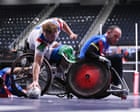
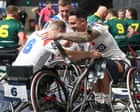
From overcoming life-altering accidents to living with rare medical conditions, almost every player in the Wheelchair Rugby League World Cup has an amazing story to tell.
Fri, 11 Sept, 7:50 pm, Final score, Rabbitohs 10, Knights 20
Sat, 12 Sept, 4:05 pm, Final score, Warriors 16, Dolphins 26
Sat, 12 Sept, 7:50 pm, Final score, Sharks 26, Cowboys 16
Sun, 13 Sept, 4:05 pm, Final score, Panthers 19, Roosters 12
Sat, 19 Sept, 7:50 pm, Final score, Roosters 46, Sharks 10
Sun, 20 Sept, 4:05 pm, Final score, Warriors 10, Knights 12
Fri, 25 Sept, 7:50 pm, Final score, Dolphins 20, Roosters 36
Sun, 27 Sept, 4:00 pm, Final score, Panthers 14, Knights 22
Sun, 4 Oct, 7:30 pm, Final score, Roosters 19, Knights 18
Sport is awash with stories of players battling injury to return to the field, but at the Wheelchair Rugby League World Cup, competitors take that courage and determination to another level.
From life-altering accidents to rare medical conditions, almost every player has overcome significant adversity to represent their country.
The two-week tournament in Wollongong, south of Sydney, saw eight teams compete, with Welsh captain Jodie Boyd-Ward becoming the most internationally capped player in the sport's history, with 51 games.
Diagnosed with arthritis as a child, she started wheelchair rugby league in 2007.
As a 14-year-old, she "initially hated it" because of the physicality of the mixed-gender but male-dominated game.
"I'm now starting to feel a bit sad because I'm retiring after this tournament, but that's my legacy, not just to be the first female, but to be the first player ever [to play more than 50 international games]," she said.
Boyd-Ward has earned a reputation as a terrifying defender and led her team to a 52-30 win over Scotland in her final game.
"It [retirement] will hit me when I get back to the UK and I'll have a little teary moment," she said.
"It's a decision I've thought about for a good year, and it's my time to let the younger players and newer players come through and continue building on that legacy."
For army veteran and two-time World Cup Wheelaroo Zac Schumacher, wheelchair rugby league gave him a new lease on life.
The Townsville man worked as a cargo specialist in the Australian Army for nine years before he was medically discharged in 2011 after dislocating his hip while on the job.
Since then, he has had 20 operations, including three hip replacements.
Schumacher said when he found wheelchair rugby league in 2016, the sport "helped save my life".
"I used wheelchair rugby league and the mateship to find a purpose and manage my pain condition.
"It's definitely been a big help in my life."
When Irish player Oran Spain broke his wheelchair in a training drill before his team's first game, his uncle put a call-out on Irish radio station RTE for anyone travelling to Australia in the next few days who could transport his spare wheelchair.
Deirdre Donoghue was listening in her car and phoned in ahead of her trip to Sydney to visit friends.
She was given Spain's wheelchair and presented it to him at Sydney Airport in time for him to play in his team's second match.
"I've been working on this for four years trying to get to a World Cup to be selected," Spain said.
"I've been flying over to Wigan in England to play every weekend in the summer, and now Deirdre's given me the opportunity to achieve that dream."
Spain's coach, Phil Roberts, is one of the sport's most experienced players.
"I was born with dislocated hips, quite common for young children, but it wasn't spotted until I couldn't walk," Roberts said.
"I had lots of operations as a child, which led me to be a frustrated sportsperson through school and young adulthood.
"Then I found wheelchair rugby league in 2007 and have been involved in it ever since."
Roberts said the World Cup in Wollongong showed the sport was growing in both popularity and inclusivity.
"To have ever thought in 2007 that we would be able to witness the haka in a wheelchair with New Zealand's debut in this World Cup, it's brilliant to see," he said.
In last night's final, England claimed its second consecutive title with a win over France, and Australia beat out Ireland for third place.
- wheelchair
- rugby
- league
- world
- cup
- par
- course
- injury