2027: INEC sets Nov 28 for nationwide mock election
Amupitan unveils safeguards against inaccurate IReV results, assures credible polls By Ben Ngwakwe, Gombe LONDON — The Independent National Electoral Commission (INEC) has announced November 28, 2026, for a nationwide mock accreditation and voting exercise to test its upgraded electoral technology and electronic result transmission system ahead of the 2027 general elections. According to a statement issued by his Chief Press Secretary and Media Adviser, Adedayo Oketola, and released by INEC’s Gombe office on Friday, Amupitan said the November 28 exercise would simulate the presidential…
Amupitan unveils safeguards against inaccurate IReV results, assures credible polls By Ben Ngwakwe, Gombe LONDON — The Independent National Electoral Commission (INEC) has announced November 28, 2026, for a nationwide mock accreditation and voting exercise to test its upgraded electoral technology and electronic result transmission system ahead of the 2027 general elections.
The commission also unveiled new technical safeguards to prevent inaccurate election results, including figures reflecting over-voting, from being uploaded to its Result Viewing Portal (IReV). INEC Chairman, Prof. Joash Amupitan, SAN, disclosed this on Thursday in London while speaking at Chatham House during a high-level dialogue organised in partnership with the Kimpact Development Initiative (KDI).
The dialogue was held under the theme, “Nigeria’s 2027 Elections: Democratic Trajectory and Regional Stability Beyond the Ballot.” According to a statement issued by his Chief Press Secretary and Media Adviser, Adedayo Oketola, and released by INEC’s Gombe office on Friday, Amupitan said the November 28 exercise would simulate the presidential election and test the commission’s accreditation and electronic result transmission processes.
He said the reforms were informed by lessons from the 2023 general elections, which he acknowledged had significantly eroded public confidence in the electoral commission. “First and foremost, let me speak about what happened in 2023, which resulted in a significant trust deficit for INEC—damage so large that the Commission has not yet fully recovered from it,” he said.
The INEC chairman, who assumed office in October 2025, said the commission had used subsequent off-cycle elections to identify operational weaknesses and strengthen its accreditation, voting and result-management processes. Citing the Anambra and Osun governorship elections, Federal Capital Territory Area Council polls, Ekiti governorship election and 16 legislative by-elections, he said the commission had recorded improvements in its electoral administration.
He particularly cited the Anambra and Osun governorship elections, where results were declared the day after voting, as evidence of improved coordination. Amupitan recalled that the 2021 Anambra governorship election took about five days to conclude, arguing that the more recent exercise demonstrated progress. “Why must Nigerians trust me? Nigerians must trust me because, number one, I have conducted off-cycle elections—and observers agree that the recent election in Osun State marked a clear improvement,” he said.
INEC introduces safeguards for IReV On electronic transmission of results, Amupitan said the commission’s post-2023 assessment identified weaknesses in the result-management process, particularly at collation centres. He said INEC had consequently introduced additional technical safeguards to ensure that results uploaded to IReV passed the necessary validation checks at polling-unit level.
“We found that the core problem of election result management and declaration in Nigeria is not even at the polling unit—it is at the collation centres,” he said. “In 2023, there were instances of inaccurate results or results with over-voting being uploaded onto IReV. We have now devised a technical safeguard: if a result is not accurate at the polling unit, it will not go to IReV at all.” He said the measures were intended to eliminate discrepancies at the point of entry and improve transparency and accountability in the collation process.
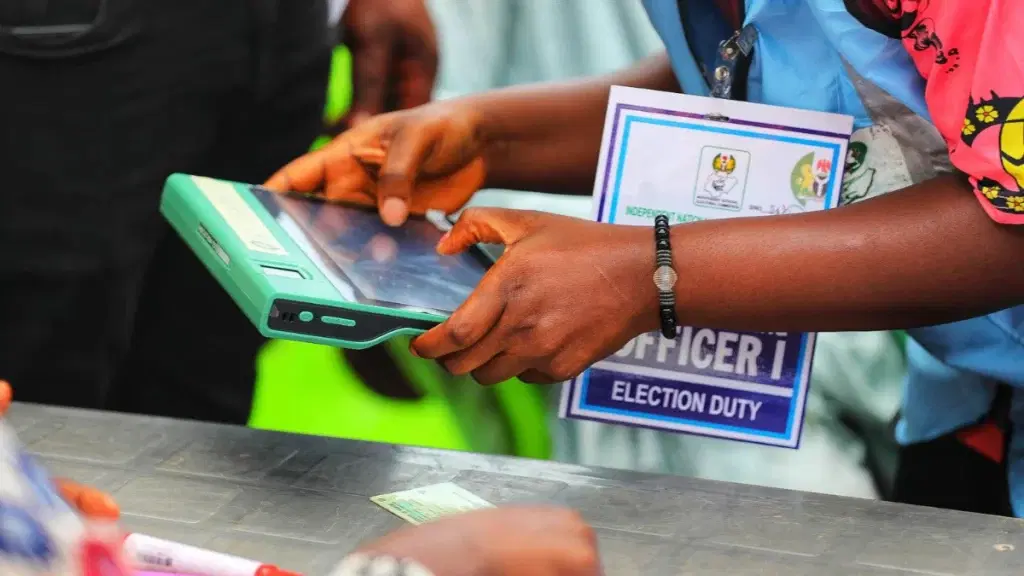
BVAS devices upgraded On concerns over the performance of the Bimodal Voter Accreditation System (BVAS) during the 2023 elections, the INEC chairman said the commission had taken steps to improve the reliability and efficiency of the devices. He recalled that extreme temperatures and inadequate storage conditions contributed to equipment-related challenges during the previous general election.
To address the problem, he said INEC was constructing climate-controlled storage facilities across the states of the federation. He added that the commission had procured additional BVAS devices and reduced the maximum number of registered voters assigned to each machine from 1,250 to 850. Under the new arrangement, polling units with more than 850 registered voters would be provided with multiple devices to ease pressure on the equipment and facilitate accreditation.
Amupitan said the nationwide mock exercise scheduled for November 28 would test the upgraded devices, electronic transmission system and other critical components of the electoral process. “On the 28th of this month, we will conduct a mock accreditation and voting exercise across all states of the federation to simulate the presidential election and verify that we have gotten both accreditation and electronic result transmission right,” he said.
Outstanding election funds expected this month On funding for the 2027 general elections, Amupitan disclosed that INEC had received a substantial portion of
- election
- inec
- result
- commission
- safeguard
- irev
- accreditation
- voting