science

NASA’s Voyager 1 to hit new space distance record of one light-day

NASA’s Voyager 1 to hit new space distance record of one light-day

The probe was launched in 1977, and it continues to relay space-related data back to a team of NASA scientists.

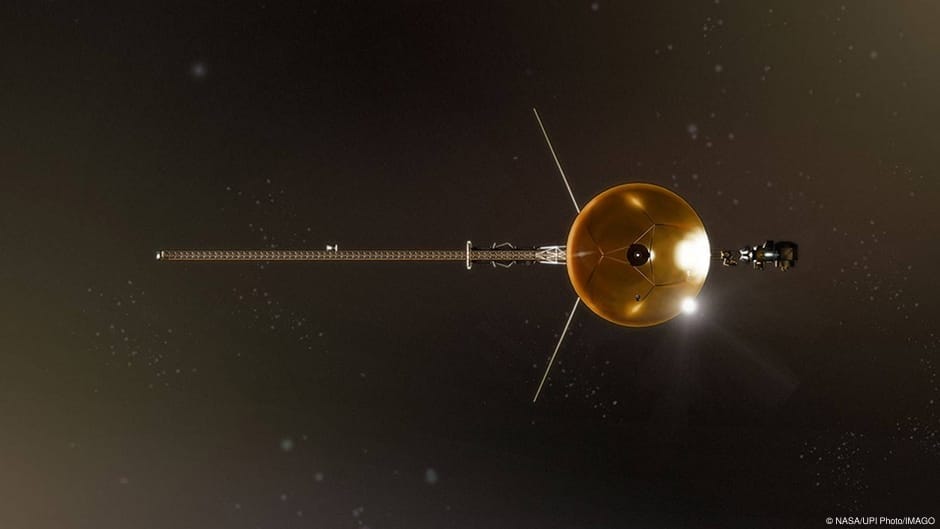
NASA has announced that its Voyager 1 probe will soon become humanity’s first object to travel one light-day from Earth.

On Wednesday, the robotic space probe will hit the milestone of travelling at least 16 billion miles since its launch in 1977, a distance equal to one light-day, or how far light can travel in 24 hours.

The probe completed its Saturn flyby in 1980, the end of its primary planetary mission, and is currently travelling at roughly 36,000 miles per hour (58km/h) in interstellar space, the vast gap between stars.

NASA expects it to take 18,000 years to travel a full light-year, and double that before it nears another star.

Plutonium-powered Voyager 1 was launched shortly before another probe, Voyager 2. Both continue to relay data back to Earth daily, including readings on the strength and direction of the magnetic field as well as on the surrounding pressure, dust and galactic cosmic rays.

Voyager 2 is expected to hit one light-day from Earth in 2035.

Both are kept active by a skeleton team of NASA engineers who send commands roughly once a week, and more if the probe gets into trouble.

In October, the team briefly lost communication with Voyager 1, and they have not yet figured out why.

Voyager 1 project manager Suzanne Dodd described Voyager 1 as “a national treasure” and told The Associated Press news agency that the two probes’ activities are akin to that of weather satellites.

The probe’s cultural impact has been significant. The famous “Pale Blue Dot” photo of Earth was taken by Voyager 1 in 1990.

“All of us — everyone on Earth — have been touched by these missions,” the Planetary Society’s Bill Nye said in a statement.

  • nasa
  • space
  • voyager
  • distance
  • record
  • probe
  • datum
  • team

Summaries and tags are generated automatically. Stay informed with VidiaNews.

Related news

Nasa’s Voyager 1 just reached a massive milestone in space - video
science

Nasa’s Voyager 1 just reached a massive milestone in space - video

Nasa sent the Voyager 1 and 2 probes into space almost 50 years ago to explore the outer reaches of our solar system. To find out more about its astonishing journey, Madeleine Finlay hears from Jim Bell, a planetary scientist and professor at Arizona State University’s school of Earth and space exploration.

Read →
GSSTI Director urges passage of national space law to unlock Ghana’s share of US$680bn space economy
science

GSSTI Director urges passage of national space law to unlock Ghana’s share of US$680bn space economy

The Director of the Ghana Space Science and Technology Institute (GSSTI), Dr Joseph Tandoh, has called for the urgent establishment of the Ghana Space Agency and the passage of a national space law to regulate the country’s space activities, protect national interests and unlock economic opportunities in the global space industry. Cabinet further approved the establishment of the Ghana Space Agency in 2025, but Dr Tandoh stressed that the approval did not mean the institution had formally been established.

Read →
Ghana Space Conference 2026 brings policymakers, experts together to advance space technology
science

Ghana Space Conference 2026 brings policymakers, experts together to advance space technology

More than 300 policymakers, scientists, technology experts, industry leaders and international partners have gathered in Accra for the 2026 Ghana Space Conference to explore ways of harnessing space technology to address national development challenges and strengthen Ghana’s position in the emerging global space economy. Spacehubs Africa pushes for coordinated national approach The Director of Spacehubs Africa, Kwaku Sumah, called for a coordinated national approach to developing Ghana’s space ecosystem, insisting that the country must move beyond discussions and translate its ambitions into…

Read →