40m MSMEs hold key to Nigeria’s economic future, Uzodimma, business leaders say
…Imo gov unveils blueprint for grassroots economic growth By Nnamdi Ojiego Nigeria’s nearly 40 million micro, small and medium enterprises (MSMEs), which account for close to half of the country’s Gross Domestic Product (GDP) and nearly nine out of every 10 jobs, hold the key to its economic future, Governor Hope Uzodimma of Imo State and business leaders have said. Delivering the keynote lecture entitled, “The Future Is Local: Stimulating Grassroots Economies for Inclusive Growth”, Uzodimma argued that Nigeria’s next phase of economic growth must come from its communities, particularly the…
…Imo gov unveils blueprint for grassroots economic growth By Nnamdi Ojiego Nigeria’s nearly 40 million micro, small and medium enterprises (MSMEs), which account for close to half of the country’s Gross Domestic Product (GDP) and nearly nine out of every 10 jobs, hold the key to its economic future, Governor Hope Uzodimma of Imo State and business leaders have said.
They spoke on Friday, at the maiden edition of the Lagos Country Club Policy Dialogue with Government Leaders in Ikeja, Lagos, where they called for a deliberate shift towards developing local economies through infrastructure, affordable financing, reliable electricity, digital skills and stronger partnerships between government and the private sector.
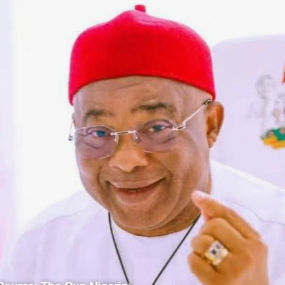
Delivering the keynote lecture entitled, “The Future Is Local: Stimulating Grassroots Economies for Inclusive Growth”, Uzodimma argued that Nigeria’s next phase of economic growth must come from its communities, particularly the towns and rural areas whose productive potential remains largely untapped. “My central argument is straightforward. Nigeria’s growth will be sustainable only when it is built on the strength of its many local economies.
Government must lay the foundations, and private capital, much of which is represented here, must turn them into productive enterprises, jobs and prosperity. Neither can do this alone,” he said. Uzodimma said the concentration of economic opportunities in major cities had contributed to rural-urban migration, poverty and pressure on urban infrastructure, arguing that development must reach the communities people were leaving behind.
Quoting National Bureau of Statistics figures, he said 72 per cent of rural Nigerians were poor, compared with 42 per cent in urban areas, while rural communities accounted for 80 per cent of the country’s poor population. “When local economies sit idle, the consequences do not stay local. Young people leave for the big cities or stay behind with nothing productive to do.
That idleness has a way of finding the wrong employers. Crime and insecurity feed on it,” he said. Drawing on the research of Professor Andrés Rodríguez-Pose of the London School of Economics, the governor warned that neglected communities could eventually turn their frustration against the political and economic system. “In our own country, neglected places have expressed their frustration at the ballot box and through far more dangerous means.
A local economy that gives young people a stake in peace is among the best security investments a government can make,” he added. To demonstrate how local economies could be stimulated, Uzodimma outlined what he described as the three pillars of his administration’s approach in Imo: laying the foundations for investment, supporting local enterprise and investing in people.
He said more than 130 roads had been constructed since his administration assumed office in 2020, reconnecting communities with markets and improving commercial activities across the state. On electricity, he described the Orashi Power Project, launched under the Light Up Imo programme, as a major intervention aimed at reducing the cost of doing business.
He also identified digital infrastructure and land administration as important foundations for grassroots development, noting that the state had introduced the Imo State Land Information System and MyImoApp to improve access to land records and tax payments. Earlier, Chairman of the occasion and former Managing Director and Chief Executive of Grand Cereals Limited, Alex Goma, acknowledged the Federal Government’s economic reforms but questioned the extent to which the gains had reached ordinary businesses.
He noted that the removal of petrol subsidy, exchange-rate unification and tax reforms had helped restore some macroeconomic stability, but argued that small businesses were still struggling with the high cost of operations. “That is macroeconomic stability. It was hard won, and it deserves to be protected. But the honest question in this room is this: has that stability reached the market stall?” he asked.
“Ask the leather worker in Kano, the grain trader at Dawanau, the adire dyer in Abeokuta, the tailor in Ilorin or the shoemaker in Aba. For most of them, the answer is: not yet.” Goma said small businesses continued to contend with expensive credit, unreliable electricity and multiple taxation, while many remained excluded from formal financing because of the requirements imposed by financial institutions.
He called for policies that would make financing more accessible, reduce energy costs and reward businesses that maintained proper records, paid workers promptly and complied with relevant regulations. In his address, President of Lagos Country Club, Seyi Adewunmi, said the policy dialogue was conceived to bring government, business leaders and citizens together to address the disconnect between economic policies and the realities of ordinary Nigerians.
Adewunmi stressed that small businesses
- uzodimma
- business
- nigeria
- future
- government
- economy
- community
- growth