PT State of the Race: Atiku–Makinde talks face ballot deadlines, ADC crisis

Governor Seyi Makinde has confirmed opposition consultations with Atiku Abubakar and Peter Obi, but negotiators have disclosed no common ticket or programme.
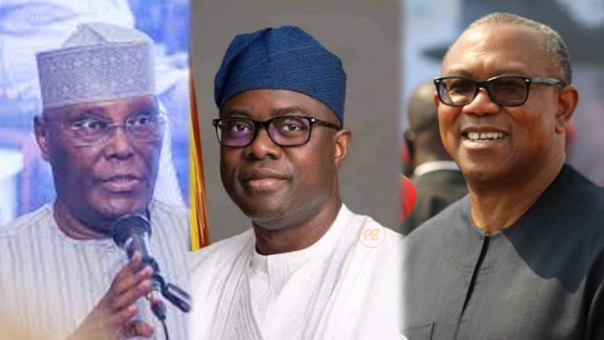
Atiku Abubakar, Seyi Makinde and Peter Obi
The week of 9–15 November ended with consultations publicly confirmed, and no common ticket or programme announced. Under the Electoral Act’s ordinary timetable, the deadline for conveying candidate withdrawals to the Independent National Electoral Commission (INEC) had already passed.
With 61 days to the presidential election, opposition leaders are bargaining over support for existing tickets and how their parties would work together. Atiku’s party faces a leadership challenge in court. President Bola Tinubu’s alliances already show how presidential cooperation can leave other ballots contested.
Mr Makinde proposed examining manifestos, past performance and public sentiment in his Friday interview with ARISE News, reported by PUNCH. The Oyo governor is himself the Allied Peoples Movement (APM) presidential candidate.
He declined to endorse a preferred candidate and identified no agreed selection method. An important part of the process therefore remains unspecified: who compares the candidates’ records and support, and how the contenders accept a decision.
On Sunday, PUNCH reported more specific Atiku–Makinde discussions, citing unnamed figures who said representatives had held meetings and reached compromises. The paper distinguished those discussions from the broader consultations about a common opposition candidate.
Oyo Information Commissioner Dotun Oyelade said Mr Makinde was open to such cooperation. African Democratic Congress (ADC) spokesperson Bolaji Abdullahi and Atiku campaign official Phrank Shaibu confirmed that discussions were ongoing.
Other candidates have offered conditional cooperation. On Tuesday, Peoples Redemption Party (PRP) candidate Donald Duke said he would accept a democratically agreed opposition choice. He wanted agreement on a national programme before choosing its presidential standard-bearer and expected the same acceptance if he emerged as the choice.
Osa Director, the NDC’s national publicity secretary and its campaign’s director of communication and media, put his party’s preference plainly in Sunday’s telephone interview. It wanted support for Mr Obi and running mate Rabiu Kwankwaso.
“Everybody can coalesce around the candidacy of Obi and Kwankwaso,” he said.
He could not confirm a formal proposal or NDC participation in the reported Atiku–Makinde discussions.
INEC’s published October presidential list records separate tickets: Atiku and Rotimi Amaechi for the ADC, Obi and Kwankwaso for the NDC, and Makinde and Lawal Daura for the APM. Those nominations involve running mates as well as the presidential contenders conducting consultations.
The Electoral Act 2026 published by the National Assembly requires a candidate’s signed withdrawal and affidavit to reach INEC through the nominating party no later than 90 days before polling. For the commission’s 16 January election date, that point was 18 October.
Section 33 limits substitution to death or withdrawal and prescribes another primary. Section 81 makes a merger a separate process requiring nine months’ notice and INEC approval.
An endorsement can direct supporters towards an existing candidate without replacing the party’s nominee. Replacing a nominee or formally merging parties requires separate legal procedures. The negotiators have not disclosed an attempt to carry out either process.
Those ordinary procedures are separate from the ADC litigation. Courts can determine an existing nomination dispute; a political agreement alone does not amend INEC’s list.
Any announcement needs to identify the ticket being supported and the instructions each party will give its supporters. Agreement among presidential contenders also has to account for their running mates and their parties’ candidates for other offices.
Last Monday’s State of the Race examined the threat to Atiku’s nomination after Justice Peter Lifu’s 5 November judgment invalidated the David Mark-led ADC leadership and decisions taken under it. This week, attention turned to INEC’s response and the rival officials claiming authority to act for the party.
A 68-page published copy of the judgment, inspected for this edition, specifies the restrictions. Order 4 invalidates official acts by Mr Mark, Rauf Aregbesola and the other national officers covered by the case, dating from 29 July 2025. Orders 7 and 8 restrain INEC from dealing with them as national officers and restrain them from acting in those positions.
The ten final orders on pages 64–67 do not name Atiku or expressly direct INEC to remove every ADC nominee. The legal risk concerns how the broad invalidation of official acts applies to the party’s primaries and nominations.
Order 5 directs INEC to recognise Nafiu Gombe as the sole elected member of the National Working Committee entitled to supervise the party’s affairs. It does not expressly appoint him national chairman.
On Wednesday, INEC National Commissioner Mohammed Haruna described the commission’s review process. Its legal department would examine the certified judgment, advise a committee and place recommendations before the commission. At that point, he said, INEC was awaiting the certified copy.
The ADC received the certified judgment on 11 November, according to PREMIUM TIMES’ Friday reporting.
ADC lawyer Kalu Kalu argued on Channels Television that the ruling did not cancel Atiku’s candidacy. The dispute concerns the consequence of the court’s broad wording for nominations; the absence of a candidate’s name from the orders does not settle that consequence.
In a telephone interview reported by P.M. News on Thursday, Mr Haruna said INEC could consider the matter after its chairman’s return, possibly on 17 November. He stressed that no definite meeting date had been fixed.
On Saturday, officials aligned with former ADC deputy national chairman Nafiu Gombe demanded that Atiku stop campaigning. Their communiqué invoked the judgment and claimed a mandate from the six zonal leaderships.
Mr Gombe himself offered conditional reconciliation in a Saturday BBC Hausa interview reported by PUNCH on Sunday. He made reconciliation conditional on what he described as the party’s membership and leadership requirements. The offer leaves room for political talks within the ADC as the legal challenge continues; no settlement with Mark was announced.
Two ADC officials confirmed to PREMIUM TIMES on Monday that the party had not obtained a court order granting a stay.
Phrank Shaibu, director of strategic communication of the ADC Presidential Campaign Council, replied to a request for an order:
“None for now, but there are applications for Stay and injunction pending in the FHC and Court of Appeal.”
He argued that those applications should be decided before INEC takes further steps.
ADC National Publicity Secretary Bolaji Abdullahi separately answered “No” when asked whether the party had secured an order stopping the 5 November judgment.
He said the ADC had appealed, sought a stay and informed INEC of the proceedings. Mr Abdullahi suggested that filing an appeal itself sufficed as a stay.
Section 17 of the Court of Appeal Act, however, provides that an appeal does not itself operate as a stay of execution.
The Court of Appeal Rules 2021 separately restrict enforcement while certain qualifying stay applications await determination, subject to specified conditions. The filed processes were not supplied for this report, so it was not possible to establish whether those conditions apply here.
Mr Shaibu’s expectation that INEC should wait is therefore the campaign’s position, not confirmation of a court order granting interim relief.
Mr Abdullahi said he had no information about a written INEC response because the party’s legal department was handling its correspondence.
Defending Atiku’s nomination, he said the candidate was selected in a nationwide direct primary by party members rather than appointed by Mr Mark and Mr Aregbesola.
“It wasn’t a decision taken by David Mark and Rauf,” he said.
Whether that primary can be separated legally from the official acts invalidated by the judgment is still at issue. Neither official furnished a stay order or an INEC written decision during the exchanges.
Authority is disputed within state structures too. The Ogun ADC rejected purported caretaker arrangements on Saturday and defended the executive led by Oluwafemi Soluade.
The national case and the Ogun complaint concern different decisions. Both involve officials asserting the authority to organise the party. A national agreement would have to reach the local executives and candidates expected to carry it out.
INEC’s press index dates its assembly-list update to 14 November. The attached Katsina list names ADC nominees, including Alhassan Sa’idu for Bakori. That is an official candidate record for a different election, not an explanation of how the commission will apply the judgment to Atiku’s ticket.
INEC must give effect to the operative orders and any later judicial relief. No separate written implementation decision was found in the official material checked for this edition. For a prospective alliance, the outstanding administrative issue is who can authorise the ADC’s dealings with the commission.
The campaign continued seeking votes for its own ticket. At Saturday’s Bauchi rally, Amaechi predicted ADC victories across the North-east and North-west, but also said one South-west state would vote for the APM. His regional forecast included both parties, with no accompanying announcement of a joint campaign.
Anambra provides an existing example of cooperation across party lines. At the All Progressives Grand Alliance’s (APGA) 6 November launch, Governor Chukwuma Soludo combined support for Mr Tinubu with the presentation of flags to 44 legislative candidates.
The state government’s account records both positions. APGA’s candidates would seek votes for their party as their governor urged supporters to vote for the All Progressives Congress (APC) president.
In Osun this week, APC leaders held a campaign walk on Saturday and promoted a two-million-vote campaign target for Mr Tinubu. Bola Oyebamiji described a good relationship with Accord and welcomed cooperation.
The Osun comments described an opening for cooperation with Accord, without setting out a shared slate of candidates. APGA’s arrangement shows why the distinction matters: support for Tinubu can coexist with legislative campaigns under another party’s banner.
In Ondo, a Saturday PREMIUM TIMES report examined the absence of flag presentations to 12 National Assembly and 26 state assembly candidates at Wednesday’s Akure presidential rally.
Party spokesperson Steve Otaloro attributed the omission to the national leaders’ tight schedule and promised another opportunity at a zonal launch. Information Commissioner Idowu Ajanaku said the presidential campaign council controlled the programme.
For the candidates passed over, the immediate issue was securing the party’s public support for their own races. Otaloro’s promise of a later presentation offered a specific action they could hold the party to.
APC campaign official Sola Adeyeye defended broad electoral alliances in a Sunday PUNCH interview. He argued that winning an election and running a government were different tasks.
The candidates are also making commitments that any common programme would have to reconcile. The week’s announcements gave substance to Makinde’s proposal to compare manifestos.
The APC unveiled its 2027–2031 manifesto on Tuesday, setting targets including six per cent annual growth, 10,000 megawatts of electricity generation and 20,000 additional teachers. Party leaders defended the administration’s reforms as a basis for improved living conditions.
Atiku renewed his fuel and electricity subsidy pledges in Bauchi on Saturday. His campaign’s earlier explanation proposed targeted support for locally refined petroleum products, including discounted crude as a possible mechanism.
The electricity pledge needs to account for support already in the tariff system. The Nigerian Electricity Regulatory Commission’s second-quarter report records a federal subsidy obligation of ₦321.26 billion for April–June 2026.
That is an incurred obligation, rather than confirmation that the amount was paid. Additional support would require decisions about beneficiaries, tariffs and financing.
Makinde’s published Reset Agenda emphasises reducing the structural cost of living through transport, energy and infrastructure, alongside security coordination and stronger public institutions.
The website proposes roads connecting farms, markets and businesses, with performance measured through journey times and logistics costs. It also describes intelligence sharing and early warning as security priorities.
Atiku proposes support for local refining to lower fuel prices; Makinde emphasises the transport and energy costs built into production and distribution.
A common programme could combine them, but it would have to explain how spending on fuel subsidies relates to investment in the systems expected to reduce costs. Agreement on that balance would give voters a policy choice to assess alongside the choice of candidate.
Election-day organisation currently runs through the separate parties. In an 8 November PUNCH report, Osa Director described NDC agent recruitment involving state chairmen, secretaries and candidates, with candidates having the final say where disagreements arose.
Governorship and legislative candidates also organise their own contests. Pooling resources for the presidential campaign would require agreement on which costs are shared and which remain with local candidates.
The national negotiators would have to secure cooperation from the people responsible for recruitment, transport and payments on the ground.
INEC’s polling-agent portal shows the formal process. The commission issues an access code to each national party chairman for authorised officials to upload agents. Each nominated agent needs identification, a photograph and a polling-unit assignment.
The platform says duplicate nominations across parties are flagged.
Joint recruitment would still need to result in submissions by recognised parties. A working arrangement should settle who trains the agents, who authorises the upload and which campaign collects their reports.
The chairman’s access-code role makes the identity of authorised officials important.
The NDC’s Lagos meeting was reportedly disrupted on Thursday. In a separate Friday statement, Tinubu promised that all parties could campaign without intimidation and directed security agencies to confront thuggery.
Supporters and agents need that protection to do the work any political agreement assigns to them.
INEC’s portal displays an upload deadline of 11.59 p.m. on 10 December, 24 days after this edition’s publication.
For cooperation to reach polling units, partners will need named, authorised agents accredited for the ticket they support.
- atiku
- makinde
- state
- race
- ballot
- adc
- crisis
- talk