Burnham says Brexit has dramatically diminished Britain’s global standing
Prime minister signals Labour could drop its Brexit red lines in major foreign policy speech Britain’s global standing has diminished in the decade since Brexit, Andy Burnham has said, as he again signalled that Labour could drop its red lines on Europe in its next manifesto. In a foreign policy speech, Burnham said that after a major Brussels summit this week he would begin new discussions with the EU about options for “our long-term relationship”.
Prime minister signals Labour could drop its Brexit red lines in major foreign policy speech
Britain’s global standing has diminished in the decade since Brexit, Andy Burnham has said, as he again signalled that Labour could drop its red lines on Europe in its next manifesto.
In a foreign policy speech, Burnham said that after a major Brussels summit this week he would begin new discussions with the EU about options for “our long-term relationship”.
However, the prime minister warned the process would take time and – amid concerns among some cabinet ministers that reopening Brexit divides could be a mistake – insisted that “at every stage the British people will be the boss”.
Burnham is expected to begin setting out the broad options for forging a closer relationship, including a customs union, the single market and fully rejoining.
He will stress that Labour will do nothing to cross its red lines this side of the next general election, with some inside government suggesting he should “press the brakes” a little on reversing Brexit rather than rushing ahead.
Downing Street sources said Burnham wanted to “frame the debate” rather than pushing automatically to an end point. However, they admitted he had potentially made that more difficult by setting out his personal preference to rejoin the bloc.
Supporters of Brexit have in recent days founded two separate campaign groups aimed at keeping Britain out of the EU, should Burnham seek to rejoin, while former prime ministers Boris Johnson and David Cameron – on opposite sides of the Brexit debate – cautioned against the move.
Burnham is due to meet European leaders at the Brussels summit on Friday to secure agreements he says could raise GDP by 0.4% – about £17bn – including on food and farming, emissions trading and a youth mobility scheme.
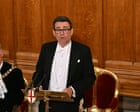
Speaking at the lord mayor’s banquet in the City of London, he reiterated that the UK’s existing deal with the EU had not been good enough, likening it to the “emperor’s new clothes” where nobody was prepared to say the truth.
“After the summit, we will initiate a discussion with our EU partners about options for our long-term relationship, recognising that both Britain and the EU are very different to what they were,” he said.
“This will take time, and we will present those options and our assessment of them to inform decisions in the next parliament. At every stage, the British people will be the boss.”
In his speech, the prime minister accused previous governments of treating the UK’s allies, stretching beyond Europe, with “insufficient care” that had damaged the UK’s international standing.
“In the decade since Brexit, our standing in the world has diminished. We treated both allies and institutions with insufficient care, and the effects went beyond Europe,” he said.
The UK had failed to invest in the modernisation of the Commonwealth and “blew hot and cold” in relations with China, he said, before criticising the approach taken to Israel before he became prime minister.
“In the Middle East, while Britain rightly condemned Hamas and the appalling attacks of 7 October, our response to what followed in Gaza left many questioning our moral compass,” he said.
“We created the impression that the Britain the world thought it knew had changed. It hadn’t. The people of this country are still as great and decent as they ever were, but the political turbulence of our times created the impression that we had changed, causing confusion.”
Meanwhile, a key European politician said the UK would not be “in the room” to help write new European legislation on food and drink and will remain a rule-taker until it joins the single market. The UK is asking for some role in “shaping” European legislation as part of an agri-food and drink deal expected to be sealed at the summit on Friday. But Sandro Gozi, chair of the EU-UK parliamentary delegation, said it could not be a decision-maker under the existing relationship. “The UK decided to leave; Brexit was the decision to get out of the decision-making. It cannot be that the UK is around the table over the elaboration and discussion of the standards because that is reserved for member states.” Gozi said the UK might get some “consultative role” like Switzerland. “Andy Burnham is right in trying to fully exploit the potential of the current situation. But there are some limits and this is a big limit,” he said.
The MEP added that the food and drink deal would show the UK “sooner rather than later” that “the status quo has concrete limits, concrete constraints that you can overcome only if you go over, if you get rid of, the red lines”.
- burnham
- brexit
- britain
- standing
- labour
- line
- policy
- speech