APEC summit: Xi, Trump and Putin gather in Shenzhen, China
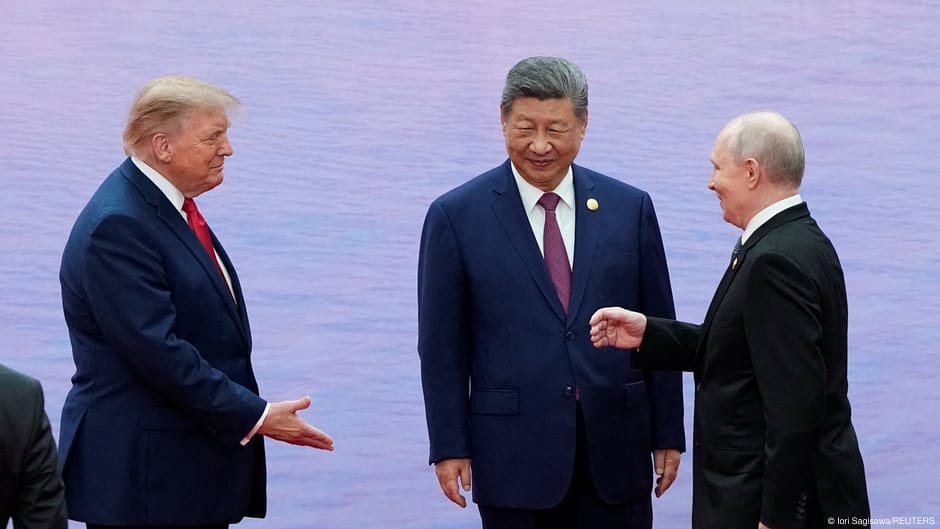
The presidents of China, Russia and the US have greeted each other amid the APEC summit in Shenzhen. This comes a day ahead of the trilateral talks between Xi Jinping, Vladimir Putin and Donald Trump.
Here are the biggest headlines from Trump's Asia tour on Wednesday, November 18:
The presidents of the US and Russia have shaken hands in their first in-person meeting since August 2025, when Putin was invited to Alaska for talks primarily concerning Russia's invasion of Ukraine.
Donald Trump and Vladimir Putin shook hands in the presence of host Xi Jinping ahead of the leaders' welcome banquet at the APEC summit in Shenzhen.
The meeting follows a rare sign of progress in the US-led efforts to broker an end to the war between Russia and Ukraine, a conflict Trump repeatedly claimed he would settle in "a day" if reelected.
Talks took place last week in Abu Dhabi involving Russia, Ukraine and European representatives, with Trump's negotiating team subsequently traveling to the Kremlin for a meeting with Putin and other Russian officials.
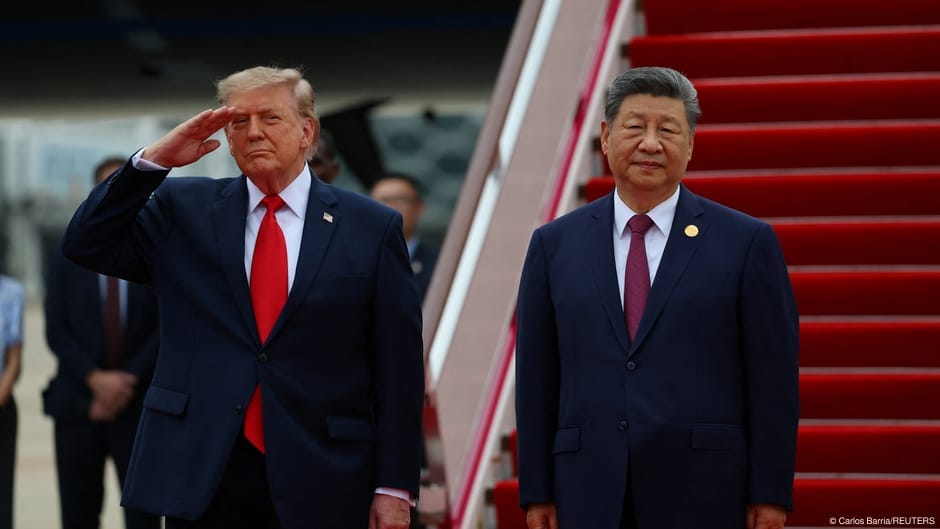
Trump's arrival was highly choreographed: He descended from Air Force One and stood on a red carpet lined with people waving colorful pom poms. Trump and Xi hugged before shaking hands.
The White House, other countries and Donald Trump himself have all listed possible or probable bilateral or multilateral talks involving the US president on the sidelines of the APEC summit in Shenzhen, beyond Thursday's highly-anticipated US-China-Russia meeting.
Some of the more notable examples are listed here:
Chinese news agency Xinhua has reported the first comments from Xi Jinping to Donald Trump following his arrival.
"I look forward to an in-depth exchange of views with you on major issues concerning China-US relations, Asia-Pacific cooperation, and the global landscape," Xi told Trump.
He said the talks would take place "with the aim of advancing a constructive, strategically stable relationship between our two nations — one built upon the foundations of mutual respect, fairness and reciprocity."
Despite Trump and Xi's efforts to regularly hold friendly face-to-face talks in recent months, the US and China are nevertheless embroiled in difficult trade negotiations as the two superpowers try to reconcile competing interests on various issues.
The two sides have been periodically extending a temporary tariff truce designed to bridge the gap until they can reach a more permanent agreement, which for now has proven elusive. China announced the most recent extension earlier this month, to run until early January.
The interim CEO of US chip giant Nvidia says the company is not currently shipping Hopper-generation data center products to China.
These are some of the most advanced Nvidia products licensed for export by the US government; the company had sold such goods worth $2.4 billion (roughly €2.2 billion) in the previous quarter, Colette Kress said.
Kress replaced Jensen Huang following his resignation last week and amid the scandal over alleged Chinese attempts both to gain intelligence on the company's CEO and to circumvent import restrictions.
"Our guidance does not have any licensed Hopper data center products included, and we are no longer shipping licensed Hopper data center products to China," Kress said.
She did not specify why such deliveries had currently stopped or say whether the step would be permanent.
Huang was influential in persuading Donald Trump to allow sales of H200 Hopper processors used to train and run advanced AI models to China, reversing export controls the US had imposed in 2022 under Trump's predecessor Joe Biden.
China has called the allegations of espionage targeting Nvidia unfounded and threatened to respond in kind if restrictions on trade follow as a result of the fallout from Huang's resignation.
US President Donald Trump has landed at Shenzhen Airport on Air Force One and disembarked.
He left Manila in the Philippines a few hours earlier.
Trump will be attending the APEC summit but is also expected to take part in a three-way meeting with Russian President Vladimir Putin and Chinese President Xi Jinping on Thursday.
Xi greeted Trump at the airport on Wednesday, mirroring a gesture Trump had recently extended during the Chinese leader's state visit to the US in September.
Sanae Takaichi arrived in China for the APEC summit, which is also her first official visit to the country as Japanese prime minister.
Takaichi's moves to bolster Japan's military and comments last year on Taiwan have upset Beijing and severely affected bilateral ties.
In particular, Takaichi's suggestion that Tokyo could intervene militarily if Beijing sought to forcibly take Taiwan — which China considers its territory — led to friction between the regional rivals with a troubled 20th century history and ongoing territorial disputes.
China imposed trade restrictions and urged citizens not to travel to Japan, which had become an increasingly popular tourist destination. Traffic is down by roughly half this year as a result.
A formal one-on-one meeting between Takaichi and China's Xi Jinping is considered highly unlikely, but Japan's NHK public broadcaster did report that Xi would "personally greet her" before Wednesday's banquet.
The leaders of China, the United States and Russia are due to hold their first trilateral meeting on the sidelines of the Asia-Pacific Economic Cooperation (APEC) summit this week.
Separately, US President Donald Trump will also hold talks with Chinese President Xi Jinping during the November 18-19 gathering in Shenzhen, China.
With different priorities on trade, Ukraine, Iran and arms control, what does each leader hope to gain?
Read DW's full report on what Trump, Xi and Putin are hoping to extract from the trilateral talks.
Canada and China are moving to give each other's financial firms greater access to their markets, Canadian Prime Minister Mark Carney said during a speech at the APEC summit.
"When our businesses depend on too few currencies or single payment channels, disruption, when it comes, can spread quickly," he said, adding that China and Canada had renewed the currency swap arrangement between their central banks and were issuing each other's currencies.
Carney's comments came a day after Carney and President Xi held talks in Shenzhen to produce deals to further reduce tariffs. Ottawa is re-engaging with China after years of strained relations as it looks to reduce its reliance on the US.
President Trump on Wednesday said that the US has just concluded a "very big trade deal" with the Philippines, albeit without providing details. Manila has not yet confirmed any agreement.
"We've just consummated a very big trade deal, the biggest trade deal we've ever made so far, and it is a fair deal for both countries," Trump said during a state luncheon at the Philippine presidential palace.
"We were very happy with that, and we didn't know that was going to take place, but it took place very quickly and it's a magnificent deal for both," he said.
Trade negotiations were not listed in the schedules provided by Washington or Manila.
The Philippines' ambassador to the US, Jose Manuel Romualdez said, "The US offered for us to diversify our food supply and energy requirements."
However, Romualdez told Reuters that nothing had been signed.
The two-day APEC summit has kicked off in China's southern city of Shenzhen. DW's Rik Glauert in Taipei offers a preview of what host, Xi Jinping, is hoping to achieve.
President Xi pledged to stand against trade protectionism in his speech at the APEC summit on Wednesday, in a subtle slight towards the United States and the trade war waged by its president.
Xi urged support for what he called "free and open trade," trying to portray his country as a stable partner on the global stage in contrast with its main economic rival, the US, which has raised tariffs under President Trump.
His remarks came after Washington announced further restrictions on China's access to advanced AI chips from companies such as Nvidia, further complicating a trade truce between the two superpowers.
Xi urged that China and Russia, together, take concrete measures to further cooperation and "lead and advance the trend toward a multipolar world."
Chinese and Russian news agencies reported at around noon on Wednesday that Xi and Putin had met for talks. That's the fifth time the two leaders have met this year, including once by video link.
Russian President Vladimir Putin on Wednesday said he expected major benefits from his upcoming trilateral meet with US President Donald Trump and Chinese President Xi Jinping.
Speaking at the opening ceremony of the APEC summit, Putin called for partnership over isolation, citing a fragmented global economy and military-political risks.
"I therefore expect big potential benefit from the upcoming trilateral meeting between the leaders of Russia, China and the United States, which is scheduled to take place on the sidelines of the APEC summit," Putin told the summit.
The Russian leader held bilateral talks with Xi ahead of the pair's trilateral talks with Trump on Thursday.
Putin said Chinese and Russian foreign policy was working "steadily and positively on the international stage."
Taiwan's presidential office said that it was in close contact with the US ahead of meetings on the sidelines of the Asia-Pacific Economic Cooperation (APEC) summit in Shenzhen.
US President Donald Trump is set to arrive in China on Wednesday.
Trump is then scheduled to take part in a highly anticipated trilateral meeting with Chinese President Xi Jinping and Russian President Vladimir Putin on Thursday.
Taiwan "views positively any effort that helps manage the risks of authoritarian expansion and contributes to regional security and stability," office spokesperson Karen Kuo said in a statement.
This comes amid heightened tensions between Taipei and Beijing.
China has refused to talk to Taiwanese President Lai Ching-te, whom Beijing sees as a staunch separatist. Lai has defended Taiwan's right to self-rule.
China's President Xi Jinping on Wednesday called for more international cooperation on AI and "free and open" trade.
Xi made the remarks as he opened a meeting of the Asia-Pacific Economic Cooperation (APEC) in Shenzhen, southern China, where he is expected to meet US President Donald Trump and Russia's Vladimir Putin, who landed overnight, on Thursday.
Trump is due to arrive in Shenzhen later on Wednesday.
"We must firmly uphold the rules-based multilateral trading system with the World Trade Organization at its core, support free and open trade and investment, maintain the stability and smooth operation of global industrial and supply chains," Xi said.
"We should actively build partnerships for scientific and technological innovation, deepen cooperation in the digital economy and artificial intelligence and promote a green and low-carbon transition," the Chinese leader said.
Trade tensions have loomed over the world's two largest economies as the summit neared.
Trump's wide-ranging tariffs have disrupted global trade.
China has responded with its own import levies and has threatened to withhold crucial exports.
- apec
- summit
- trump
- putin
- shenzhen
- china
- president
- russia