The Xi-Putin-Trump summit will not be a ‘new Yalta’

The three leaders have divergent geopolitical goals and visions for the world order.
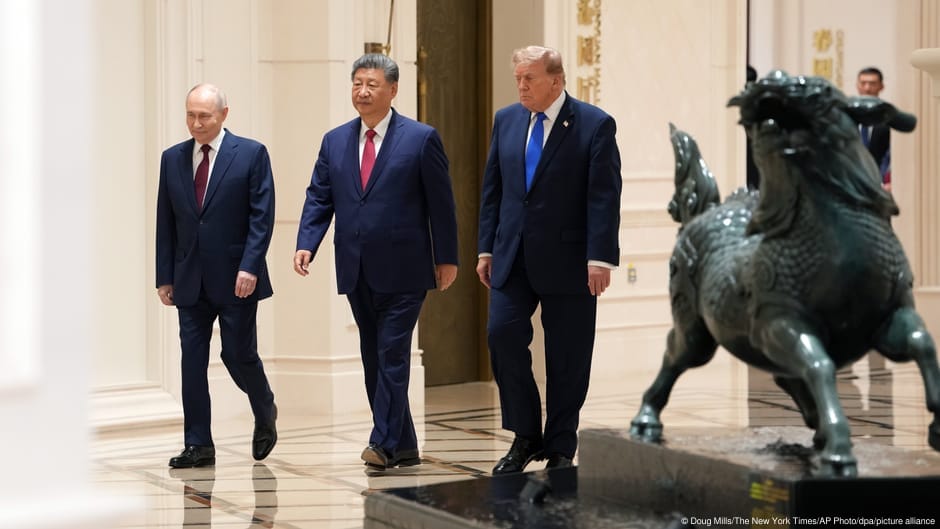
On November 19, the leaders of China, the United States and Russia will gather for a trilateral meeting in Shenzhen on the sidelines of an annual Asia-Pacific Economic Cooperation (APEC) summit. The three have never met for formal trilateral talks, and some commentators are already calling the meeting “historic”.
In Moscow, many observers see the gathering as a “new Yalta” – another conference to divide the world into spheres of influence, similar to the one held in 1945 between Britain, the USSR and the US.
This thinking reflects Russian President Vladimir Putin’s own worldview. It is perhaps unsurprising that he was the one to propose the trilateral meeting during a call with US President Donald Trump in October.
A “new Yalta”, however, appears to be more of a case of wishful thinking than a realistic possibility. In 1945, the Soviet Union, the US and Britain came together after emerging victorious from the second world war, in which they fought against a common enemy. Today, not only do they find themselves on opposing sides of various conflicts and disputes, but they also seem to disagree on how the world should run.
While all three powers speak of a new, multipolar world and formally reject the language of hegemony, they seem to have divergent understandings of what that means.
Moscow, for example, seeks to establish itself as one of the poles in a multipolar world and a regional leader in Eurasia.
Washington, on the other hand, wants to secure its status as the pre-eminent power, while Beijing remains preoccupied with pulling the Global South away from US leadership.
Therefore, the US and China are championing a bipolar system – a world shaped by the “G2” as Trump calls it – which Russia might be unhappy with but has no means of stopping.
This disparity of aspirations is also apparent at the economic level. While Russia has chosen a path towards archaisation and opposes almost any manifestations of progress, the US and China are leading the world in technological innovation and competing in spheres such as semiconductor production, mobile communications, space exploration, robotics, biotechnology and, most recently, artificial intelligence (AI). In all these spheres, Russia has fallen behind not years, but decades.
These divergent visions are reflected in the apparent disagreement over what this summit should be about.
Trump has said he would prefer to address nuclear disarmament, a topic that is unpopular in China given that it has the smallest nuclear arsenal of the three countries. Russia, too, is not very eager given that it is relying on its nuclear arsenal as the last remaining element of its great-power status.
Putin, on the other hand, wanted to focus the summit on the settlement of the Ukraine war without the Ukrainians and Europeans present. Yet, it is unclear what can be achieved in a sit-down with Trump and Xi Jinping, given Putin’s maximalist demands.
As the recent consultations in Abu Dhabi and Moscow demonstrated, the Russian president wants profound changes to the current European order that simply cannot be secured because they would be in violation of international law.
Even if a rollback of NATO might appeal to China, Putin’s insistence on violating the principle of sovereignty would be too much for Beijing. Therefore, I cannot imagine President Xi willingly engaging in discussions that are bound to face a dead end.
Instead of entertaining his guests’ unrealistic agendas, Xi is likely to yield to no more than a general declaration on cooperation and common understanding.
For him, the summit is a long-awaited – and much-deserved – foreign policy triumph, and an acknowledgement of China’s standing in the world.
After all, he will be hosting the leaders of the two states that Beijing had looked up to as superpowers for the better part of the last century. From the late 1940s, China was highly dependent on the USSR, and even after the Mao-Khrushchev break, it replicated many Soviet policies and technologies.
Then with the launch of market reforms in the late 1970s, Beijing gradually became the most talented disciple of the US-led West, masterfully convincing the Americans that its economic rise would benefit everyone while capturing global markets through formal acknowledgement of World Trade Organization (WTO) rules and intellectual property laws.
In this sense, it is highly symbolic that China welcomes the leaders of Russia and the US at a time when it dominates global manufacturing and trade, has the fastest-growing economy of the three powers, and is a frontrunner in the global technology race.
There is also quite the contrast between the level-headed Xi and his US and Russian counterparts, whose irresponsible policies have dragged their countries into disastrous wars they cannot win or get out of.
In the end, the summit may lay the foundations of a new trilateral format between China, the US and Russia. Each leader may have their own reasons to maintain it: Trump would like to continue with his unilateral policies, sidelining traditional allies; Putin desperately wants to become a part of something reminiscent of the old times when Moscow was a superpower; and Xi might use this format to institutionalise a G2+1, knowing that the +1 – Russia – will be dropped after the Ukraine war ends and the world’s attention to the Kremlin diminishes.
Yet, little of substance would come out of these meetings. These would not be venues where the pressing issues of the world would be resolved.
And in any case, Xi, Trump and Putin may not be capable of resolving them. After all, they belong to an outgoing generation of policymakers representing a world captured not so much by powerful ideologies or leadership aspirations, but rather by memories, nostalgia, old phobias and prejudices.
In the coming years, it may happen – as it did after the “old Yalta” – that they no longer occupy positions of power and a new generation will take their place, leading the world into a better future.
The views expressed in this article are the author’s own and do not necessarily reflect Al Jazeera’s editorial stance.
- summit
- yalta
- putin
- trump
- leader
- goal
- vision
- world