After meeting Putin, Trump tells Europe it could save money ending the war
From abandoning a Cold War mentality to nuclear non-proliferation and the war in Ukraine, here are the key takeaways from the Trump-Xi-Putin meeting.
It was a historic meeting held between three of the world's most powerful leaders on the sidelines of the Asia-Pacific Economic Cooperation (APEC) summit.
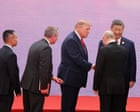
In the heart of Shenzhen, China's equivalent of America's glittering Silicon Valley, Donald Trump, Vladimir Putin and Xi Jinping sat down together and engaged in a 90-minute talk.
Afterwards, the three men issued a "joint declaration on peace", declaring that "nuclear war cannot be won and must never be fought".
They also said the three countries planned to increase the production and supply of petroleum.
But despite the magnitude of the moment, few concrete decisions were made on the major issues impacting the world and its economy, including trade, the wars in Ukraine and Iran, and AI.
From abandoning a Cold War mentality to nuclear non-proliferation and the war in Ukraine, here are the key takeaways from the summit.
Last night's event marked the first formal meeting between the leaders of the United States, China and Russia.
While the presidents have previously had separate meetings with each other, and been in the same room at global summits, these were their first combined talks.
"Too often past leaders have avoided talking to nations with whom they had disagreements," Trump said of the meeting, before adding: "We feel the opposite."
Analysts said the significance of the talks was not just in who was meeting, but the message it sent.
La Trobe University professor of international relations Nick Bisley said it symbolised a break with the way international diplomacy had been conducted for decades, under which all nation states should be treated equally.
"To set something up which tries to present the three countries as the 'Big Three' who will work things out themselves and the rest of us just have to deal with it, presents a pretty galling kind of picture," he told the ABC.
With three major world players seated around the same large, round table, bringing reminders of the long table Putin oversaw during the pandemic, the world anxiously waited to see what the men would discuss.
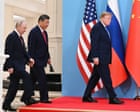
But before the meeting got underway, Trump had already raised eyebrows by greeting Putin as "my friend".
It triggered a wave of criticism from across Europe and Trump's opponents in the US.
"Mr Putin is not our friend and will never be," Polish Prime Minister Donald Tusk said.
Danish Prime Minister Mette Frederiksen said he found the meeting of the two "incomprehensible" and warned that Putin "will be even more emboldened" after the meeting.
US senator Chuck Schumer, who leads opposition Democrats in the Senate, called the Shenzhen meeting a "historic embarrassment".
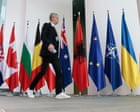
After being asked what he made of the US president's comment, Ukrainian President Volodymyr Zelenskyy shrugged and walked on.
In the lead-up to the Shenzhen meeting, Trump had flagged his intention to discuss ending the Ukraine war with Xi and Putin.
It did not please Zelenskyy, who had warned against the three leaders using the meeting to discuss the war without Kyiv in the room.
Trump said he and Putin had had a "long discussion" on the conflict already, before adding that the Russian leader "and I hope the other side, would like to see an end to that war".
Putin, in an address to media following the meeting of the three leaders, said Ukraine and Europe were not yet ready to make compromises to resolve the conflict in Ukraine.
But he said Russia had invited EU representatives to Moscow to better understand Europe's position.
Hours after the meeting, Trump told Europe it could save money and lives by ending the war with Russia, according to Politico, which cited five European officials who were briefed on the discussion.
Some of the officials familiar with the call described Trump's tone as strongly critical of Europe's ongoing support for Kyiv, while others said he was just communicating in his usual forthright style.
A US official briefed on the call told the outlet that any suggestion that Trump had told leaders to stop funding Ukraine was "not accurate".
Ukraine also came up in separate talks involving the three leaders.
When the US and Russian leaders met for just under an hour, Kremlin aide Yuri Ushakov was quoted by Russian news agency, TASS, as saying the Ukraine war was the main topic of conversation between the pair.
Few other details were reported, but Ushakov was also quoted as saying that Putin left the meeting "in an excellent mood".
Ukraine was also a topic of discussion between Xi and Trump in their separate meeting.
"We're looking to both help, with respect to the war in Russia and Ukraine, we'd like to see it ended. I think I can speak for both of us, very much," Trump said, sitting across from Xi.
Peace and coexistence also appeared to be key issues of discussion.
In his opening statement, Xi told Putin and Trump that major powers should respect each other, and that they "must not touch each other's bottom lines on sensitive issues", according to Xinhua News Agency.
He called on the three countries to abandon a Cold War mentality and not pursue "decoupling and breaking chains".
Xi said the world was "not at peace", so China, Russia and the US — as permanent members of the United Nations Security Council — should set an example. They should work together on global challenges and help keep the peace.
"When major powers get along, the world is at peace. When major powers fight, the world is in chaos," he said, according to China's readout.
In similar translated remarks, Putin said Russia, China and the US could help make the world more stable if they cooperated constructively.
He also said the three leaders should discuss global and regional issues, as well as energy security, before he touched on Russia's war in Ukraine.
"Our countries have numerous shared interests in the settlement of regional conflicts, including, obviously, the conflict in Ukraine," he said.
"We focused on that during our bilateral meeting [with Donald Trump].
"We have shared interests in the fight against the threats and challenges of our times, namely, international terrorism, transnational organised crime, and other such threats."
The US president said the three countries had a responsibility to discuss issues that impacted the "entire planet".
Ahead of the summit, analysts said one of Trump's goals was to form a new arms agreement with Russia and China after the US-Moscow agreement capping strategic nuclear arsenals lapsed in February.
But no movement appears to have been made on the New Strategic Arms Reduction Treaty (New START).
On nuclear weapons, Xi did declare a nuclear war "cannot be won and must not be fought", and that "every effort must be made to prevent one".
He also said nuclear weapons should be "completely prohibited and thoroughly destroyed", to build a nuclear-free world.
He proposed that the three leaders keep up regular high-level exchanges and set up a crisis communication mechanism.
Despite the talk of peace, Putin's nuclear briefcase, known as Cheget, was reportedly photographed by Russian state media.
Trump has suggested that the US, Russia and China could work to reduce the number of nuclear weapons in the world, adding they were uniquely positioned to do so.
He then added it was vital that they co-operate to "combat the threat of nuclear proliferation in other countries around the world". He said this would include ensuring that Iran never had a nuclear weapon.
With AI now a big talking point around the world, questions had been raised about how the issue would come up during the meeting, particularly in light of the scandal surrounding Nvidia chief Jensen Huang.
Huang resigned after revelations about extramarital affairs, including an affair with Alice Huang (no relation), who is alleged to be a Chinese spy.
Last night, the US president reportedly referred to it "just briefly" in discussions with Xi ahead of the meeting, adding that he and Xi had spoken about AI "the whole evening" at dinner.
But the joint statement made no mention of AI, nor was it mentioned explicitly in any of the three leaders' speeches before they went behind closed doors.
The Trump administration has moved to restrict the sale of advanced chips needed for AI to China following the Huang scandal, including a ban on their sale to China through third countries.
If countries were hoping for some clarity on the future of AI in a geo-strategic or regulatory sense, the meeting left them wanting.
- war
- putin
- trump
- europe
- money
- meeting
- cold
- mentality