NFL legend John Madden’s unlikely, unfiltered brilliance: ‘Coach was indeed animated’
With the release of a new David O Russell biopic about the coach turned commentator turned gaming icon, those who knew him best remember his singular career Wearing his Oakland Raiders uniform and helmet, and gripping an orange traffic cone like a lance, Ted Hendricks rode into the training session on a roan horse and stopped at the 50-yard line. All Coach said once I dismounted was, ‘All right guys, Ted’s here, let’s get started.’
With the release of a new David O Russell biopic about the coach turned commentator turned gaming icon, those who knew him best remember his singular career
Wearing his Oakland Raiders uniform and helmet, and gripping an orange traffic cone like a lance, Ted Hendricks rode into the training session on a roan horse and stopped at the 50-yard line. Some American football coaches might have reacted to the stunt with fury. But John Madden was unfazed.
“We needed some relief from the intense grind,” recalls Hendricks, 79, who had borrowed the horse from a nearby stable. “It was a spur of the moment idea, but put a smile on everyone’s face. All Coach said once I dismounted was, ‘All right guys, Ted’s here, let’s get started.’ But I know he got a kick out of it too – just from the look on his face and the comments he made later in interviews.”
Madden is fondly and indelibly remembered by his former players, fans who relished his TV commentaries and a generation who grew up playing his eponymous video game. That sets a high bar for the actor Nicolas Cage who, with the help of silicone prosthetics, plays him in a new biopic co-starring Christian Bale, Kathryn Hahn, Sienna Miller, John Mulaney and Shane Gillis, directed by David O Russell.
Entitled Madden, the film tells how this unkempt, unpretentious man became a triple threat: a Super Bowl-winning coach of the Raiders under owner Al Davis; one of the most recognisable voices in American football during a three-decade broadcasting career (his signature sound effects were “boom!” and “doink!”); and central to the creation of Madden NFL, one of the most influential video game franchises in history.
When he was elected to the Pro Football Hall of Fame, Madden reflected: “People always ask, are you a coach or a broadcaster or a video game guy? I’m a coach, always been a coach.”
But first he was a player. Raised in Daly City, California, he was drafted by the Philadelphia Eagles in 1958, but an injury ended his career before he had played a professional game. Instead, Madden got into coaching, first at Allan Hancock College and then as defensive coordinator at San Diego State University.
Davis brought him to the Raiders as a linebackers coach in 1967, and Oakland went to the Super Bowl in his first year. Two years later he was promoted to become, at 32, then the youngest head coach in professional football history.
Between 1969 and 1978, Madden compiled a 103-32-7 regular season record. His 75.9 winning percentage remains the NFL’s highest for any coach with at least 100 career victories. What was the secret of his success?
In an email interview, Hendricks, a Hall of Fame linebacker who played for Madden from 1975 through 1978 and was known as “the Mad Stork”, writes from Nevada: “Coach Madden was mostly on the offensive side of the ball, but in general he was guided by his three major expectations: 1) Be on time, 2) Know your assignments and the offensive schemes of the other team, 3) Play like hell on Sunday. He was less programmed and more in tune to situational football than my other coaches.”
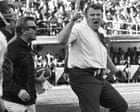
Madden became known for his touchline theatrics: shouting, gesticulating, throwing his arms around and arguing with referees. Hendricks adds: “Coach was indeed animated. I really liked that about him, just wore it on his sleeve. I think that helped him relate to our team and the individuals.
“Away from the lights he was a very caring person. He loved a great story and loved to tell great uplifting stories as well. His laughter was infectious. He appreciated the regular people and everyday fan. I think that was obvious and why so many fans could relate to him.”
Working for the intense and irascible Davis was no picnic. Drawing on his 40 years covering the NFL, Peter King, sportswriter and author of a new book, The Game, says by phone from Brooklyn, New York: “A lot of people worked for Al Davis and the vast majority of them chafed and found it exceedingly difficult. Al was a relentless perfectionist who demanded people do things his way.
“John Madden is about the only guy who understood that Al was, in his own way, a borderline genius, although an acquired taste. They worked as a great team for a decade: Al mostly getting players and being very demanding, and John realising that the only important thing was did you win or lose. All the other stuff didn’t matter all that much.”
Madden led Oakland to seven conference title games, winning Super Bowl XI in 1977. Yet the physical and mental toll was immense. He developed an ulcer, suffered acute claustrophobia and endured agonising playoff losses – not least the 1972 “Immaculate Reception” when the Pittsburgh Steelers’ Franco Harris scooped a deflected pass for a disputed touchdown.
Madden remained convinced that the ball hit the turf or bounced illegally between offensive players. He also harboured a lifelong suspicion that the NFL officiating chief, Art McNally, illegally communicated with on-field officials via a sideline telephone.
The phone in question later ended up in Madden’s California home. King, 69, reveals: “I texted him very late in his life. I said, ‘Hey, I heard you have this phone, I would love to talk to you about it.’ Madden wrote back very curtly: ‘I won’t be talking about that. Anything else?’ That was six or eight months before his death. He was bitter until he died over that game, convinced it was stolen from the Raiders.”
In 1979, aged only 42, Madden walked away, announcing: “I’m retiring from football coaching, and I’m never gonna coach again.” He never wavered, rebuffing Matt Millen’s plea to coach the Detroit Lions: “Those days are over.”
But retirement opened an even bigger chapter. Over the next 30 years, Madden became the voice of autumn, commentating on 11 Super Bowls and winning 16 Sports Emmy awards alongside broadcasting partners Pat Summerall and Al Michaels, who described working with him as “like hitting the lottery”.
For a time, Madden gave out a “turducken” – a chicken stuffed inside a duck stuffed inside a turkey – to the outstanding player in the Thanksgiving game that he analysed. He starred in numerous TV commercials and hosted Saturday Night Live in 1982.
King reflects: “In 50 years of watching games in all sports, very closely on television, he’s the best I’ve ever heard at being the guy sitting next to you in the pub. He just talks to you. He doesn’t preach. He gets excited, he yells, but he taught you a lot about football without seeming to lecture.
“He dumbed down football but he also made it so people who were smart could appreciate that he knew where to apportion blame on a play. And he got thousands upon thousands of women to like football because he was funny, relatable and understandable.”
Due to the severe claustrophobia that made commercial air travel impossible, Madden used train travel early in his broadcast career, frequently serving as an informal spokesperson for Amtrak. Later, he transitioned to traveling the country in a private, customised, 40ft motorcoach known as the Madden Cruiser.
King joined him in October 1990 for a 3,000-mile, 55-hour journey from Pleasanton, California, to New York. When they boarded the bus at noon one Wednesday, Madden told him the rules: “We don’t wait for anyone. Finish any bottle of water you start, and drink right out of the bottle; don’t leave ’em laying around. We never take I-80 in or out of New York – there’s always too much traffic.” Within an hour, King left a half-empty bottle on a bench, earning an immediate reprimand.
King says: “Madden would have been a very good reporter. He was highly curious and, when he was back in his college days and right after college, he read Travels with Charley in Search of America by John Steinbeck and became lured to travel across the United States – not on an airplane.
“He always thought it would be good to see what the country actually looked like. He made a few profound statements on that trip like: everybody who runs for public office in the United States should take a ride like this to see what the country is really like rather than just seeing it from 40,000ft, when you don’t see it at all.”
On a sunny October day they stopped on the side of the road on Interstate 80 in rural Nebraska. King continues: “He asked the driver to stop and went foraging through a drawer in the bus and he found a book called Wild Flowers of America. It identified all these flowers and Madden got off the bus because he saw this field of brilliant fire red wildflowers and he went looking in his book and finally found it. He said, ‘Hey, I found it, it’s called the spotted knapweed.’ It was like he was coaching a game and somebody just threw a touchdown pass for him.
“He was excited; he wasn’t embarrassed about it at all. He thought it was the coolest thing that here he was riding across the United States and he saw something that he had never seen before, these gorgeous, beautiful flowers bursting with colour. That was an example of what he said you’re never going to see from an airplane but you’re going to see if you’re driving right by it.”
For his third and final act, Madden embraced the nascent digital world. In the mid-1980s, the Electronic Arts (EA) founder Trip Hawkins set out to create a genuine football simulation rather than an arcade novelty. After a two-on-two concept with Joe Montana fell through due to an Atari contract, Hawkins sought a strategic architect.
Speaking in a video call from Santa Barbara, California, Hawkins explains: “NFL football is a team sport; there’s going to be 22 players on the field. I didn’t think any one or two athletes could adequately define the brand. Furthermore, I would rather work with a coach who represents the brand, because I wanted to be able to ask a million questions of that coach to make it the most realistic possible game.”
Hawkins approached Madden, recognising the football savant behind the media star. “John, it turns out, is a brilliant guy with a big brain and, when he went into announcing, he realised he needed to create a persona and not come across as a stiff, squirrelly, strategic-thinking head coach who knows how to boss around 60 very large men.
“He’s trying to have a personality that the audience – men, women and children – can relate to, so he created this buffoon character that did a lot of funny things. But when I started working with him, he was totally deadly serious about football. Every conversation was super serious. It was almost like we were building the Sistine Chapel. We had to get every detail right; there was no time to screw around. Meanwhile, he was extremely profane. Every third word was an F-bomb.”
Their collaboration began on an Amtrak train ride from Denver across the Rockies, with Hawkins deploying a 50-page questionnaire.
“He had dining privileges in the dining car all day long, even though it was mostly closed,” Hawkins recalls. “It was like John’s personal office space. He had a corner booth and he had a cigar that was almost 2 inches in diameter – certainly the biggest cigar I’d ever seen in my life.
“He basically played with it all day. He never lit it but he put it in his mouth and chewed it and it started to disintegrate, with big chunks of tobacco leaf falling on the table. It was vintage John because John was a classic slob. He didn’t care about fashion.”
Madden insisted the game feature 11 players per side. Since its launch in 1988, the Madden NFL video game has become a cultural phenomenon, with a new version released each summer before the NFL season, generating billions of dollars in revenue. Yet Madden himself could never master the hardware.
Laughing, Hawkins says: “He didn’t want to embarrass himself with the joystick. This is a human condition, particularly for elders who didn’t grow up using a joystick. It required too much dexterity and knowledge of buttons, so he would just hand it to one of his sons, Mike or Joe, and then he could gesture like a coach about what his son should do with it.”
Madden had a perfect source of advice for the video game: his grandson Jesse. Now 23, Jesse Madden recalls by phone from Ashburn, Virginia: “By the time I was in middle school I was playing it with my buddies all the time and my grandpa was not the most technologically sound person so I could explain stuff to him and he’d be able to understand it.
“I would be able to make some recommendations and he would spend time with people who were the high-ups at EA and give them some information that came from me, which is cool.”
Madden died at his home in Pleasanton in 2021, aged 85. He had invested his final years in family, making memories that Jesse still cherishes. “He was the most supportive person I had been around,” says Jesse Madden, now an assistant running backs coach with the Washington Commanders. “Once he retired from broadcasting in 2009, he would, if he could, make it to all of my not only football games but baseball games as well.
“He was always there because he knew he probably missed out on some memories with his kids when he was coaching, and some time with me and my cousins when he was broadcasting. In that window, say from 2009 to 2020, he was always around, always present, and it meant a lot.”
- coach
- john
- madden
- nfl
- legend
- brilliance
- ted
- hendricks