From the Reeboks of a retired raver to a nude swim in a Monster Energy drink: four free exhibitions to see
Malaysian cruisers overwhelm a gallery, a red balloonist is crushed by an orb, sneakers are brought back to life in someone’s basement and a woman makes a splash in a kids’ drink ★★★★☆ Continue reading...
Malaysian cruisers overwhelm a gallery, a red balloonist is crushed by an orb, sneakers are brought back to life in someone’s basement and a woman makes a splash in a kids’ drink
Desire is a quiet, private, lonely thing in Malaysian painter Zearo’s world. In a single monumental image that spans almost the entire gallery, Zearo depicts men in a park at night, waiting, hoping, longing for companionship and love, but it feels like it might never come.
The park in the centre of the painting is a cruising spot, a place for men to express their sexuality in a society where that isn’t an acceptable thing to do. The men smoke languidly, leaning against trees, or lie impatiently on the grass. Some have found each other, they embrace or talk, but most are isolated, alone despite being in one of the only places where they don’t have to be.
The painting is called The Curfew. Read from left to right, it’s a journey from daytime through the early hours and on to dawn, when desire has to be hidden again. This is a painting of a window of opportunity – a chance to be free – that won’t stay open for long.
Upstairs, the paintings are smaller, depicting interior scenes in bedrooms and living rooms, but no less lonely and dreamlike. It seems to be perpetually dusk in Zearo’s world, like life is always on the precipice of transformation that never comes.
Zearo makes hazy, fuzzy, melancholy paintings filled with intricate details and symbolism. Like Salman Toor at the Courtauld and the recent Louis Fratino show at David Zwirner, queerness here is presented in elegiac, quiet, nostalgic ways, with this gentle 90s colour palette. It’s something permitted but barely accepted, suffused with loss and angst.
The Sunday Painter, London, until 19 December
Richie Culver has encased history in resin, just like that mosquito preserved in amber in Jurassic Park. But this isn’t the ancient, prehistoric, geological past. This is personal memories, hazy nostalgia, the lost joys of youth preserved in thick, gloopy, oozing toxic plastic.
A pair of white Reeboks – signifiers of a youth spent at raves, every filthy scuff earned through hypnotic movement in some field or club long ago – is frozen in yellowed resin. Behind it, a cap has been pinned to a sheet of timber and framed against gluey, sticky cardboard, another marker of the past saved for the present.
But this is more than just rave-culture nostalgia, it’s Culver reckoning with what’s happened since those heady party days. Another Reebok has been bent and glued into a twisted, awkward shape. On its sole there’s now a photo of Culver’s stepfather in the final days before he died. Pictures of old clothes have been pasted on cardboard around the gallery, a sheet of wood is covered in staples and ripped fragments of images. On the wall, a mirror is grubby and opaque with glue, making your reflection opaque and fuzzy. It’s like Culver is trying to sift through the past, through what he was, trying to understand who he is now that it’s gone, but the answer is too out of focus to decipher.
I like Culver’s art, a lot. I want to see more of his post-rave minimalism, somewhere bigger. But shown here, in the basement of someone’s flat (you have to book an appointment via the website), the domesticity amps up the introspection, the queasy, uneasy nostalgia, the feeling that the past is a distant world that you will never ever be able to grasp again.
When he was a student, David Micheaud got a job operating the Bournemouth Eye, a tethered hot air balloon tourist attraction that floats over the coastal city. They offered him the job full-time. He could see his life’s path laid out before him: four decades of balloon tethering, retirement, death.
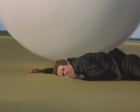
He said no and became an artist instead, but that big old balloon seems to have haunted him ever since. There’s one in the middle of this small show, drooping bulbously from the ceiling. And the orb appears in every work on the wall – his first foray into pastels after a body of quiet, austere paintings. It’s a red buoy with a boat tethered to it, it’s a paper Ikea ceiling lamp, it’s the knob on top of a banister, a ball on a table. All these orbs are weird, ghostly presences – he draws precisely but foggily, everything is hazy, uncomfortable, all the shadows are harsh, all the lighting is dramatic. They’re awesome images, strange and discomfiting. It’s like he escaped a fate that just keeps coming back to pester him, leaving the traces of what could have been dotted throughout his life for him to notice.
In one image, a huge orb has crushed a man, based on a still from 60s TV show The Prisoner. Life can crush you, or you can dodge the ball of fate and make your own way.
The phrase “green energy” promises natural, ecological optimism. But it’s something a lot more toxic in Amélie Mckee’s debut UK exhibition, a few doors down from David Micheaud’s show.
Two ionic columns in the centre of the space have been turned into Tesla towers, most of the stone replaced with metal. In the middle of each, vintage 1930s dinner plates glow a sickly green because they’re made of uranium. The same stuff we use to build nuclear weapons used to be fine china for dinner parties. Mckee is making the line between caloric energy and industrial power feel pretty blurry.
On a plinth, more gross glow: a can of Monster Energy drink has been poured into a 1928 pin tray with the figure of a nude woman now seeming to swim in the yellow sludge.
The gallery text is some of the most incomprehensible semi-English bullshit I’ve read for a long while, which makes figuring the work out a little tricky, but I think I get it. This is about authority and energy, about fuel on an industrial and personal level, about how toxic our relationship with power (who controls it, who consumes it, the greed and evil of it all) has become. It’s all framed in a semi-retro, toxic sludge aesthetic. Power corrupts, but energy is monstrous.
Plicnik Space Initiative, London, until 19 December
- drink
- reeboks
- raver
- swim
- monster
- energy
- exhibition
- cruiser