‘It’s peak Aussie – and it’s fantastic!’ How Australian TV conquered the world
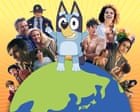
‘It’s peak Aussie – and it’s fantastic!’ “When I was a kid, I would do an American accent when I played with my toys,” says Daley Pearson, co-founder of Ludo Studio, which makes Bluey.
From Colin from Accounts to a certain blue heeler dog, Australian TV has swept the globe – so much so that many kids have picked up the accent. Homegrown stars and creators explain how down under went overground
About four years ago, parents around the world began observing a strange phenomena in their children: Australian accents. Bluey – the charming cartoon about a dog and her family that is currently one of the most watched shows in the world – had children saying words such as “dunny” and “brekky” without thinking twice.
“When I was a kid, I would do an American accent when I played with my toys,” says Daley Pearson, co-founder of Ludo Studio, which makes Bluey. “So this is like the colony taking back over!”
In the last five years, Australia has staged a global cultural invasion via television. Count just the recent successes: Colin from Accounts, My Brilliant Career, Fisk, The Narrow Road to the Deep North, Dalliance, The Newsreader, Reckless, Goolagong, Territory, The Twelve, Apple Cider Vinegar, High Country, Love on the Spectrum, Last Seen, Mix Tape, Do Not Watch This Show, The Airport Chaplain, The Artful Dodger, Dog Park, Gnomes, Austin, Deadloch – and of course, a certain blue heeler. In the coming months, Brits will also get the outback thriller Treasure & Dirt (BBC), the true-crime documentary 2.6 Seconds (Netflix), the Anna Torv-led mystery Dustfall (BBC), as well as more Austin and Scrublands (BBC).
“It’s peak Aussie – and it’s fantastic,” as Amanda Duthie, Netflix’s head of content for Australia and New Zealand (My Brilliant Career, Apple Cider Vinegar), puts it.
“There’s people looking over the fence at us, saying: ‘What’s in the water in Australia at the moment?’” says Jennifer Collins, director of screen at the ABC, Australia’s national broadcaster (Love on the Spectrum, Bluey, Fisk, Austin, Dog Park). “Back in the day, kids’ shows and one or two dramas would do really well for us – but now all of our shows are cutting through.”
“I’ve been in the industry quite a while – some may say too long – but I remember the olden days when it was hard to get a pitch meeting with the UK commissioners and there weren’t that many Australian shows picked up there,” says Ian Collie, founder of production company Easy Tiger (Colin from Accounts, The Twelve, Scrublands, Territory). “But definitely in the last three or five years, there has been an upward trend, which is great.”
The question is: why? Is Australian TV getting better? Is there more of it? Or are international broadcasters and streaming services finally catching up to a good thing?
After speaking to more than a dozen producers, stars, directors and executives across Australia’s TV industry, the consensus is that something started changing 10 years ago, but really sped up around 2020. Covid lockdowns meant that the many talented Australians who had left for entertainment jobs in Hollywood and London fled home as work dried up. Everyone who used to moan about having to live in Los Angeles realised they didn’t need to any more.
“Actors now audition from a distance. Writing teams are scattered across the globe. Shows that are shot in England can be edited in Australia, or vice versa,” says Andy Ryan, head of drama at Australian streamer Stan (Scrublands, The Killings at Parrish Station, The F Ward). “That’s an unintended benefit of Covid for Australians – you don’t have to travel halfway around the world to have a meeting any more.”
Suddenly, Australia had a brain gain: all the expertise built overseas began being shared on masse. Meanwhile, the international streamers – Disney+, Netflix, Prime Video – had set up shop and were funding local productions; Australia’s domestic streamers and broadcasters geared up to compete. Then the Hollywood strikes of 2023 happened, which coincided with the start of a huge, ongoing decline in TV production in the US and the UK. The streaming giants and big broadcasters started hunting furiously for readymade hits abroad that they didn’t need to fund.
“There’s been a massive contraction globally in the number of shows being made, so all buyers are looking for shows that they think stand out,” says Carly Heaton at Fremantle Australia (Heartbreak High, Wellmania). “Everywhere, we’re seeing different content than what we might have normally seen – the Brits are seeing more Aussie content, and vice versa.”
Shrinking budgets have also made Australia a lot more attractive to foreign streamers and broadcasters looking for co-productions, rather than funding a show themselves: Colin from Accounts, for instance, was produced by Easy Tiger and CBS – but that means it was shown on CBS in the US (as well as the BBC in the UK).
“Australia is very cost-competitive internationally,” says Ryan at Stan, which regularly partners with UK broadcasters. “We make TV for a great price.”
Australia has also benefited from one international success: Squid Game. When the South Korean show became a massive global hit, all the old wisdom around commissioning went out of the window.
“People thought that Brits wanted to see Brits, Aussies wanted to see Aussie,” says Heaton at Fremantle Australia .“But Squid Game was a massive hit globally, and with subtitles – who would have thought that would happen? No buyers would have braved that before.”
“Everyone is watching so much more international TV,” says Duthie at Netflix (the brave buyer of Squid Game). “We are open to subtitles now! Nobody can quite believe it – ‘Honey, come and watch this show, it’s called Squid Game!’ The audience has muscled up, along with the sector.”
As Australian TV spreads, there seems to be a growing realisation that we don’t just make soaps. We have our own period dramas (My Brilliant Career) and office comedies (Fisk) and war stories (The Narrow Road to the Deep North) and romcoms (Colin from Accounts), plus a wealth of entirely unique First Nations stories. Australia is exotic enough to be interesting, but not so foreign that it’s challenging. “We feel quite distinctive, a bit fresh – just like Scandi noir did 10 or so years ago,” says Collie. We’re having our time in the sun.”
“There is an inherent curiosity about who we are as a nation, as a culture. We are not here making a watered-down version of a British or American show,” adds Nakul Legha, head of scripted at Australia’s multicultural public broadcaster SBS (The Airport Chaplain).
Frankly, though, some of Australia’s recent international successes simply can’t be explained. “None of us knew that Fisk would take off in the way it did,” laughs Collins at ABC, which sold the show to Netflix internationally.
Liz Doran was the showrunner on Netflix’s My Brilliant Career, which reached the Top 10 in 72 countries this year. The drama features a storyline where one character is implied to be part of the Stolen Generations – Aboriginal and Torres Strait Islander children forcibly removed from their families by the state – a historical point that is well known in Australia but not always abroad. “But we were never asked to add more dialogue to explain that, because we’re just treating the viewers like adults – if they’re curious, they’ll chase it,” Doran says. “Which is exactly what we have always done for shows from America.”
Australia is done explaining itself to the world: you figure out what a smoko or a bogan is if you care, hooroo. But the world seems to like that. When I recently interviewed Patrick Brammall and Harriet Dyer, the married creators and stars of Colin from Accounts, they recalled being asked by US executives to tweak an “arvo” in a script to “afternoon”. “And we were like … no,” Dyer told me. “It stayed in.”
“When Bluey took off, it felt like nobody cares any more – in a really great way,” says Pearson at Ludo. “People don’t need you to change things, they get it. That’s the stuff we loved about The Simpsons or John Hughes or the Beatles – they never pandered to you. People not only are happy to watch Australian stuff, they maybe even prefer it the more personal you go, the more foreign it feels.”
“What we’ve seen is when we’re hyperspecific in Australian content, that travels particularly well in the UK. Humour is an obvious shared sensibility,” says Alexandra Gilbert, head of content at Prime Video Australia and New Zealand (Deadloch, The Narrow Road). “Take something like Deadloch – a British audience might need a dictionary to translate half the words, but it travels incredibly well.”
“I’m quite sure most people don’t understand half the things the Heartbreak High kids are saying,” adds Heaton at Fremantle, which made the show for Netflix. “But you get the tone and, because of the specificity, it’s funny. And as long as you get the intent, you get the humour.”
“Specificity is hugely appealing,” adds Dena Curtis, head of Indigenous commissions and production at NITV, Australia’s Aboriginal and Torres Strait Islander channel, which made Reckless. Although the show was based on a Scottish series (Guilt), Reckless is told from an Aboriginal perspective – “[which] is appealing overseas because that isn’t something that has been easily available,” Curtis adds. “It just takes one show to break through and then people say, OK – what else have you got?’ And I think it’s becoming anticipated that something coming out of Australia will be good.”
“I’m really mindful of the narrative that says: ‘Well, Australia is only starting to get good at making TV now!’ No!” says Legha. “We’ve had stories like The Flying Doctors, Wentworth, Rake, Kath & Kim, McLeod’s Daughters. We have an amazing history of great storytelling, I don’t think that’s changed. It is just that international buyers are seeing there is a real point of difference in the stories we’re telling here.”
“Everyone’s like, what’s the difference? It’s money,” says Doran. “I think one of the reasons some of our dramas haven’t travelled well in the past is because we are working on lower budgets than other countries. Australian crews and creatives are incredibly fast-paced and have initiative and we’ll work our arses off – but you can only make a low budget go so far. The international streamers mean we can make a show that has a polish and style on par with international shows.”
“Higher budgets don’t mean greater success; if only it was that easy!” counters Jo Porter, of production company Curio Pictures (High Country, The Artful Dodger, The Narrow Road). “But I think we’ve had to compromise in the past because we haven’t been able to finance at the level a particular story needed. Now we are able to prove our shows will sell globally, distributors have more confidence taking risks.”
A familiar face tends to inspire the UK to buy in particular: think Anna Friel in The F Ward, Ciarán Hinds and Jacob Elordi in The Narrow Road, David Thewlis in The Artful Dodger or Juliet Stevenson in Dustfall. Feral, a new Netflix drama, is filming in Queensland with Downton Abbey’s Michelle Dockery and Baby Reindeer’s Jessica Gunning; next year Sheridan Smith will lead Two Birds, a Stan and ITV co-production made in Western Australia.
“Marquee cast members do help sell the show internationally,” says Ryan. “And we’re not asking for them to come out to Australia for six months, more like four weeks. So it’s much more achievable from a logistics point of view. Also, 15 years ago, if you brought Anna Friel into an Australian medical show, you’d probably make a story point about why an English-accented doctor was in your hospital. Now we don’t explain it at all.”
So it is a bit of everything: a bit more money, a bit of pain overseas, a bit more openness internationally, and a lot of talent finally getting their dues. The phrase most often repeated was: “A rising tide lifts all boats.” Duthie at Netflix calls the current situation “a self-saucing pudding of confidence and opportunity: the more you do, the more you learn, the more you can deliver”.
“The Aussies are coming, watch out!” Collie laughs. “More than 200 years ago, the Brits sent all their riffraff to Australia. Now we’re coming to get them!”
- world
- accent
- peak
- aussie
- dog
- kid
- child
- bluey