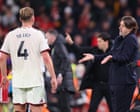
Pochettino needs New Manager Bounce to break torrid Manchester United turnover

Latest hire will depend on fresh faces and time to bed in at Old Trafford where the dugout churn is hardest to budge Everybody knows the pattern. A title challenge becomes clinging on for the last Champions League spot becomes mid-table.
Latest hire will depend on fresh faces and time to bed in at Old Trafford where the dugout churn is hardest to budge
Everybody knows the pattern. Performances fade. Results falter. A title challenge becomes clinging on for the last Champions League spot becomes mid-table. Or a promising start becomes a troubling dip, becomes a full-on battle against relegation.
Fans begin to grumble. The media wonder whether the spark has gone. Players look disaffected. A dressing room, once lost, is seldom rediscovered, and few managers are given the opportunity to find it again. A crisis in football, once acknowledged, is only ever resolved in one way: by the sacking of the manager.
With hindsight, Michael Carrick’s dismissal was probably inevitable from the moment Manchester United lost at Hull on the opening weekend, just as Ruben Amorim was doomed from the moment cameras picked him up fiddling with magnetic counters on a tactics board in the rain at Grimsby. The message for Mauricio Pochettino is clear: don’t go playing badly on the east coast.
It’s generally acknowledged that Carrick, while he may not have been the ideal manager for United, was a long way down the list of the biggest problems at the club. So what was the point of sacking him? As Pochettino begins his United career at Anfield on Sunday, what realistically can any manager hope to achieve?
Sackings have become almost ritualistic. Football demands blood sacrifice. How else can the harvest be guaranteed but by the torching of the wicker man? How else can Crystal Palace stay up but by the sacking of Pierre Sage? Once, when the manager defined the club, bought the players, decided the tactics, set the mood, that perhaps made sense. When managers were messiahs, it requires only a slight tweak to the underlying theology to see a logic in sacrificing them.
But managers now, at least at the majority of Premier League clubs, are part of a wider structure. In one of his meltdowns at Spurs, Antonio Conte made the point that it made little sense for him to be answering questions about the broader future of the club when he had so little power compared with the tiers of executives. Why sack the manager rather than the head of recruitment or the sporting director or the chair?
The answer to that perhaps goes back to the emergence of the English idea of the manager, which began in the 1930s and blossomed in the post-war golden age of Matt Busby, Bill Shankly, Don Revie and Brian Clough. As Barney Ronay argues in The Manager, at least part of the reason he became a figure of such pre-eminence was that it was useful for the board to have a hapless ashen-faced figure standing out on the touchline to take the blame. A handful of geniuses aside, the manager was essentially a convenient scapegoat.
But does the sacrifice work? It was one of the shibboleths of football’s early data wonks that the new manager bounce was a myth. What was being witnessed when form improved after a sacking was nothing more than regression to the mean. Which sounds sensible: squads make games and are determined by finance. There is a wealth of evidence that the biggest single factor in determining league position is the wage bill.
And yet there is also evidence that new manager bounce does exist. A lot of early data analysis in football ignored the fact that those involved are human and respond emotionally to circumstance. More recent studies, though, suggest that, while around a quarter of clubs experience no improvement, the first five matches under a new manager show a 41% improvement in points per game, although the impact wears off after around 10 games.
That feels intuitively true and is readily explicable. A manager under pressure can become embattled, lashing out at enemies real and imagined, their capacity to make lucid decisions impaired as confidence ebbs, creating a doom spiral. Replacing him breaks that pattern and permits a psychological reset.
In a world where everything is studied endlessly, a new manager should make a team less predictable. It’s possible, of course, that as those early analyses suggested, performances would have turned anyway as part of a regression to the mean, but it is curious how often the uptick in form coincides with the replacement of the manager.
Anthropologists are yet to determine precisely why United sacrifice managers so frequently, although there does appear to be some sense of deflecting blame. There is also a sense that it has become routine, that reasons that once probably did exist have been forgotten over time.
Sacking the manager is just what the club do a few months into the season, the ritual now as divorced from its original purpose as modern Hallowe’en customs are from their origins in the Christian commemoration of All Hallows’ Eve.
Will the arrival of Pochettino help? He is a far more ebullient and charismatic figure than Carrick, whose status as a dead man walking for most of this season perhaps meant players did not take him as seriously as they might have an incumbent who appeared to be there for the long term, or had them beginning to ponder moves away from United.
But this remains a mismatched hotchpotch of a squad assembled over six previous managers. If there is some style of play that would suit most of them it has yet to reveal itself.
It will take time for Pochettino to instil in a side that are habitually outrun the levels of conditioning that characterised his Tottenham, and perhaps even longer to get them playing in a coherent pattern. There will probably have to be five or six new signings (and at least as many departures). Probably most difficult of all, there is the entire culture of the club to overhaul, which may not be possible without a change of ownership.
Given United came back from two goals behind three times in their final two games under Carrick, these are not usual circumstances: beleaguered managers rarely inspire such defiance, and the fans never turned against him. In that sense, there will not be the immediate benefit that comes when toxicity is removed.
Some sort of bounce, though, is probable under Pochettino, if only because a negative pattern has been broken. The question is how long it can be maintained.
- manager
- pochettino
- bounce
- torrid
- manchester
- united
- turnover
- hire