Climate talks crash a sign of anger with oil lobby, scientist says
Countries have rejected a climate deal that ignores fossil fuels, but experts say that reflects anger rather than indifference.
Global climate talks have ended without an overarching agreement after countries rejected a draft that did not commit to move away from fossil fuels.
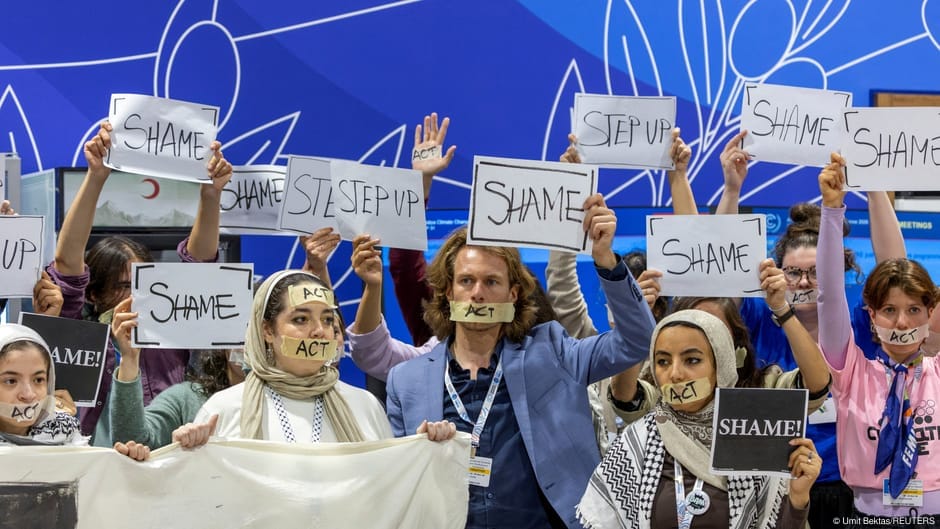
Climate scientist Bill Hare says the rejection reflects rising anger over a lack of action, rather than a lack of ambition.
The next round of climate talks will be held in Addis Ababa, Ethiopia, next year.
It would be easy to look at the breakdown of the latest global climate negotiations as yet another sign that the world lacks the ambition to tackle climate change, but climate scientist Bill Hare says it indicates something else — rising anger.
"The main decision has been blocked by a whole bunch of countries who are very unhappy about the fact it didn't mention the transition away from fossil fuels," he told ABC RN breakfast.
The annual COPs are decided on consensus and are famously complex because they require almost 200 countries with competing interests to agree.
In an attempt appease the interests of fossil fuel-producing countries such as Saudi Arabia, conference organiser Türkiye, with Australian Climate Change and Energy Minister Chris Bowen as lead negotiator, stripped all mentions of fossil fuels from the draft text.
While not mentioning fossil fuels in a climate agreement may seem bizarre, the need to move away from them had only been central to one previous COP, the United Arab Emirates conference held in 2023.
Fossil Fuel Treaty Initiative research and policy head Amiera Sawas said she felt it was "one of the worst" COP summits in history.
"There were some areas of progress, there were some agreements that were made in the negotiating space," she said.
"Quite a lot of fossil fuel lobbying language ended up in that cover text, particularly around new technologies such as carbon capture utilisation and storage."
"Which basically allow the fossil fuel industry to extend its lifeline, instead of actually making the transition away from fossil fuels."
Türkiye and Australia hoped to focus on electrification as a way to bring down emissions and sidestep the contentious issue. But both countries' roles as fossil fuel exporters came under criticism throughout the conference, and calls for clear language about the transition only became stronger as the conference progressed.
The final draft opened with a reference to the 2023 conference as an attempt to appease all parties without mentioning fossil fuels, but it was not enough.
In the end, two days after talks were scheduled to conclude, the European Union's declaration that it could not support the text signalled there was no way forward.
The conference ended without a cover decision, which is an overarching agreement from all the states who attended.
"Oil states have been hijacking these talks for 30 years. So for me that's nothing new," Mr Hare, who was at the conference, said.
"I think what was really new is a line in the sand has emerged now where countries have said enough is enough."
While the failure at COP represents another example of the world falling short to act on climate change, it does not spell the end of the process. Countries' commitments to the Paris Agreement remain intact, and since it was signed in 2015, the focus on solutions has shifted from politics to economics.
This event has been held against the backdrop of increasing natural disasters and extreme weather driven by climate change.
It was also the first conference since the UN confirmed that the global temperature is likely to rise by more than 1.5 degrees Celsius in the next few years. Limiting that increase was the most ambitious target of the Paris Agreement.
The world is also grappling with its second fuel shock in five years as the war in Iran highlights the vulnerabilities of an energy system built around fossil fuels.
Emissions from fossil fuels have fallen this year and the International Energy Agency has highlighted how renewable energy and electrification are rapidly shaping the global economy.
It was this trend that Türkiye and Australia hoped to capitalise on with their electrification pitch.
The transition will continue even in the absence of collective action from COP, and Clean Energy Investor Group chief executive Richie Merzion cautioned against writing the event off as a failure.
"I've been to 13 COPs now and most of them did not have a 'cover decision' — the part that failed to pass at the end of COP31. A cover decision is like icing on the cake. Even without it you still [have] the main meal," he said.
"COP31 achieved many things — it was not a raging success nor was it a failure. At these annual Conferences of Parties to the UN climate convention, there are many, many mandates, with over a hundred negotiating streams.
"And the precedent is there, where COPs fell short [COP6 and COP15 for example], the next year we saw even greater process."
But progress is nowhere near fast enough to offset the worst impacts of climate change.
When Prime Minister Anthony Albanese defended the outcome, he pointed to the importance of the issue to Pacific nations.
"It's evidence that we're living in difficult geopolitical times, that is the reality. The important work of COP, can I say, from Australia's perspective, is the work that we've done with the Pacific," he said.
"There's a link, as well, between environmental security and national security. You'll see some of that played out this week in order to have credibility the entry fee is action on climate change."
Meanwhile the opposition has slammed the outcome, with Shadow Energy Minister Dan Tehan calling for Mr Bowen to resign.
"As the lead negotiator, Chris Bowen is personally responsible for this catastrophic diplomatic disaster," he said.
This conference was unusual because it was born out of a stalemate between Australia and Türkiye on who would host. The compromise was for Mr Bowen to act as lead negotiator. A meeting was to be held before the conference in the Pacific to draw attention to their concerns.
Dr Hare hoped the experiment of a shared negotiation was not repeated, but said Mr Bowen had gone all in on trying to make the conference work.
"I think he's done a great job, very difficult political environment, very complicated situation with, essentially, a dual presidency — an experiment I hope we never repeat again," Dr Hare said.
Fijian Climate Change Minister Lynda Tabuya said she did not hold Mr Bowen responsible for the outcome.
"You have tried your utmost best, and we have seen it. Your door has always been open," she told the final session.
"The failure here is not yours to carry. It is the responsibility of all parties."
But Dr Hare said there was no doubt the outcome was a huge blow for Pacific nations.
"When I look at my [Pacific] mates leaving today, they're feeling very sad and upset that we haven't made more progress on this," he said.
- climate
- anger
- sign
- oil
- lobby
- scientist
- talk
- country