EACC flags past vetting failures, calls for tougher candidate scrutiny ahead of 2027 polls

NAIROBI, Kenya, Nov 23 – The Ethics and Anti-Corruption Commission (EACC) has called for tougher scrutiny of candidates seeking elective positions ahead of the 2027 General Election, warning that past failures to enforce constitutional integrity requirements allowed individuals with questionable records to secure clearance and access public office. In a separate address delivered on his behalf by EACC Director of Investigations Paschal Mweu, Chief Executive Officer Abdi A. Mohamud said the Commission would intensify integrity verification of individuals seeking elective positions.
NAIROBI, Kenya, Nov 23 – The Ethics and Anti-Corruption Commission (EACC) has called for tougher scrutiny of candidates seeking elective positions ahead of the 2027 General Election, warning that past failures to enforce constitutional integrity requirements allowed individuals with questionable records to secure clearance and access public office.
The Commission said 87 individuals whose integrity records were submitted to the Independent Electoral and Boundaries Commission (IEBC) ahead of the 2017 General Election were all cleared to contest, despite unresolved questions about their suitability for public office.
In 2022, the EACC submitted the integrity records of 241 individuals for consideration, but only five were disqualified.
EACC Commissioner Col. (Rtd) Alfred Mshimba said the experiences raised serious questions about the country’s commitment to enforcing Chapter Six of the Constitution, which sets out the standards of integrity and ethical conduct expected of public officers.
“These experiences raise an important question: Are we doing enough, as institutions and as a country, to ensure that integrity is given the attention it deserves when electing our leaders?” Mshimba posed.
He said some of the individuals flagged in 2017 were subsequently arrested, charged and convicted of corruption-related offences, while others were removed from office through impeachment proceedings over violations relating to Chapter Six.
Mshimba warned that the failure to adequately scrutinise candidates had come at a cost to the country through the misappropriation of public resources, mismanagement of public offices and lost development opportunities.
He called on political parties to take greater responsibility during nominations by ensuring that candidates presented to voters meet the moral, ethical and leadership standards prescribed by the Constitution.
The EACC commissioner also urged the IEBC to work closely with investigative agencies and consider credible information on the suitability of candidates in exercising its constitutional mandate to register those seeking elective positions.
“Let us work together. Let us share information, coordinate our efforts and ensure that the law is applied fairly and consistently,” he said.
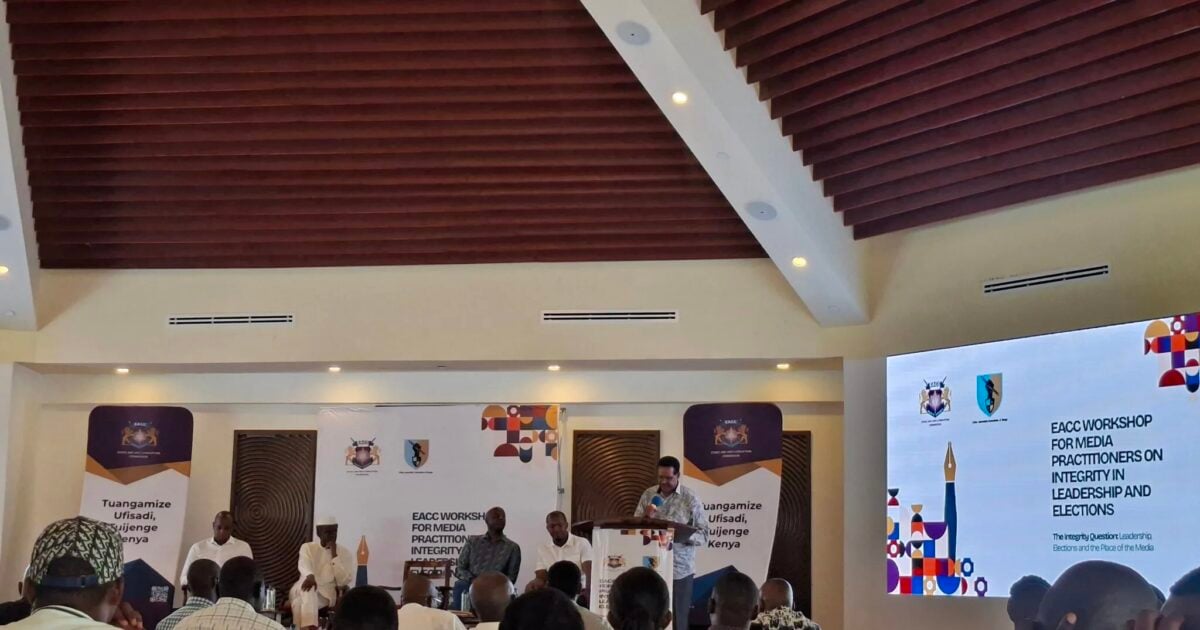
Mshimba was speaking during a two-day workshop for media practitioners on integrity in leadership and elections at Whitesands Beach Resort in Mombasa.
His remarks were delivered against the backdrop of growing concerns over electoral malpractice and the use of young people to advance political interests through violence and intimidation.
He said the Commission was concerned about attempts by politicians to mobilise young people to disrupt public gatherings, intimidate opponents and undermine the electoral process.
Mshimba linked the concerns to the youth-led protests of 2024 and 2025, which he said were driven largely by grievances over high taxes, corruption and the accumulation of wealth by leaders through the theft of public resources.
He cautioned politicians against recruiting or sponsoring young people to perpetrate violence, warning that those involved would be held accountable.
“There is nothing political about sponsoring violence, organizing gangs or using young people to intimidate opponents. These are criminal acts, and those responsible must be held accountable,” he said.
The Commission said it would work with the IEBC, the National Cohesion and Integration Commission and other investigative agencies to address electoral corruption, violence and other offences within their respective mandates.
In a separate address delivered on his behalf by EACC Director of Investigations Paschal Mweu, Chief Executive Officer Abdi A. Mohamud said the Commission would intensify integrity verification of individuals seeking elective positions.
Mohamud clarified that the EACC does not have the constitutional mandate to bar candidates from contesting elections, noting that the responsibility rests with the IEBC.
He said the Commission instead investigates integrity concerns and submits recommendations to the electoral body based on constitutional requirements and agreed verification criteria.
The CEO disclosed that the Commission receives more than 20,000 self-declaration forms from individuals seeking nomination as candidates during election years.
He said the EACC had also made progress in investigating the use of forged academic and professional certificates to secure public positions.
To date, the Commission has investigated 228 allegations involving forged academic and professional certificates and recommended prosecution in 134 files forwarded to the Office of the Director of Public Prosecutions.
Of the cases, 60 are pending before courts, while 50 have been concluded, resulting in 45 convictions and five acquittals.
The Commission has also recovered Sh41.2 million acquired through the use of forged academic and professional qualifications.
Mohamud said the EACC would continue examining documents submitted alongside self-declaration forms to ensure falsified certificates were not used to obtain clearance to contest elections.
He further warned public officers against participating in political campaigns in violation of the Conflict of Interest Act, saying those found culpable would face legal action, including prosecution.
Ahead of the 2027 polls, the Commission announced plans to roll out a National Integrity Awareness Campaign targeting different segments of society, with a particular focus on young people.
The campaign will educate voters on the constitutional and ethical requirements for leadership, responsible citizenship and peaceful participation in elections.
The EACC also plans to establish public reporting desks to receive complaints relating to corruption, voter bribery and public officers engaging in partisan political activities.
Mohamud said the Commission was aware of allegations of voter bribery during recent by-elections and pledged to investigate the claims, gather evidence and pursue prosecution where appropriate.
Mshimba said enforcement alone would not guarantee ethical leadership, urging Kenyans to take a more active role in scrutinising candidates before voting.
“Our message is simple: Do not just prepare to vote. Prepare to vote wisely. Do not just prepare to participate. Prepare to participate responsibly,” he said.
He challenged the media to give greater prominence to integrity issues, scrutinise the records of political aspirants and hold politicians accountable for conduct that threatens peaceful elections.
Bruhan Makong is a Senior News Reporter for Capital FM in Nairobi, covering diplomacy, foreign policy, national security, climate, and human rights across East Africa and the wider region.
- eacc
- candidate
- commission
- integrity
- individual
- mshimba
- scrutiny
- corruption