Pat Cash on the Davis Cup in the 1980s: ‘It felt like you were going to war’
One of Australia’s greatest tennis players remembers being pelted with coins, tampering with nets and wanting to ‘beat these fuckers’ This year’s Davis Cup Finals begin in Bologna on Tuesday but the culmination of the oldest team competition in tennis will probably pass most Australian sports fans by. Few countries can challenge Australia’s history in the Davis Cup; they reached the final every year between 1938 and 1968 and have won the event 28 times, second only to the United States.
One of Australia’s greatest tennis players remembers being pelted with coins, tampering with nets and wanting to ‘beat these fuckers’
This year’s Davis Cup Finals begin in Bologna on Tuesday but the culmination of the oldest team competition in tennis will probably pass most Australian sports fans by.
Few countries can challenge Australia’s history in the Davis Cup; they reached the final every year between 1938 and 1968 and have won the event 28 times, second only to the United States.
However, after losing a qualifier earlier this year to Belgium, they will not be involved in the eight-nation finals. Alex de Minaur will end the year ranked No 11, but he is the only Australian man in the top 50 and only three more are in the top 100. These are lean times.
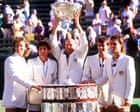
It’s a far cry from 40 years ago when Pat Cash led Australia to what was then their second Davis Cup title in four years, his dramatic victory over Mikael Pernfors, from two sets to love down, sealing the deal.
Cash, like so many great Australian players before him, grew up on tales of Davis Cup heroics. On the court, he gave everything for his country, winning it first in 1983 and then again in 1986. Cash loved the cut and thrust of the competition, especially the home-and-away format, where teams could be faced with genuine hostility.
“You’d play against Mexico in Mexico, for example, and they’d do anything to try to win,” Cash says. “It felt like you were going to war. I know I am exaggerating, but it felt literally like you were fighting against the other country. Mexico, [the former] Yugoslavia, some of the places I played at, the things they did were just downright cheating. Dirty, absolutely dirty.
“Some of the things that they were doing – they wouldn’t get us tennis balls, they wouldn’t pick us up, they wouldn’t give us food, they’d throw stones. I remember in Mexico, standing there as the team as the national anthem was played, and people were throwing coins and cans at us as we stood on the court.”
Cash could be pretty feisty on the court himself and the alleged actions of the likes of Mexico, he said, had the opposite effect on him and his teammates. “That was probably the worst thing they could have done to us, because we were like, ‘we’re going to beat these fuckers’,” he said. “Had they sort of applauded nicely, they might have had a chance, but they just wound us up.”
Australia were not averse to playing the game themselves. The 1986 final against two-time defending champions Sweden was played on grass at Kooyong, which back then hosted the Australian Open, and which famously had a slope. Australia’s captain, Neale Fraser, saw a home advantage he could exploit.
“Kooyong was a very special court in those days,” Cash said. “It was a little higher in the middle because of all the flooding they used to have. It was like Lord’s, this special thing that that only people who play at Kooyong know [how to deal with]. It’s basically like playing with a net two inches higher from the baseline to the net compared to a normal court.
“Obviously, Frase had played there before, so he knew all the tricks of the trade. We didn’t know until afterwards, but he told the groundsman to put the net up two inches higher and then when the Swedes go on, to put it back two inches lower, back to normal height, and to put a measuring stick right there on the court so they know it’s the right height.”
Cash considers his two Davis Cup wins on a par with his Wimbledon triumph in 1987 and was angry when the home and away matches were initially removed under the ill-fated partnership with investment group Kosmos, led by footballer Gerard Piqué in 2018.
The split from Kosmos in 2023 and recent restoration of home and away ties in the early stages of the event each year is an important step to restoring the Davis Cup’s prestige.
The 1986 win was extra special because of the effort Cash had made to be there. He’d had his appendix removed earlier in the year and had set his sights on Davis Cup glory.
Leading 2-1 after the doubles, but with Stefan Edberg favourite to beat Paul McNamee should it go to a deciding rubber, Cash knew he had to win. Outplayed for two and a half sets, Cash was buoyed by his teammates, who told him he could still win.
“I said OK, I’ve got to bloody do it,” Cash said. “I managed to get the third set. The fourth set was ridiculously tight. I remember picking up probably the best smash I ever hit in my life. Fifth set was easily the best tennis I’d played in the whole tie. Only took me three days to get warmed up.”
- davis
- cup
- pat
- cash
- war
- australia
- tennis
- player