Take me to the fatberg! The £437m new Museum of London is an astonishing sight
The £437m new Museum of London is an astonishing sight. It is the jazzy tagline of the new-look London Museum, which has gone from being marooned on a roundabout in an armpit of the City to taking over this prime Victorian market complex, following an arduous decade-long transformation.
After a 10-year transformation, the glorious cathedral-like Smithfields market is now telling the capital’s story. Our architecture critic enters a world of jewels, axes, DJs and dog races – with unposh coffee from Syd’s century-old stall
‘All the grit and the glitters,” trumpets a big illuminated sign on the roof of the old Smithfield general market, beaming out as if advertising a raunchy burlesque show. It is the jazzy tagline of the new-look London Museum, which has gone from being marooned on a roundabout in an armpit of the City to taking over this prime Victorian market complex, following an arduous decade-long transformation.
The slogan is fitting for a museum that displays everything from priceless Tudor jewels to a lump of congealed fat and rags dredged from a Whitechapel sewer. Just as the colossal fatberg was scraped from the murky depths, so has the former market hall (and its extensive warren of basement vaults) been meticulously scoured and scrubbed up. London’s centre of butchery for 800 years, which Charles Dickens found “all asmear with filth and fat and blood and foam”, has been lavished with a £437m glow-up, reborn to tell the story of the capital in all its gritty, glittery glory. And the finished result is an astonishing sight.
It may be hard to remember now just how off-putting the museum’s previous home was. Since 1976, it had been imprisoned in a windowless brick bastion, throttled by traffic and accessed by a couple of elevated bridges, like a fortified keep. “We still got 700,000 visitors a year,” says Alec Shaw, director of transformation. “But they wouldn’t come back.” It was a dingy ordeal, somewhere you went because your school dragged you there, not for the active pleasure of spending time.
Now it is hoped people will drift in off the street, possibly without even knowing they’re entering a museum. “We’re essentially wrapped with 250 metres of high street,” says Asif Khan, one of the architects involved, alongside Stanton Williams and conservation specialists, Julian Harrap Architects. The 44 shop units that used to ring the market, where grocers and butchers hawked their wares to the street, have been converted into 12 outward-facing “houses” for the museum and its partner organisations, “making it more like a coral reef than a singular organism”, says Khan. Encrusted with these retail barnacles, which will range from cafes and pubs to galleries and shops, the museum hopes to lure in passersby who might never have thought of going.
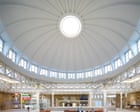
Inside, they will find a place that is light years from the city museum stereotype of a dusty, fusty repository. Opened in 1883, the general market was the last of Smithfield’s three market halls designed by City architect Horace Jones, also the author of Tower Bridge. Jones concocted a dazzling cathedral of commerce: a majestic dome rises above the vast former market hall, where decorative iron “phoenix columns” support a lattice of trusses that hold up a roof of vaulted skylights.
Around the edges, dilapidated shops have been stripped away to reveal the building’s raw brick shell, with iron fireplaces left hanging surreally halfway up the walls. The former shop of James Burden Ltd, purveyors of premium meat, now houses a stepped theatre for educational programmes. Another unit has become the museum store, where the wares of London artisans will be on sale.
In every nook, historic architectural details have been lovingly preserved, making the building itself, and its accrued layers of history, a prime exhibit. Bucketloads of fragments in the museum’s collection – known as “bulk archaeology” – have even been cast into the polished concrete floor, forming a sort of archaeological terrazzo from bits of old pots, pipes and tiles. “It’s a gesture to our primordial reflex to dig, to find,” says Paul Williams, co-founder of Stanton Williams. Kids will love searching for curious fragments. Thirteen displays are scattered around the perimeter of the main hall, loosely themed around “Our Time”. Topics range from greyhound racing – there’s a rotating “totalisator” contraption used to calculate betting odds at Harringay Stadium – to an altar of shop signs, where the likes of Morley’s fried chicken and Topshop glow like neon relics of the British high street. A stack of hefty speakers teeters in one corner, dedicated to carnival sound system culture. Shaw promises the space will come alive with DJs on Friday and Saturday nights, when the museum will open until midnight.
In tune with the neighbourhood’s 24-hour culture, it will open again at 7am with a ring of the last bell to be cast in the Whitechapel foundry , just as the meat market traders clock off next door, and revellers stagger out of Fabric night club, perhaps accidentally stumbling into the museum on their way home.
“We will be flowing out on to the streets and going right into the night,” says museum director Sharon Ament, who wants it to retain the energy and bustle of a market. With at least four entrances and no ticketing or bag checks, it is aiming to redefine how a museum meets the surrounding city, as a truly porous public place. “You might even slip on a piece of old chicken skin on the way,” she adds, “and we love that.” The main former market hall feels quite sparse (left empty with corporate hire in mind) but its sheer scale means that pleasingly chunky objects can be displayed. Syd’s coffee stall, a century-old east London institution run by three generations, stands on one side, near an Italian knife-grinding van parked precipitously up on a mezzanine balcony. Syd’s, which will serve tea on Tuesday afternoons, was donated by the family on the proviso that it wouldn’t be used to serve “posh coffee”. It makes a refreshingly earthy foil to Clerk’s House, the museum’s restaurant, where you can dine on a Smithfield chop for £34.
The hall feels as if it will be a lively place to loiter, with the energy of a station concourse, but the main event is buried underground. A cut in the floor leads visitors down, past theatrical layers of pigmented concrete suggesting sedimentary earth, to the stygian realm of “Past Time”. Here, in the atmospheric former goods depot, the museum’s trove of 5,000 objects are displayed in five loosely chronological chapters, charting London’s 2,000 year history from Roman Londinium to the fatberg.
Designed by Atelier Brückner, it is a well-paced romp through neolithic axes, medieval glassware, royal robes and rock guitars, culminating in the museum’s most startling feature. At the far end of the vaults, a big picture window opens on to a tunnel where you can marvel at the Thameslink trains swooshing by. Few museums have ever managed to convey the thrill of infrastructure quite so viscerally. Delight in the startled shock of commuters as they see your ghostly face peering back at them from the shadows.
It goes on and on. (Shaw estimates it would take eight hours to see everything.) A series of side rooms, like chapels along a nave, contain displays dedicated to Roman mosaics, the Great Fire, women’s suffrage, and the Cheapside Hoard, a bounty of Elizabethan and Jacobean jewellery discovered in 1912.
Along the way, the museum made some momentous discoveries of its own. A set of vaulted chambers was uncovered, which will become an additional exhibition space set to open next year with items from the Bloomberg collection, which were found during construction of the megalithic media company’s HQ. Back upstairs, one of the shop units was revealed to contain a miraculously intact tiled interior of Lockhart’s Cocoa Rooms, a temperance movement cafe from 1875. It will operate as another living exhibit, serving hot chocolate late into the night – a touch of Victorian abstinence fitting for gen Z’s sober social habits.
These discoveries, along with Covid and inflation, are part of the reason the project budget rocketed from an initial £150m, as the scope grew ever larger. A second phase is now under way, due in 2028, which will see the neighbouring 1960s poultry market transformed with conservation labs, open collection storage and a large temporary exhibition space beneath Ove Arup’s soaring concrete dome. As Williams notes, wholesale markets make ideal venues for museums: “Where else in London could you find a world-class exhibition space,” he asks, “with a loading bay purpose-made for articulated lorries?”
The project is one of the most accomplished and complex transformations of an existing building the capital has seen, but it almost didn’t happen – twice. Behind all the grit and glitter is the fact that this magisterial complex almost became a soulless office development, as so tragically happened to the bulk of Spitalfields market in the early 2000s at the hands of Norman Foster. Save Britain’s Heritage (SBH) fought two public inquiries, with English Heritage in 2007 and the Victorian Society in 2014, against the City of London Corporation, which would have happily seen most of the market bulldozed for offices in the name of growth.
- museum
- london
- fatberg
- sight
- market
- transformation
- smithfield
- capital