Australia, Solomon Islands sign sweeping pact seen as countering China
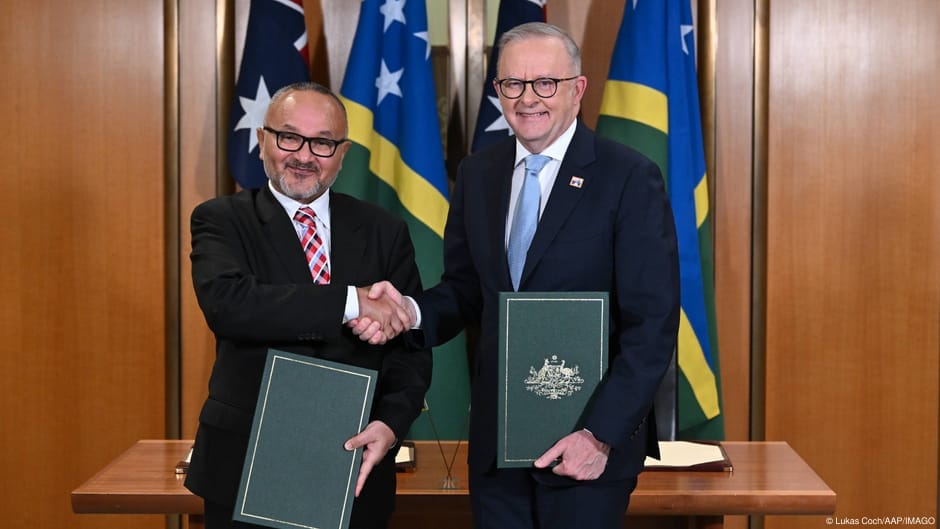
Australia will become the Solomon Islands' primary security partner, while the archipelago will reject any foreign power trying to "interfere" on its "sensitive" infrastructure.
Australia and the Solomon Islands signed a security pact on Wednesday that makes Australia the archipelago's main defense partner.
This came four years after the Pacific islands country signed a similar deal with China.
The deal is a win for Canberra, which is battling China for influence in the region. It also recently secured similar agreements with Papua New Guinea, Vanuatu and Fiji.
With the deal, Australia will support the expansion and development of the Solomon Islands' law enforcement.
It also includes Australian funding for investment in infrastructure and education, improved visa arrangements for Solomon Islanders, and requires Honiara to consult Australia on the development of critical infrastructure.
Solomon Islands' "sensitive" infrastructure will also "remain free from militarization, foreign interference and unauthorized access".
This covers airports, ports, energy and telecommunications infrastructure, sectors where China has invested through million-dollar loans since the Solomon Islands switched diplomatic ties from Taiwan to Beijing in 2019.
"Australia is proud to be the Solomon Islands' main security partner, and that's a responsibility that we take seriously," Prime Minister Anthony Albanese told a joint press conference in Australian capital Canberra with his Solomon Islands counterpart, Matthew Wale.
Albanese also said the Solomon Islands would also be required to consult with Australia before striking deals with non-Pacific Island Forum countries on critical infrastructure or security cooperation.
"Solomon Islands has been for a number of years a source of uncertainty and doubt in the region. Those days are done," Wale told the press conference.
Wale has been rebuilding diplomatic relationships with Canberra and Washington since he was elected in May. His predecessor Manasseh Sogavare had built closer ties with China since coming to power in 2019.
Asked whether he had ended the 2022 security pact with Beijing, Wale told journalists that he could not comment due to a non-disclosure clause in the treaty with China, set to expire in April 2027. Discussions with China were "ongoing," he said.
Asked the same question on Wednesday, China's Foreign Ministry did not confirm whether the deal had been scrapped, news agency AFP reported. However, ministry spokesman Guo Jiakun warned Australia and the Solomon Islands that their cooperation "should not target any third party."
“I think this deal, coupled with indications that the Solomon Islands will allow its agreement with China to lapse, goes beyond the success of previous deals Australia has struck in the region,” Connor Graham, a research fellow in the Pacific Islands Program at the Sydney-based Lowy Institute, told Reuters news agency.
He said it was a "blow to Chinese security ambitions in the Pacific."
- australia
- solomon
- islands
- pact
- china
- security
- partner
- archipelago