China sends first Pakistani astronaut into space
China has invested billions in space race to catch up with US and Russia China has flown the first foreign astronaut to its Tiangong space station, starting what it says will be the globalisation of its space operations as the US-led International Space Station (ISS) enters its final years of operation. Floating through a hatch to enter Tiangong, Pakistan’s Muhammad Zeeshan Ali grinned broadly as he was embraced by the onboard crew in what China’s space agency dubbed the country’s first foreign “space handshake”.
China has invested billions in space race to catch up with US and Russia
China has flown the first foreign astronaut to its Tiangong space station, starting what it says will be the globalisation of its space operations as the US-led International Space Station (ISS) enters its final years of operation.
Floating through a hatch to enter Tiangong, Pakistan’s Muhammad Zeeshan Ali grinned broadly as he was embraced by the onboard crew in what China’s space agency dubbed the country’s first foreign “space handshake”.
Tiangong, completed in 2022, is the jewel in the crown of China’s space programme. The government has invested billions into its celestial ambitions in recent years to catch up with the US and Russia, two of the five partners involved in the ISS (along with Europe, Japan and Canada). After 25 years of continuous occupation, the ISS is set to cease operations from 2030, according to Nasa.
On Wednesday China’s President Xi Jinping told his Pakistani counterpart that China was “willing to work with all countries … to uphold the banner of the peaceful use of outer space”.
Ali was part of the Shenzhou-24 crew, the most recent iteration of the missions that rotate the astronauts in the space station every six months. He is the first Pakistani to reach orbit.
“Sending another country’s astronaut to space is a major undertaking,” Blaine Curcio, managing director at Orbital Gateway Consulting, told the Guardian. “Pakistan is putting a lot of trust into Beijing by having him fly into space on a Chinese-built rocket. There are also considerations related to security: Ali is getting detailed insights into China’s crewed space program … It makes China better-prepared to do it again, and also makes it clear to other countries that China is open to this type of collaboration.”
Space cooperation between China and Pakistan dates back to the early 1990s. China has launched Pakistani satellites and a Pakistani-built rover is also set to fly on a Chinese lunar mission around 2028.
Shenzhou-24 blasted off from the Jiuquan launch centre in northwestern China against a pink-tinged dawn sky on Wednesday, footage showed, and first docked with the space station three-and-a-half-hours later.
Ali, a 40-year-old Pakistan Air Force pilot and payload specialist, will conduct experiments including one cultivating micro-algae as a potential food and another testing the effects of spaceflight on quinoa seeds. To prepare for the mission, he trained for seven months in Beijing, including intensive Chinese-language classes.
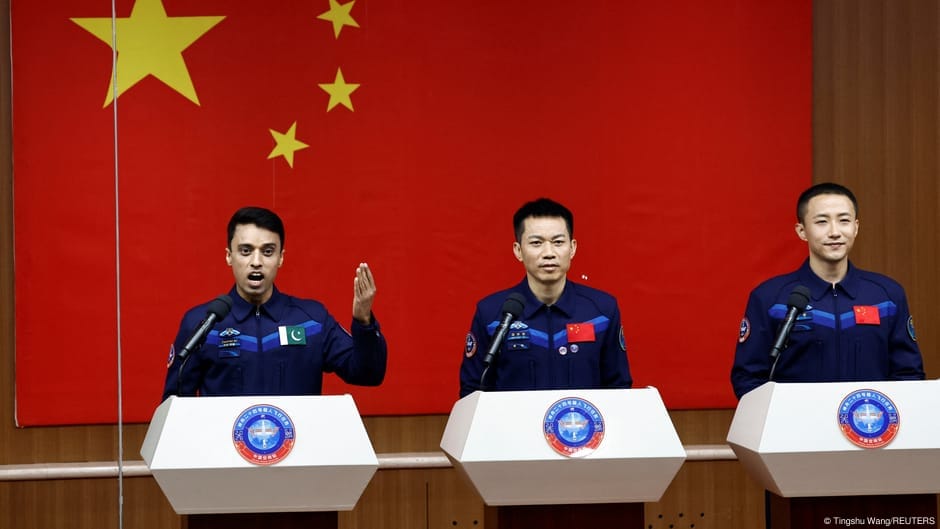
He demonstrated his prowess at a press conference the day before the launch, reciting a line from a classical Chinese poem. Commander Tang Hongbo told reporters that differences in language and culture had made learning to work together more challenging, but that the effort had paid off.
Ali will not stay for the six-month term usually demanded of Tiangong astronauts. Instead, he will return to earth with two of the Shenzhou-23 crew while its commander Zhu Yangzhu will remain to complete another milestone – China’s first full-year stay in space.
Beijing’s accelerated achievements in the skies have spooked its rivals. China is the third country to put humans in orbit and has landed robotic rovers on Mars and the Moon, where it hopes to send crewed missions within the next decade. In racing to the Moon before 2030, Beijing is competing with the US’ Artemis programme. And it is the US that has excluded China from the ISS since 2011, banning NASA from collaborating with Beijing. In 2025 Nasa went further by blocking Chinese citizens from its facilities altogether.
“We know that China is quite keen to develop Tiangong as an international hub,” said Curcio, pointing to China Manned Space Agency documents published in coordination with the UN outlining “Resources for International Cooperation” aboard the station.
In the future, he said, he would expect countries like Brazil and Egypt to seek out the opportunity to send astronauts on Chinese missions. He added: “I think when the ISS is retired, if there is no western replacement (government or commercial), then yes, we may eventually see European or other ISS-involved countries – like Russia – send astronauts to Tiangong.”
- space
- china
- astronaut
- station
- operation
- billion
- race
- russia