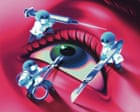
Crocodiles, witches and gremlins. Patients speak on ICU delirium
Patients speak on ICU delirium. Doctors are playing with ICU delirium as they try and end the days of patients struggling with hallucinations and mental health issues during their recovery.
The hallucinations that come with ICU delirium can be horrifying.
Knife-wielding gremlins, "ten-foot crocodiles climbing up the walls" — even a witch making a deadly potion.
The condition can leave patients struggling to make sense of where they are and what is happening around them, and can arise when serious illness, some medications or sleep deprivation interferes with how the brain works.
The environment inside intensive care units can make those things worse.
ICU patients have shared their delirium experiences with 7.30, as Australian doctors try to better understand the impacts of ICU treatment, and improve patient outcomes.
Some studies suggest delirium is linked to long-term cognitive impacts and post-traumatic stress disorder (PTSD) but symptoms are variable, fluctuate over time, and commonly mimic other conditions such as depression or psychosis.
Terry Frawley believed hospital staff were trying to harvest his organs.
It was one of many intense delusions and hallucinations he experienced while recovering from a routine heart operation in ICU earlier this year.
"I saw that ICU room as almost like a torture chamber," Mr Frawley told 7.30.
"The noises, the sounds, the machines, it just seemed to be horrible."
His experience of delirium occurred hours into his recovery, in the open-plan ICU ward at the private St Andrews War Memorial Hospital in Brisbane.
"The beginning of it, I was seeing things, 10-foot-long crocodiles, walls of words, symbols just floating up over the ceiling," he told 7.30.
"They were coded messages. They were crazy."
Aside from the visions, he became paranoid and agitated, believing doctors with "huge needles" in their pockets were "there to harvest my organs".
Mr Frawley says he called the police and his partner Jenny Young.
"I'd got on the phone, I'd rung the police, I'd rung Jenny. I'd pulled drips out of my neck.
Ms Young arrived at 4.30am and witnessed that scene.
"He kept saying, 'Just take me home.' I said, 'I won't.' And he couldn't understand the reason why I wouldn't," Ms Young told 7.30.
While Ms Young and the doctors tried to figure out what was happening, Mr Frawley believed they were conspiring against him.
"I felt utterly betrayed when they started talking, and that's when I just gave up," Mr Frawley said.
"I just dissolved in tears and gave away the scissors, threw them on the floor."
But it wasn't the end of the delirium, for Mr Frawley it came in waves, over two days.
"I'd get my head straight and then it'd come back again. I thought I was clear and I wasn't," he recalled.
"The doctor was very keen to make me believe that it was not my fault, but the fault of the chemicals in my brain interacting."
Intensive care specialist Dr James Winearls has the unique perspective of having been both a physician and patient in his own ward.
While admitted with a severe chest infection and blood clots in his lungs, he became critically ill and delirious.
"It's almost like being in a real life dream — you can't communicate in your dreams even though you think you are — so it's a very unusual dissociative and quite distressing experience," Dr Winearls said.
"I remember one of the nursing staff was making up some medications and the hallucination was of this particular member of staff — who I knew extremely well and was a wonderful nurse — as a witch making up potions in a cauldron that was specifically going to try to kill me.
Octogenarian Cluny Seager has decades of experience working and volunteering in hospitals, but when she was admitted to the ICU at St Andrews for life-saving heart surgery three months ago, she felt entirely unprepared.
"The hallucinations, I mean, you hear about them," she told 7.30, "but they can't describe them to you."
"I was lying there and ... little gremlin people were trying to saw off the top of my head.
"But they couldn't get in there because there was a surgical steel plate on the top of my head, and they couldn't get in underneath, but they were making a lot of noise.
That wasn't her only experience. The next time she saw red patent leather heeled shoes under her bed.
While Cluny says she has been able to shrug off her experience, it hasn't been the same for many others.
Peer-reviewed published research has linked delirium in ICU with longer hospital stays and problems with thinking and memory after discharge.
One review estimated that approximately 20 per cent of adult ICU survivors experienced symptoms of PTSD after discharge, approximately 10 times the normal community incidence.
"I still hear, and remember, me screaming. I still remember pulling the [drips] out. It's crystal clear. None of it has gone away," Mr Frawley told 7.30,
Even with the support of his colleagues and family, it took Dr Winearls several months to return to work in the ICU.
"I spent quite a bit of time undergoing rehabilitation and both physical and mental rehabilitation," he told 7.30.
"There were several times when I would go into the unit and I'd not actually be working clinically, but something would happen, a noise would ping or something, you'd smell something and {I would] burst into tears and have to leave."
Professor John Fraser is Director of Intensive care at St Andrews and is leading research into delirium. He believes the loud and bright ICU environment is a causal factor.
"We measured the volume, and it's the equivalent — during the daytime — of being in the middle of a six-lane motorway, because the beeps and the bongs are everywhere -- the ventilator, the monitor, six infusion pumps, the dialysis machines," Dr Fraser told 7.30.
"Delirium increases your mortality, increases your intensive care length of stay, your hospital length of stay."
"It's great that we get our patients to survive, but what we have to aim for is that they thrive."
Along with Brisbane’s Critical Care Research Group, Professor Fraser has co-designed a study to test whether quieter ICU care rooms can improve sleep, reduce delirium and support recovery.
The team has called the project the 'ICU of the Future'.
A randomised trial has been taking place at Brisbane's public Prince Charles Hospital since 2022.
Two ICU rooms have been isolated and retrofitted to be calmer, with artificial lighting and digital windows.
Professor Fraser's counterpart Dr Oystein Tronstad, estimates that approximately 200 patients have been treated in either of the two rooms, with around 80 surveyed.
"Patients are telling us these beds are more comfortable than other spaces. Less stressful, they feel they can sleep better," Dr Tronstad said.
The research group says its preliminary data suggests delirium rates were around 10 per cent lower among patients in the redesigned bedspaces. Further research is needed to establish whether the changes improve recovery.
Three new future ICU beds opening at St Andrews War Memorial Hospital will speed up the research.
"Before we can get to that point where we can say 'this should go into every bed space', we have to also prove an actual reduction in delirium," Dr Tronstad said.
For Dr Fraser there is a personal side to this professional endeavour.
He still has handwritten notes his late father penned while experiencing ICU delirium 30 years ago -- including a single-word plea of “help”.
"I think that note encapsulates the fear, the night terrors," he told 7.30.
"Our job [is] to try and not make the patients feel like this, not make them scared.
Dr Winearls agrees patient treatment needs to be improved.
"I think you've got to think not just about quantity, but quality of life," he told 7.30.
"By definition, our career is to try and save a life ... but we have to try to improve the quality for the survivors.
"If we can improve that experience in the intensive care unit, even just by a little bit, hopefully that will have significant ramifications for longer term physical and psychological recovery, hopefully."
Mr Frawley hopes sharing his story might help others realise their delirium experiences aren't uncommon.
Watch 7.30, Mondays to Thursdays 7:30pm on ABC iview and ABC TV
- icu
- delirium
- patient
- crocodile
- witch
- gremlin
- doctor
- hallucination