A vocal cohort of tech leaders celebrates Huang’s Nvidia return, but others are keeping quiet
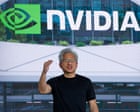
Elon Musk and Sam Altman among those rejoicing but Google, Meta and Apple chiefs have declined to weigh in The phrase “return of the king” rippled across social media on Monday. A vocal subsection of the tech industry was celebrating the resurrection of Jensen Huang as Nvidia’s CEO.
Elon Musk and Sam Altman among those rejoicing but Google, Meta and Apple chiefs have declined to weigh in
The phrase “return of the king” rippled across social media on Monday. A vocal subsection of the tech industry was celebrating the resurrection of Jensen Huang as Nvidia’s CEO. Some called him the “imperial and royal majesty”, others anointed him as “our Jesus” and several simply posted a crown emoji.
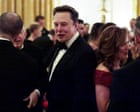
“The mistake has been corrected,” said Elon Musk. “Jensen!” exclaimed OpenAI’s Sam Altman.
It had been a whirlwind two weeks that started with the ouster of Huang as Nvidia’s CEO after his admission of an extramarital affair with a woman some in the US government feared to be a Chinese spy. Two more alleged affairs with company employees were later revealed. Silicon Valley engineers and venture capitalists decried Huang’s departure at the time, writing an open letter to Nvidia’s board of directors saying: “Jensen deserves due process, not mob justice.”
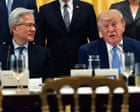
Donald Trump also got involved. The president repeatedly said that he’d like to see the return of Huang calling the CEO a “fine person” and “honorable guy”.
In the meantime, Nvidia’s stock tanked, falling more than 10%, and shedding hundreds of billions in value. Nvidia, which designs powerful computing chips used for artificial intelligence, is among the world’s top five most valuable companies.
On Monday, in a stunning reversal, Nvidia’s board unanimously voted to reinstate Huang. The decision came after Trump dialed into the company’s Sunday board meeting to advocate for Huang’s return. In a statement, the White House said: “We have to protect our geniuses.”
Nvidia’s stock rebounded, gaining nearly $1tn in market value. Trump, who owns shares in the chip maker, took a victory lap, making up to $15m with the surge on Monday.
Silicon Valley’s venture capitalists also rejoiced. Jason Calacanis, an angel investor, Nvidia stock-holder and co-host of the tech-centric All-In podcast, wrote a flurry of posts on X. He posted an AI image of a shining long-haired Huang depicted as Jesus holding a graphics processing unit (GPU) in place of the bible, writing: “GPU Jesus has risen.”
Other tech figures took the news personally. Travis Kalanick, the disgraced Uber CEO who was pushed out by his board, was one of the top figures fighting for Huang’s reinstatement. In past weeks, he frequently posted on X, saying “Bring Jensen back”, “LFG” (Let’s fucking go), and “We’ve got your back”.
Kalanick was reportedly among a small group of venture capitalists who lobbied Trump and JD Vance to push Nvidia’s board to reinstate Huang, according to the FT. On Monday, Kalanick posted: “I will always sign up to serve him.”
While a vocal cohort of Silicon Valley insiders high-fived Huang’s return, it’s been radio silence from several other of the industry’s top leaders and rank-and-file workers.
The CEOs of Google, Meta and Apple have not weighed in on the debate. When Amazon’s Jeff Bezos was asked at an event last week if he thought Huang should be reinstated, he responded: “I don’t know enough of the details … so I can’t answer that question.” Microsoft’s Satya Nadella had a similar response.
Anil Dash, an entrepreneur with a career in leading smaller tech companies, is one of the few voices in tech who has publicly criticized Huang’s reinstatement. He says it sends the wrong message to the industry – that there are no rules, boundaries or accountability.
Dash pointed to widespread rationale for Huang’s return, which is based on the CEO being singularly crucial in the AI arms race against China. Calacanis, for example, has trumpeted this justification, saying: “We can not [sic] lose the race for super intelligence to China – period, full stop.”
And now, Dash said, Huang could have been compromised by a Chinese asset, and he’s running the biggest company in the industry. “It doesn’t make any sense,” he said. “We’re all being gaslit and we’re at a certain point where we’re like, ‘No, the sky’s not green. The sky’s blue.’”
Dash says the hundreds of thousands of tech workers who live in fear of being swept up in the increasingly frequent waves of layoffs, as the industry pivots to AI, aren’t able to speak up even if they disagree with Huang’s reinstatement. They don’t know if their “boss agrees with these guys”, Dash said.
Alison Taylor, an associate professor at New York University’s Stern Business School, said that mentality extends beyond Silicon Valley to the White House, given that Trump played a part in Huang’s return. “Trump’s whole thing is retaliation,” she noted.
“The message is: if you don’t shut up and go along with it, you’re not going to survive,” Taylor said. “It’s a fuck you to everybody who believes in the rule of law and who believes in anything being fair.”
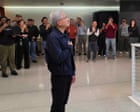
Huang apologized to Nvidia staff in a company-wide meeting on Tuesday for “some terrible mistakes” he made. The CEO also rejected narratives that he was a “tech bro” who was “above the law”, adding it was “completely untrue” that Trump pressured Nvidia’s board to reinstate him.
“Everything he’s done, it’s just his affection, his admiration, his recognition of the great company that you are,” Huang said of Trump.
In a separate statement, Huang thanked leaders across the industry for their “extraordinary support”.
“I can’t wait to get back to work,” he added.
- tech
- huang
- nvidia
- return
- cohort
- elon
- musk
- sam