EU-Indonesia trade deal opens new markets, but challenges remain
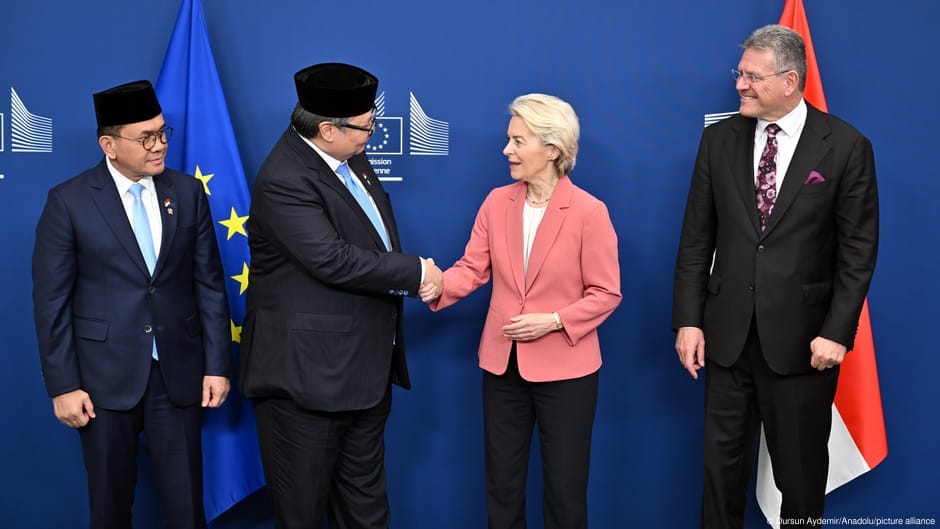
The agreement offers new export and investment opportunities for Jakarta and Brussels. But can Indonesia turn Europe's growing interest in its markets and critical minerals into sustainable gains at home?
As the European Union seeks to deepen its presence in Asia and diversify its trade relationships, Indonesia is emerging as an increasingly important partner.
At a signing ceremony in Brussels last week, European Commission President Ursula von der Leyen described the bloc's trade agreement with Jakarta as one of its "most ambitious deals" in the region, linking markets of 730 million people.
The deal, the culmination of nearly a decade of negotiations, reflects the EU's efforts to diversify its trade partnerships, secure access to critical raw materials and reduce strategic dependencies on China.
For Indonesia, it offers opportunities to attract investment, expand exports and strengthen its position in global supply chains.
The agreement will gradually scrap tariffs on more than 98% of product categories, covering almost the entire value of bilateral trade over 15 years.
For the EU, gaining better access to critical raw materials, particularly nickel, and diversifying its supply chains are central to its strategic partnership with Indonesia, said Philip Schleifer, an associate professor of political science at the University of Amsterdam.
"The main strategic interests are opening up a large and growing market for European companies, diversifying and deepening its economic partnerships, reducing strategic dependencies on China, and securing access to critical raw materials," Schleifer told DW.
Indonesia's mineral resources are particularly important for Europe's green and digital transitions. Nickel, for instance, is a key material for batteries and electric vehicles.
The agreement also creates opportunities for European investment in strategic sectors, including electric vehicles, electronics and pharmaceuticals.
But Indonesia has its own industrial ambitions. The government wants to move beyond exporting raw materials by developing domestic processing industries and retaining more value from its natural resources.
"The challenge for the EU is to reconcile its own interest in securing raw material supply with Indonesia's industrial development objectives," said Eline Blot, a senior policy analyst at the Institute for European Environmental Policy (IEEP).
Yose Rizal Damuri, an economist at the Center for Strategic and International Studies (CSIS), said his institution's study estimates Indonesian exports could increase by around 60% in the coming years.
"Not only can Indonesia increase exports to Europe, but it can also become more strongly integrated into the global supply chains of European companies," Yose told DW.
Potential beneficiaries include labor-intensive manufacturing sectors such as textiles, garments, footwear and furniture, alongside other Indonesian commodities and manufactured products.
The agreement could also encourage European investment and create employment opportunities. However, Yose stressed that access to the European market does not automatically translate into higher exports.
He identified three priorities for Indonesia: raising awareness of the agreement among domestic businesses, strengthening production capacity and improving the country's business climate.
"Various trade agreements signed by Indonesia have relatively low utilization rates. The value of exports using these facilities remains limited compared with overall export values," he said, emphasizing the need for better information and outreach to producers.
Syafruddin Karimi, an economist at Andalas University, also highlighted the opportunity to diversify Indonesia's export markets and reduce dependence on major trading partners such as China, the United States and regional Asian economies.
However, he warned that Indonesian producers must improve their compliance with European standards.
"Products must be traceable, including whether their production involves environmental damage or labor practices that undermine human dignity," Karimi said.
He added that smaller businesses would need greater government support to meet requirements concerning raw materials, production processes and workers' rights.
The expansion of trade and investment could also increase environmental pressures, particularly in nickel mining, palm oil production and manufacturing.
IEEP analyst Blot warned that increased production without stronger environmental safeguards could worsen pollution, ecosystem degradation and industrial emissions. "Nickel mining and processing can contribute to pollution and ecosystem degradation, while palm oil remains closely associated with deforestation," she said.
The growing importance of Indonesian iron and steel exports also raises concerns about emissions from energy-intensive production.
The EU's Deforestation Regulation (EUDR) presents another challenge for Indonesian producers, particularly small-scale farmers who may lack the resources, technical capacity and documentation needed to demonstrate compliance.
Blot acknowledged that these requirements could create disproportionate costs for smaller producers and potentially favor larger companies.
However, she cautioned against using smallholders' livelihoods as an argument to weaken environmental regulations.
"Rather than weakening environmental requirements, the priority should be to ensure that smallholders receive adequate financial and technical support to meet them," she said.
Professor Schleifer at the University of Amsterdam also warned that growing global demand for Indonesian natural resources could create environmental and social problems previously associated with commodities such as timber, palm oil and coal.
While Indonesia has considerable bargaining power because of its mineral wealth, the challenge is ensuring that increased demand translates into domestic industrial development rather than simply expanding resource extraction.
The agreement includes a dedicated Trade and Sustainable Development chapter covering climate change, biodiversity conservation, sustainable forest management and labor rights. It also provides mechanisms for cooperation and civil society participation.
However, there is no guarantee these commitments will be implemented. "Experience with other EU trade agreements suggests that there is often a big gap between sustainability commitments on paper and outcomes on the ground," Schleifer said.
For Indonesia, the challenge also lies in preparing domestic industries to compete. Karimi stressed that the government, both at national and regional levels, must work with businesses to improve production standards, particularly among small and medium-sized enterprises.
Yose also emphasized the importance of a predictable business environment, warning that frequent policy changes and regulatory uncertainty could discourage investors.
"Without improvements in the domestic business climate, this will not become a reality. Everything will remain good on paper but will not turn into real momentum for change," he said.
Ultimately, the trade agreement offers Indonesia an opportunity to strengthen its position in international trade and attract investment from Europe.
But whether the agreement delivers broader economic benefits will depend on the country's ability to develop competitive industries, move into higher-value production, and ensure that environmental protection and workers' rights are not overlooked.
DW's Muhammad Athif Aiman contributed to this article.
- indonesia
- trade
- deal
- market
- challenge
- agreement
- export
- investment


