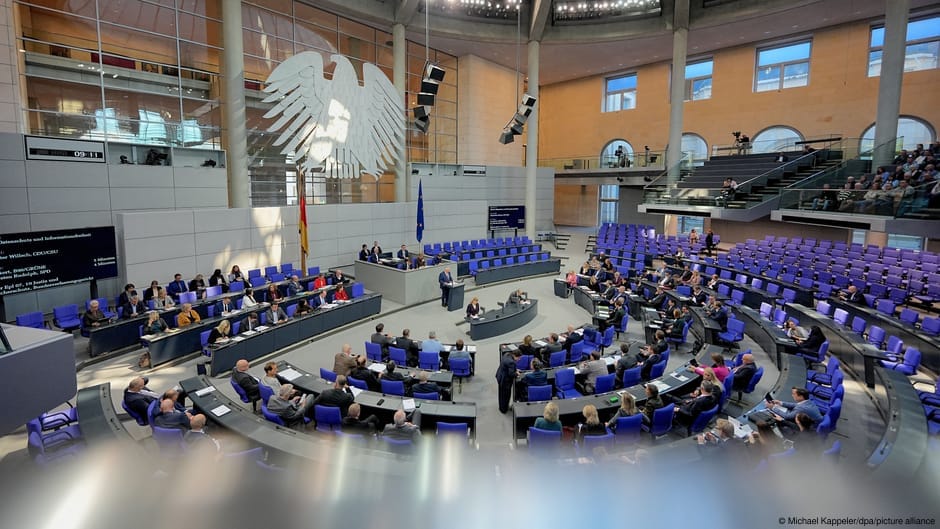
Germany's tiny BSW is a party in crisis as it is set to hand the far-right AfD power in Saxony-Anhalt
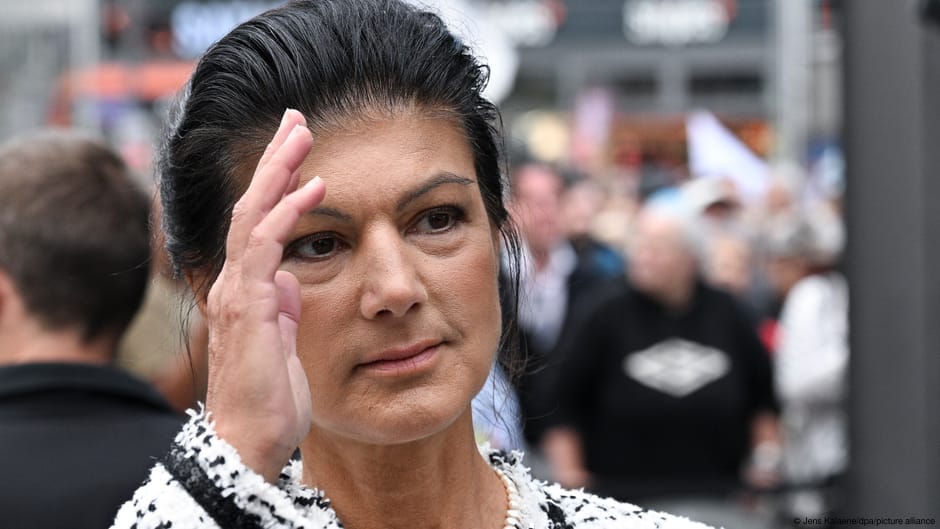
Sahra Wagenknecht's BSW party is set to disrupt German politics yet again. Espousing a mix of left-wing economic policy and populist far-right anti-migration rhetoric, it now stands to play kingmaker to the far right AfD
This fledgling party has experienced many highs and lows in quick succession. Launched in January 2024, it was named the Sahra Wagenknecht Alliance (BSW) to capitalize on the high profile and momentum of its founder, a former communist who had just exited the socialist Left party.
Since October 2026, the acronym BSW has instead stood for theAlliance for Social Justice and Economic Reason. In the past 34 months the newcomer party celebrated election successes at the European Parliament level and in German state elections. In the eastern states of Brandenburg and Thuringia, the party even took part in governing coalitions; however, both of these collapsed relatively quickly.
Even more painful for the BSW was its defeat in the general election in February 2025. The party failed to gain the 5% share of votes required to enter parliament, by less than 10,000 votes. With that, it was denied the country's most important political stage and took the matter to court, demanding a complete recount.
But Germany's Constitutional Court dismissed the BSW's election challenge as inadmissible, pointing to a lack of evidence. "Simply insinuating the possibility of voting errors or expressing an unproven assumption does not meet the requirements for claiming an electoral mistake," the court explained. The court's decision was published about a week before the party's federal conference is due to be held in Dresden, the capital of the eastern state of Saxony.
"Germany's election scrutiny process resembles that of a 'banana republic'," was the angry reaction of former party leader Sahra Wagenknecht, who stepped back from frontline leadership of her eponymous party in December 2025. Since then, she has led its commission on fundamental values.
One of her successors at the top of the BSW is European Parliament lawmaker Fabio De Masi. In his view, the decision of the Constitutional Court was a "black day for democracy in Germany." Fellow co-leader Amira Mohamed Ali did not want to accept the rejected recount. "It remains unclear whether the Bundestag is correctly composed and whether the approximately 2.5 million BSW voters have unjustly been deprived of their parliamentary representation," she said.
The disappointment at the failure to enter the Bundestag runs deep. The party has not recovered from this setback. It again failed to win representation in 4 out of 5 state parliaments in elections this year, albeit narrowly.
In Baden-Württemberg and Rhineland-Palatinate, as well as in the city-state of Hamburg in 2025, the BSW received less than 2%. This clearly shows that it is politically irrelevant in the western German states.
They find themselves in the spotlight, however, because of the role they are set to play in the eastern state of Saxony-Anhalt, where the BSW got 5.3% of the vote in September.
Despite being the smallest party in that state parliament, they are set to play a pivotal role. They are the only political party that has indicated a readiness to help the election winner, the far-right Alternative for Germany (AfD) into power.
The AfD, which is classified as right-wing extremist in Saxony-Anhalt by Germany's domestic intelligence agency, won the election with almost 44% of the vote. Although his party does not hold an absolute majority in parliament, lead candidate Ulrich Siegmund wants to be voted Germany's first-ever AfD state premier in December.
The BSW has not indicated any intention to vote for Siegmund, but if he falls short of winning the absolute majority of 42 votes in the first two rounds of voting, a third round will be held in which a simple majority will suffice to win. The BSW has announced plans to abstain from that vote. Siegmund would then only need to pick up one more "yes" vote or abstention.
During the secret ballot for the state parliament speaker, AfD candidate Tobias Rausch received 9 votes more than his party has lawmakers. It is not known exactly who they came from. Alongside the AfD and BSW, there are 4 other parties in the state parliament: the conservative Christian Democrats (CDU), environmentalist Greens, socialist Left Party and center-left Social Democrats (SPD).
The situation in Saxony-Anhalt will be at the center of the party's upcoming conference in Dresden, because the BSW's increasing closeness with the far-right party is highly controversial.
Several BSW members, including board member Christian Leye, criticized this path in a column published in the weekly magazine Die Zeit. They recalled their party's founding consensus: "The clear political demarcation from the AfD." They quoted party founder Sahra Wagenknecht, who at that time said: "Of course we will not collude with the AfD."
"We are starting a party so that all the people who are considering or have voted for the AfD out of anger or disappointment — but not because they are right wing — have a credible political home," she continued.
Wagenknecht has long argued that the so-called "firewall" policy of mainstream parties refusing to work with the AfD has failed. This is also why she is rejecting the idea of entering a mathematically possible governing coalition with the other parties in Saxony-Anhalt. "We are basically agreed that we neither want to go into coalition with the AfD, nor tolerate them, just as much as we do not want to participate in a firewall coalition," she told German news agency dpa.
How the BSW plans to make its way through this dilemma at its party conference is totally unclear. Fabio De Masi, who replaced Wagenknecht as co-chair in December 2025, seems well aware of this. He told German media network RND that dealing with the AfD continued to be like "riding on the edge of a razor blade."
- bsw
- party
- afd
- crisis
- power
- germany
- saxony
- anhalt