Divisions deepen between EU member states after tense budget summit
An EU leaders summit on the bloc's seven-year budget fell apart amid divisions over how to fund Ukraine. The budget proposal also includes a 3% tax on US tech companies, in a bid for the EU to generate additional funds.
EU leaders arrived in Brussels braced for a difficult showdown over the bloc's multitrillion-euro seven-year budget. But few expected the summit to unravel so quickly, with talks breaking down late on Thursday night.
Squabbles and thinly veiled public barbs meant they left without a deal and didn't even attempt to resume discussions on the planned second day.
There is a self-imposed deadline to find agreement before the end of 2026 on the budget which covers the 2028-2034 period. But experts say there is no cause for alarm, yet.
"Every time there are long-term EU budget negotiations, there are breakdowns, chaos, recrimination and a lot of political theater and drama," said Jacob Funk Kirkegaard, an EU economist and expert at the Bruegel think tank in Brussels.
The center of that political theater this time was the prime ministers of Denmark, Sweden, Belgium and Austria — countries wanting a reduced budget — who staged a walkout during smaller, group meetings, claiming the atmosphere had not been constructive to getting a deal.
Hungarian Prime Minister Peter Magyar called the whole summit "completely unnecessary," pointing the blame at the man who had decided to call it and whose job it is to meditate the talks, European Council President Antonio Costa.
Costa was diplomatic in defending his decision to bring the leaders to Brussels, telling the press: "For me it was very useful to figure out the parameters of a possible landing zone in December."
Long before the summit started, Germany had laid down an ultimatum — Berlin would only sign off on the budget if all the other EU countries greenlit an additional €45 billion ($49 billion) support loan for Ukraine to fund the country in its war efforts through 2027.
Hungary, Czechia, Bulgaria and Slovakia have dug their heels in against the proposal, insisting that giving Ukraine money to buy weapons will prolong the war. Slovak Prime Minister Robert Fico even accused Germany of "blackmail."
As Europe's biggest economy, Germany's contribution amounts to around 25% of the whole budget.
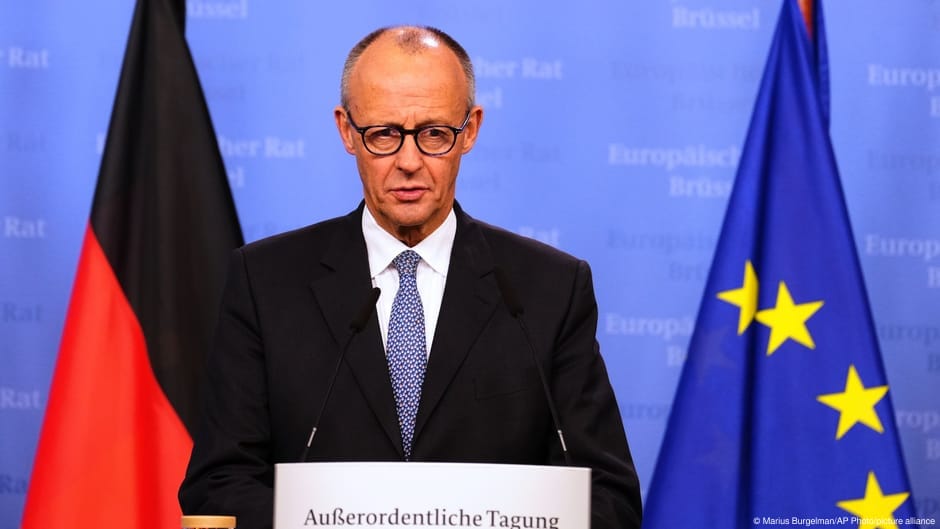
In a press conference after the summit, German Chancellor Friedrich Merz said "hundreds of billions" still need to be slashed. The European Commission's original proposal of approximately €1.786 trillion had already been reduced by €204 billion (down 10.2%).
"Europe needs to exercise a sense of proportion," said Merz. "The budget cannot grow indefinitely, and the burden of financing it must be distributed fairly."
Merz also aimed a comment toward Costa, who has been renewing the details in the budget proposal at every stage.
"The proposals that have been on the table so far are not a basis for an agreement," said Merz.
Costa did tell leaders on Thursday that he is planning to cut between €220 billion to €230 billion out of the next proposal.
Berlin's budget reduction push is backed by six other countries who together call themselves the "Sensible Seven." All pay more into the collective EU financial pot than they receive out of it.
They are opposed by 17 EU member states who insist the total budget should grow, led by France and Italy. These countries call themselves the "Friends of Cohesion" — a nod to the EU cohesion funds which are used to share wealth from the EU's richer regions and nations to its poorer ones.
In the current proposal, agriculture, fisheries and cohesion spending falls from 59.1% to 42.4%, while money for economic competitiveness, security, and defense rises from 17.7% to 27.7%. This rebalancing is a key German demand.
The EU is also searching for a way to add money into the budget that doesn't come from national contributions. The current proposal includes a controversial EU-wide digital tax which could chart a course for a major battle with the US.
The idea, originally put forward by French President Emmanuel Macron, is for a 3% tax on revenues of online advertising, online marketplaces and on the monetization of user data. The money, to be paid directly into the EU's budget, is estimated to bring in €5 billion per year.
But the proposal is ringing alarm bells in Ireland where US tech giants like Google, Meta, Apple, Microsoft and LinkedIn are headquartered.
"A digital tax is sending out all the wrong messages," said Irish Prime Minister Micheal Martin, who could still veto the proposal.
There is a fear in some European capitals that without being able to generate its own funds, future EU loans could downgrade the European Commission's unblemished standing on international markets.
The EU has around €860 billion in outstanding debts it took out for its pandemic recovery funding and to support Ukraine. Its triple-A credit rating could be downgraded if Marine le Pen, the far-right front-runner in France's presidential election, wins in the spring and follows through on her promise to reduce French contributions to the EU budget.
EU member states that favor a financing model through national contributions rather than through tax revenue "understand very well what will happen if the EU loses its triple-A rating," said Bruegel's Kirkegaard. "Interest rate costs will go up even more. Who has to pay for that? Net contributing countries, like Germany, the Nordics, the Dutch, which is why they are much more open to this than in the past."
Other European tax experts believe that prior examples of these digital taxes show the costs outweigh the benefits.
"We analyzed the states which have a digital services tax [DST], and we've seen that economic cost exceeds the revenue generated," said Cristina Enache, an economist at the Brussels-based nonprofit Tax Foundation Europe. "Spain has a DST and the expected revenue was twice or three times larger than what they actually are collecting."
Enache called the tax proposal "politically impossible."
EU leaders know that the clock on their end-of-2026 deadline is ticking, and will return to the same conference rooms in late December hoping for a more conducive atmosphere to strike a deal.
- budget
- summit
- division
- member
- state
- leader
- bloc
- ukraine