Rare Nanotyrannus skeleton sells for $47.3m at New York auction
Sale makes ‘Jodi’, a smaller relative of T rex, the ‘second most valuable dinosaur ever sold at auction’, Sotheby’s says A rare skeleton of a Nanotyrannus, a smaller relative of the Tyrannosaurus rex, sold at auction in New York this week for $47.3m, making it one of the world’s most expensive fossils. The skeleton, named “Jodi” after the person who found the remains in 2019, sold at Sotheby’s on Tuesday for $47.3m, “after a twelve-minute bidding battle that saw six bidders compete online and over the phones, before ultimately selling on the phone,” Sotheby’s said in a statement.
Sale makes ‘Jodi’, a smaller relative of T rex, the ‘second most valuable dinosaur ever sold at auction’, Sotheby’s says
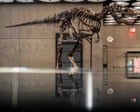
A rare skeleton of a Nanotyrannus, a smaller relative of the Tyrannosaurus rex, sold at auction in New York this week for $47.3m, making it one of the world’s most expensive fossils.
The skeleton, named “Jodi” after the person who found the remains in 2019, sold at Sotheby’s on Tuesday for $47.3m, “after a twelve-minute bidding battle that saw six bidders compete online and over the phones, before ultimately selling on the phone,” Sotheby’s said in a statement.
Sotheby’s initially estimated that the skeleton would sell for $6m to $9m. Tuesday’s result makes “Jodi” the “second most valuable dinosaur ever sold at auction”, Sotheby’s noted. The buyer has not yet been identified publicly.
The skeleton, which was unveiled at a Manhattan auction earlier this month, was discovered by Jodi Pierson in 2019 on her privately owned land in the Hell Creek Formation in Garfield County, Montana, near the town of Jordan. According to Sotheby’s, the skeleton measures 19.6ft long from nose to the tail, and around 9.6ft tall on the armature, and is “comprising approximately 191 fossil bone elements”.
In a statement on Tuesday, vice-chairman and Worldwide Head of Science & Natural History at Sotheby’s, Cassandra Hatton, thanked the team who assisted in the efforts to “excavate and save ‘Jodi’”.
“Their passion and expertise have been fundamental to Jodi’s story,” Hatton said. “From the discovery and excavation, their commitment to understanding and preserving this remarkable specimen has helped bring us to this moment, a testament to the fact that we can all make major contributions to science. This exceptional result is a wonderful recognition of that work, and of the enduring fascination with the Nanotyrannus.”
“Jodi” is one of only “three substantial Nanotyrannus skeletons known to science, and the first to come to market since the genus was confirmed last fall,” per Sotheby’s. Judging from the overall size and degree of bone development, “it can be determined that the skeleton belonged to an adult individual,” according to a description on Sotheby’s website.
Sotheby’s described the nanotyrannus as “a fast, highly specialized carnivorous tyrannosaurid that lived alongside Tyrannosaurus rex at the end of the Cretaceous, about 67 million years ago”. It added that “previously hypothesized by some to be adolescent T rex, Nanotyrannus has been shown to have over 150 morphological differences that distinguish it from its much larger cousin”.
Notably, the sale and cost of the fossil has prompted criticism from some in the science community.
Thomas R Holtz Jr, author and principal lecturer on vertebrate paleontology at the University of Maryland, said that as a “tyrannosaur researcher”, his “concerns about the sale of Jodi are the same general concerns about all these multimillion-dollar sales of fossils.
“At the same time this sale went on, some museums are closing (the Academy of Natural Sciences at Drexel in Philadelphia) or being threatened with closure (the Sternberg Museum of Natural History at Fort Hays State University) because of cost overruns literally only 1/10th that of the final cost of Jodi.
“So a person really interested in paleontology could do vastly more good by supporting the ongoing operations of multiple museums than the sale of one specimen. And indeed, the total cost of excavation, preparation, and mounting of a skeleton like this is probably on the order of $1m at most, possibly much less. So a well-funded museum would be able to gather multiple good skeletons for the price of this one ‘trophy.’”
He also emphasized that “potentially scientifically significant fossils” like Jodi “can be lost to research and the public when they are in private hands”.
“Now maybe the as-yet unidentified purchaser will donate it to a museum or similar institution, where the public can see it and where scientists now and in future generations can measure the bones, take samples and scans of the fossils, and apply current analytical procedures (as well as procedures no one has dreamed of yet) to help us better understand the biology of these ancient animals. But if it simply graces the lobby or ballroom of one of some billionaire’s mansions, unseen and unaccessible to all but their friends, servants and so forth, it is effectively lost to both the public and the scientific community. In fact, at that point, it is no different than if it had just been left in the ground,” he said.
Linda Ivany, a professor of evolutionary paleoecology at Syracuse University, echoed similar sentiments to the the New York Times: “These amazing fossils should stay in the public sphere for scientists to study, for children to be awed and inspired, and for everyone to be able to marvel at worlds long past and what we can learn from them.”
- skeleton
- auction
- nanotyrannus
- york
- sotheby
- rare
- jodi
- relative