Israel election too close to call as exit polls give Netanyahu bloc slightly fewer seats

Early indications suggest it will be some time before the shape of new government and who will lead it is clear Israel election – live updates Israel’s election appeared to have delivered no clear winner on Tuesday night after a historic turnout by voters for an election described by some as the most consequential in the country’s history, and marked by a record participation by Israeli Arab voters. Exit polls published on Tuesday evening suggested that the opposition bloc of parties led by the former chief of staff of the Israel Defense Forces, Gadi Eisenkot, would win most seats in the Kness
Early indications suggest it will be some time before the shape of new government and who will lead it is clear
Rise of Palestinian parties in Knesset will redraw Israel’s political landscape
Israel’s election appeared to have delivered no clear winner on Tuesday night after a historic turnout by voters for an election described by some as the most consequential in the country’s history, and marked by a record participation by Israeli Arab voters.
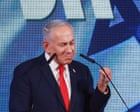
Exit polls published on Tuesday evening suggested that the opposition bloc of parties led by the former chief of staff of the Israel Defense Forces, Gadi Eisenkot, would win most seats in the Knesset by a slight margin, edging out Benjamin Netanyahu’s right and far-right coalition despite the prime minister’s Likud emerging as the largest party.
The result is likely to set off weeks of jockeying over who can form a coalition government before a prime minister is declared or another round of elections is called, but represents a sharp electoral rebuke to Netanyahu.
After a day in which Israelis streamed to polling stations across the country, exit polls suggested Netanyahu’s ability to command the loyalty of a large core of Likud party voters remained undimmed despite his rejection by large numbers of Israelis.
The predicted haul of up to 18 Knesset seats for Israeli Arab parties is likely to make them the kingmakers in what seem certain to be protracted talks to form a new government, with Netanyahu likely to fall short of the support required to form a new coalition.
While Eisenkot could theoretically assemble a majority by forming a government with the Arab parties, he ruled that out before the election.
The exit polls – if they prove accurate – suggest a struggle for either Likud or Eisenkot’s Yashar to find a road to a majority in the 120-seat Knesset. Likud’s projected showing, not for the first time, appears to have defied predictions in the run-up to the vote.
However, the stalemate could yet work in Netanyahu’s favour, allowing the prime minister to remain in power in a caretaker capacity. What is clear, however, is that Netanayhu no longer has a claim to a mandate with his political fate hanging in the balance.
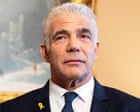
Opposition figures were quick to cast the exit polls as a defeat for Netanyahu, with former prime minister Yair Lapid saying: “Netanyahu’s bloc has suffered a crushing defeat. This is a total collapse. The public has told them to get out.”
For his part Eisenkot called the exit polls a vote of “no-confidence in Netanyahu. If these are the final results, it’s a complete victory for Israel’s mainstream majority. I’ll work immediately to enact the will of the nation, to change Netanyahu’s government … as soon as possible.”
The exit polls were released after a last-ditch effort by Netanyahu and several other parties to keep polling stations open beyond their 10pm deadline was rejected by the Central Elections Committee. The prime minister had suggested publicly that efforts were being made by the “left and Arabs” to steal the election, a claim rejected by the committee that said it had seen no evidence of systematic tampering.
Entangled in a long-running corruption trial, Netanyahu and his far-right coalition had stoked xenophobic fears and suggested Israel would be vulnerable to a nuclear attack without him.
Tuesday’s election, which drew the highest turnout in 50 years, had been framed as a referendum on nearly 17 years of unbroken rule by Benjamin Netanyahu, who has most recently overseen three years of unprecedented conflict, instability and growing international isolation.
With more than 7 million people eligible to vote, by 6pm voter turnout was 77.1% – a rise of about 9% on the previous election – with marked increases in the number of serving military members voting. There were also reports of tens of thousands of Israelis living abroad who had arrived to vote in recent days, with many still arriving at Ben Gurion airport to cast their ballots on Tuesday.
Voting was heavy in a number of major cities, including Tel Aviv and Haifa, which some analysts had suggested would benefit the opposition, with long queues to vote in some locations. That pattern was repeated in Israeli-Arab towns, many of which have a long history of boycotting elections.
As polls opened on Tuesday, Netanyahu and his far-right coalition allies launched what critics condemned as a scare campaign to encourage their supporters to turn out, with the familiar racist tactic of warning that large numbers of Israeli Arabs would be voting. Netanyahu made a similar claim to rally support in 2015.
In a recorded message to voters, Netanyahu suggested Arabs and the left were trying to steal the election and Likud claimed suspected irregularities at hundreds of polling stations used by Israeli Arabs.
Israeli citizens of Palestinian origin make up about 20% of the country’s population.
That prompted Netanyahu’s main challenger, Gadi Eisenkot, to say Netanyahu was laying the ground to challenge the result.
“Netanyahu has returned to his familiar tricks, lies and fearmongering to mobilise voters,” he said. “The same lies we saw in previous election campaigns.”
Since the deadly attack launched by Hamas on Israel’s southern communities on 7 October 2023 – an event that many blamed on Netanyahu’s failings – Israel has devastated Gaza with the loss of more than 74,000 Palestinian lives, fought Hezbollah in Lebanon, occupied new territory in Syria and launched a war with the US against Iran.
Netanyahu and his far-right coalition partners have also attracted international opprobrium for Israel’s actions in the occupied West Bank, where violent Jewish settlers have been accused of pogroms against Palestinians and ethnic cleansing.
Despite the many issues confronting the country, much of the focus in the campaign has been on the contrasting characters of the two main party leaders – the machiavellian, grandstanding Netanyahu, who is on trial for corruption, against Eisenkot, the unpolished former IDF chief of staff who rose from humble origins.
The campaign, unusually febrile even by Israeli standards, included a struggling Netanyahu posting a picture of a nuclear explosion devastating Tel Aviv on the eve of the polls opening.
On Tuesday, encouraging ultra-orthodox voters, Netanyahu – who has long elided his personal and political survival with that of Israel – returned to his apocalyptic language. “The Jewish state is on the brink of ruin,” he said.
In the midst of a major trial for corruption, which has been moving at a glacial pace through the courts, Netanyahu has appeared rattled by the challenge mounted against him by an array of centre-right parties whose unifying pitch has been “anyone but Netanyahu”.
“This is a very moving and fateful moment,” he told journalists after voting, saying he believed the Arab parties that could make or break the election were “receiving massive, truly massive support … heading to the polls in unprecedented numbers”.
Despite tonight’s results, the complexity of Israel’s fragmented political system, with many parties jostling and horse trading, means that it will probably be some time before the shape of any future government – and who will lead it – is clear.
All of which has amplified the importance of Israeli Arab parties, which could emerge as potential kingmakers.
“Our vote will change the government,” the head of the Islamist Ra’am party, Mansour Abbas, said while voting, adding that he hoped turnout would surpass 70% in Arab communities.
Israel’s far-right national security minister, Itamar Ben-Gvir, known for taunting Palestinian detainees and saying some Palestinians in Gaza are “not even people”, said “it will be Mansour Abbas’s government” if Netanyahu and his allies lose.
Underlining the sense of a country at a defining crossroads, an editorial in the left-leaning Haaretz publication had exhorted Israelis to vote, which they did in huge numbers.
“Israel cannot afford another four years under Netanyahu,” it said. “It has exhausted its reserves. The erosion of its diplomatic credit has reached dangerous proportions, and its tired citizens are at the very limits of what they can bear.”
- israel
- election
- exit
- netanyahu
- bloc
- poll
- seat
- voter