Smuggling, power, profit: Irregular migration out of eastern Libya
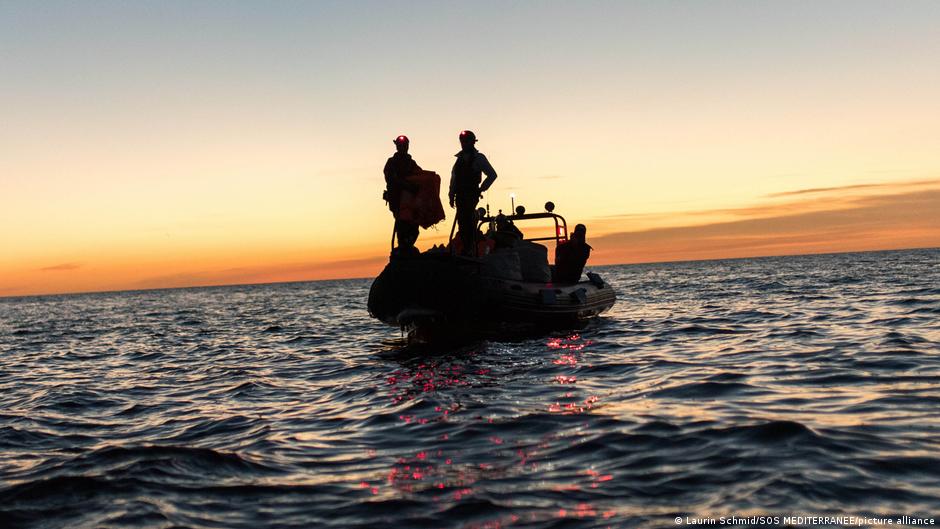
There is currently more irregular migration between eastern Libya and Crete, Greece. It's raising questions as to what connects people smugglers with powerful militias in eastern Libya and then in turn, Europeans.
This year, almost 20,000 people have already tried to make the perilous crossing from Libya in north Africa to the Greek island of Crete.
The route, which runs from the east coast of Libya to Greece, has become an increasingly significant corridor for irregular migration into Europe, Greek daily Kathimerini recently reported.
On Oct. 20 alone, Greek authorities registered 710 people in 14 boats. Hundreds more arrived the next day.
Many of the boats depart from areas around Tobruk, a port city on Libya's eastern Mediterranean coast. According to Kathimerini, migrants pay as much as $4,000 (€3,600) for the crossing, which takes around a day and a half.
This particular route is becoming more popular in part because of crackdowns on alternative passages.
After eastern Libyan armed forces acted against people smugglers heading for Italy in 2023, the smuggling networks changed their methods, using smaller boats and sailing them towards Crete instead.
According to the Global Initiative Against Transnational Organized Crime, a think tank based in Switzerland, other groups have since entered the people smuggling business too, including those who previously mostly moved goods, vehicles or drugs.
Human trafficking in Libya is closely connected with what is known as the "conflict economy."
This sees armed actors gaining economic resources and political influence by controlling informal markets and transport routes. It also sees local power brokers using measures against smuggling to obtain financial or political support for themselves.
"Conflict and subsequent instability in Libya have created a fertile environment for migrant smuggling and TIP [trafficking in persons] activities to develop, in turn leading to the growth of smuggling in other locations along an established route," researchers at British think tank Chatham House wrote, after looking in depth at three different transit hubs across Libya. "This has led to an increase in the number of migrants entering Libya and the expansion of Libya's conflict economy."
"It remains the case that an entire business has developed around smuggling routes, regardless of whether that [smuggling] involves weapons, goods, people or drugs," Hager Ali, a researcher at the German Institute for Global and Area Studies, or GIGA, told DW.
If there are already contacts, transportation and security arrangements in place, then these can also be used for illegal activities like people trafficking, Ali said. Since 2014, Libya has been split into two. In the west, a United Nations-backed administration is based in Tripol; and in the east, in Tobruk, the second Libyan leadership is backed by former warlord-turned-politician Khalifa Haftar.
Haftar has managed to consolidate control over various armed militias, ruling with an iron fist. His sons also hold important positions. However, there are no proven links between the Haftars' networks and people smugglers on that coast.
But, as Ali explained, even the appearance of having some influence over these sectors can confer political influence.
"The more apparent control one has over this market, the greater one's influence," Ali told DW.
Those Libyans who can influence, or even prevent, departures are demonstrating their importance to other actors. For example, high profile operations against the smuggling networks can serve as a sign of political legitimacy. "They present themselves as somebody who can restore order and curb migration," Ali noted.
There's also increasing geopolitical competition in the eastern Mediterranean. In late October, the Tobruk government signed a maritime agreement with Turkey, a deal that Turkey had actually originally concluded with Libya's other government in Tripoli.
Turkey previously fought Haftar-sponsored militias during the Libyan civil war, and this deal represents rapprochement between the two. It is also a way for Turkey to get what it wants in a rivalrous situation in this maritime area — Greece rejects the agreement, saying that it infringes on Greek economic rights around islands like Crete and Rhodes.
A direct link between the new agreement and rising numbers of irregular migrants in Crete is not clear. However, Ali suggested that it wouldn't be inconceivable that irregular migrants could be used as leverage in these kinds of geopolitical conflicts.
The European Union has been cooperating with Libyans to prevent irregular migrants from getting to Europe — despite the Libyan actors' links to armed groups and their disputed political legitimacy.
There's an obvious contradiction in that, argued Andreas Dittmann, a retired professor from Giessen University and expert on human geography and development. Such cooperation between the EU and Libyans can serve as a control on irregular migration but it also adds to the Libyans' local power.
"If those in charge in eastern Libya are actually able to influence the scale and timing of such [migrant] movements, they're demonstrating their own strategic importance to European governments," Dittmann told DW.
A report by the United Nations' International Organization for Migration, or IOM, illustrated how precarious the situation is for many migrants.
According to the report, which is based on data from May and June this year, around 950,000 migrants and refugees were registered as living in Libya. Many have only limited access to healthcare and tend not to have residence or work permits, all of which increases their dependence on informal markets as well as the risk of exploitation.
- libya
- migration
- smuggling
- power
- profit
- crete
- greece
- question