Edward Lucie-Smith obituary
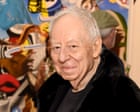
Art historian, critic and poet who hosted ‘the Group’, a literary workshop of the 1950s and 60s The poet, art critic and historian Edward Lucie-Smith, who has died aged 93, was both prolific and polymathic. He wrote almost 100 full-length books, including studies of individual artists and large-scale historical surveys, among them The Male Nude: A Modern View (1985), Impressionist Women (1989) and Art and Civilization (1992).
Art historian, critic and poet who hosted ‘the Group’, a literary workshop of the 1950s and 60s
The poet, art critic and historian Edward Lucie-Smith, who has died aged 93, was both prolific and polymathic. He wrote almost 100 full-length books, including studies of individual artists and large-scale historical surveys, among them The Male Nude: A Modern View (1985), Impressionist Women (1989) and Art and Civilization (1992).
His suspicion of contemporary pieties did not lead him to any quick dismissal of contemporary work; rather, he remained permanently excited by the new, and keen to communicate what he saw in it. In an interview in 2017, he gave his account of what he saw as the value of an art critic: “1. Pointing out what they think is good. 2. Saying why they think it’s good, in terms transparent enough for the audience they are addressing to understand.” His own work more than fulfilled this simple manifesto.
This clarity was also apparent in how he considered his creative medium, poetry. Along with Philip Hobsbaum, he was one of the founders of the contemporary poetry workshop. The venture known as “the Group” was set up by Hobsbaum in Cambridge, as an extension of the literary critic FR Leavis’s undergraduate seminars; it created a space where students could frankly discuss contemporary poetry, offering up complaints and suggestions for improvements.
When Hobsbaum graduated and moved to London in 1955, he set up a second iteration of the Group in his Edgware Road flat; Lucie-Smith joined after four months, and after Hobsbaum moved to Sheffield in 1959, Lucie-Smith became the Group’s presiding spirit.
Meetings were held in Lucie-Smith’s Chelsea house on Thursday evenings – Philip Larkin wrote cattily in a letter to Anthony Thwaite about “Teddy’s Thursday’s”, with the poems to be discussed circulated in advance among members. At first, discussion of the attendees’ own poems was something of an afterthought; gradually it took up more and more of the evening, until the sessions had evolved into something recognisable as the poetry workshop of today.
Regular attendees included the poets Peter Redgrove, Peter Porter, Alan Brownjohn, Martin Bell, Zulfikar Ghose, Rosemary Joseph, George MacBeth, Adrian Mitchell and David Wevill: a roll call of the UK poetry establishment in the early 1960s. Ted Hughes was also a member, but left to accompany Sylvia Plath to the US; however, he continued to send poems to the Group for discussion and dissection.
In his introduction to A Group Anthology (1963), Lucie-Smith wrote: “The only principle to which we would all subscribe is that poetry is discussable, or, to put it another way, that the process by which words work in poetry is sometimes open to rational examination.” This commitment was one that he maintained throughout his career.
Born in a suburb of Kingston, Jamaica, Edward was the son of Mary (nee Lushington) and Dudley Lucie-Smith. John Barkly Lucie-Smith, his grandfather, had been the postmaster general of Jamaica, and Edward, an only child, grew up in comfortable circumstances. He boarded overseas at the King’s school, Canterbury, and went from there to Merton College, Oxford, where he studied history, and began publishing poetry in Oxford Poetry and art criticism in Isis.
In 1954 he gained his degree, and the Fantasy Press put out a chapbook of his work in their Fantasy Poets series. Lucie-Smith’s first full collection, A Tropical Childhood and Other Poems (1961) contains The Lesson, probably his best-known poem today, after Larkin selected it for The Oxford Book of Twentieth-Century English Verse.
It describes the poet’s reaction, at school, to the death of his father, and his realisation that “grief has uses” (it will stop him from being bullied). As the school learns about the death in assembly, there’s a startlingly realised image, characteristic of Lucie-Smith’s poetry: “All the other eyes / Were turned towards me. Somewhere in myself / Pride like a goldfish flashed a sudden fin.”
Lucie-Smith had by this point completed national service as an education officer in the RAF (1954-56) and began working for Notley’s Advertising Agency. The firm had accumulated a surprising number of poets: fellow Group members Porter and Redgrove, along with Wevill’s wife, Assia, were also working there. Porter was the only one able to find poetic inspiration in the work, but Lucie-Smith gained something perhaps more valuable: the painters who hung round the office introduced Lucie-Smith to the artists of the Colony Room drinking club on Dean Street.
In 1970, Lucie-Smith edited the anthology British Poetry Since 1945 for Penguin. A remarkably catholic view of the 25-year period, it holds up very well to this day, finding room not just for establishment stalwarts but also more sidelined poets including Rosemary Tonks, Christopher Middleton and Karen Gershon. But by this point – although he continued writing poetry, with Changing Shape, his new and selected poems (2002) and Surviving (2017) – art criticism had become his metier.
As well as the books, he wrote the Critic’s Diary column, profiles, reviews and longer pieces in Art News and Review (now ArtReview) for nearly 30 years from the 1970s, and contributed to the Listener and the New Statesman. For several decades from the 1950s he was a regular voice on BBC radio, with a series of Conversations With Artists on Radio 3 (1980-82).
While he could take a panoramic view, as in The Thames & Hudson Dictionary of Art Terms (1984), he was also keen to pursue his particular interests, notably as a gay man and photographer in the erotic images of Flesh and Stone (2001). Several images taken by him are held by the National Portrait Gallery in London; among its images of him is a nude faun with quill painted by Beryl Cook. The two were friends, and among their collaborations was a children’s story about a chaotic dog, Bertie and the Big Red Ball (1982).
- edward
- art
- critic
- lucie
- smith
- obituary
- historian
- poet